Mold Assessor vs. Remediator: Why You Need Both Separately
Hiring one company to assess and remediate mold creates a $4,500 conflict. Why you need separate companies (and how to verify each independently).
An independent mold assessment costs $300-$700. A dual-role inspection is usually free, because the company performing it earns nothing unless you buy the remediation it recommends. Same house, same musty smell, same square footage of growth; two different incentive structures, and they do not reliably produce the same number. If your inspector also handed you the remediation quote, get an independent assessment before you sign anything. The mechanism below is about how that incentive works, not about any one company's honesty.
A mold assessor diagnoses your problem through visual inspection, moisture-meter readings, and 2-4 air samples sent to an AIHA-accredited lab; assessment runs $300-$700. A mold remediator physically remediates the contamination following the assessor's written protocol; remediation runs $500-$30,000+. Different jobs, different licenses in some states, and the rule that costs homeowners the most money when they ignore it is that the same company should not do both.
If you've already gotten one quote from an all-in-one shop and the scope feels inflated, the breakdown below is the part most "vs" guides skip; it explains the dollar mechanism, the states that codified the separation rule, and the 90-second verification call that filters out the conflict before you book.
Drew Fuller, who reviews this guide, runs Restoration 365; an IICRC Certified Firm in Willow Grove, PA. Drew's company does mold remediation. He doesn't do mold assessment. The rule below, that you should hire separate companies for those two jobs, is a rule that costs Drew's profession money. A remediator publicly confirming that rule is the cleanest credibility check on it you'll find.
In This Guide
- The $4,500 problem: The conflict-of-interest mechanism
- What a mold assessor does: Role, cost, when you need one
- What a mold remediator does: Role, scope, when you need one
- The 3-step process: Assessment, remediation, clearance
- Which jurisdictions require separation: FL, TX, NY, LA and OK, and how DC and other states differ
- How to verify credentials: The 90-second call
- Certifications by role: Which credentials apply where
- Can the same company do both?: The direct answer
- Do I need an assessment first?: Almost always
- FAQs
Why hiring one company for both is a $4,500 problem
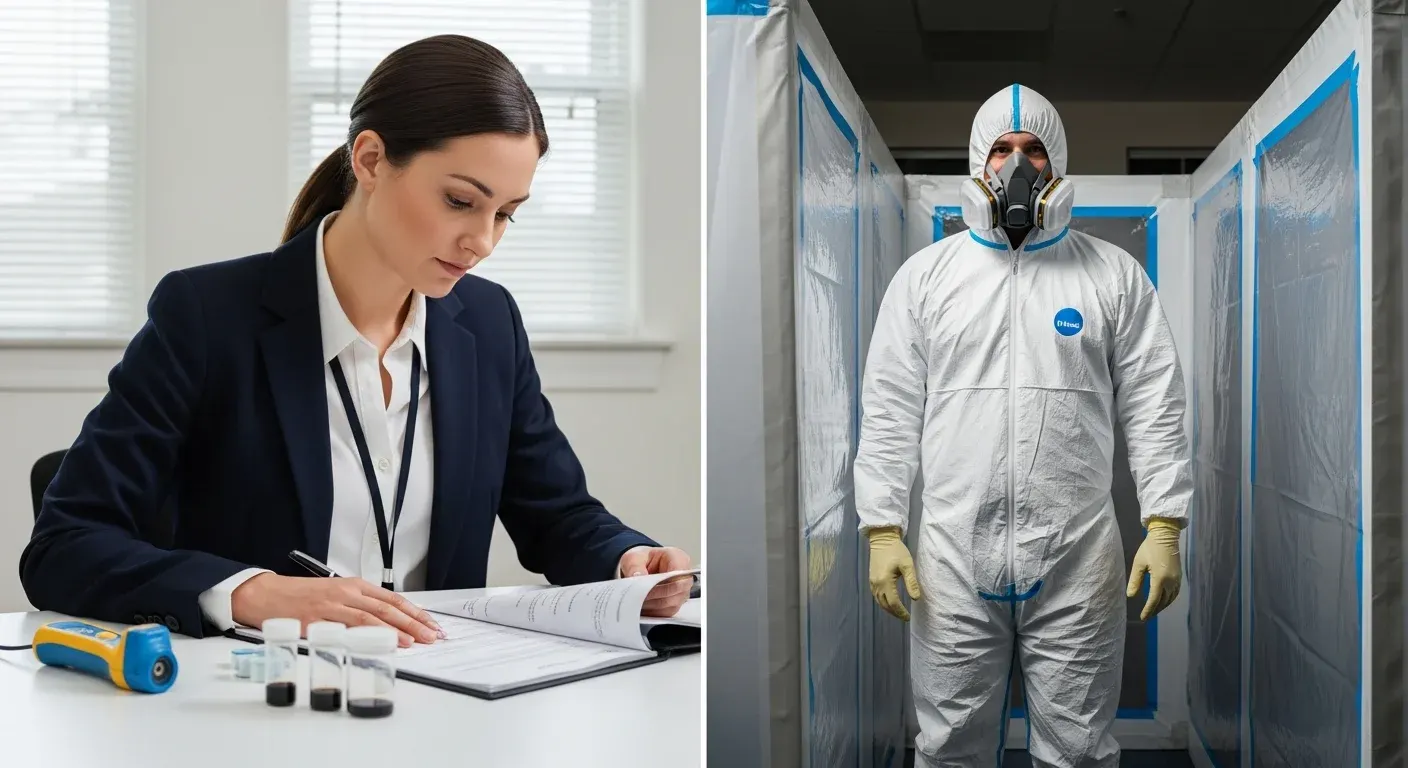
The company that finds your mold benefits financially from finding more of it; that's the rule, and it works against you on every dual-role quote. An independent assessor charges $300-$700 to inspect, sample, and write a remediation protocol; that's their entire revenue on the job. A dual-role inspector charges nothing (the "free inspection") because the inspection is the loss-leader; the remediation upsell is the revenue. Same data collection, two completely different incentive structures.
The mechanism (the dual-role inspector's incentive math)
The mechanism. An inspector who finds 50 sq ft of mold and also offers remediation will quote you $4,500 to fix what they found. An independent assessor who finds the same 50 sq ft hands you the report and walks away. Same square footage, two different numbers, because the all-in-one shop is pricing you for the next six weeks of their crew's work, not the inspection. The dual-role inspector also has a financial incentive on sample count; more sampling stations, more rooms flagged, bigger remediation footprint, bigger total ticket. The Air-O-Cell spore-trap cassette returning a high count from the bathroom doesn't lie; the question is whether the inspector who pulled three additional samples in the adjacent rooms was responding to data or padding the scope.
"Free inspections" are the warning sign
Free inspections. Companies offering free mold inspections then handing you a remediation quote have the conflict baked into their business model. The free inspection is the loss-leader; the remediation upsell is the revenue. That math only works for the company if a meaningful share of the free inspections convert to remediation contracts, which means the inspector's job is to find work, not to diagnose accurately. An independent assessor charges $300-$700 because the assessment IS their revenue; they're paid to give you a report whether or not it leads to remediation.
Warning: A "free mold inspection" that ends with a remediation quote from the same company is the conflict in action. Get a separate, independent assessment before you sign any remediation contract over $1,500.
What does a mold assessor do?
A mold assessor is a professional who diagnoses mold problems but does not perform remediation work, licensed where the state requires it. They conduct visual inspections, take moisture-meter readings, collect 2-4 air samples for an AIHA-accredited lab, and produce a written remediation protocol you take to multiple remediators for comparable bids. Residential mold assessments run $300-$700.
The assessor's role
The assessor's role. A mold assessor does seven things on a typical inspection, and the work is finished when the lab returns spore counts and the assessor delivers the written protocol.
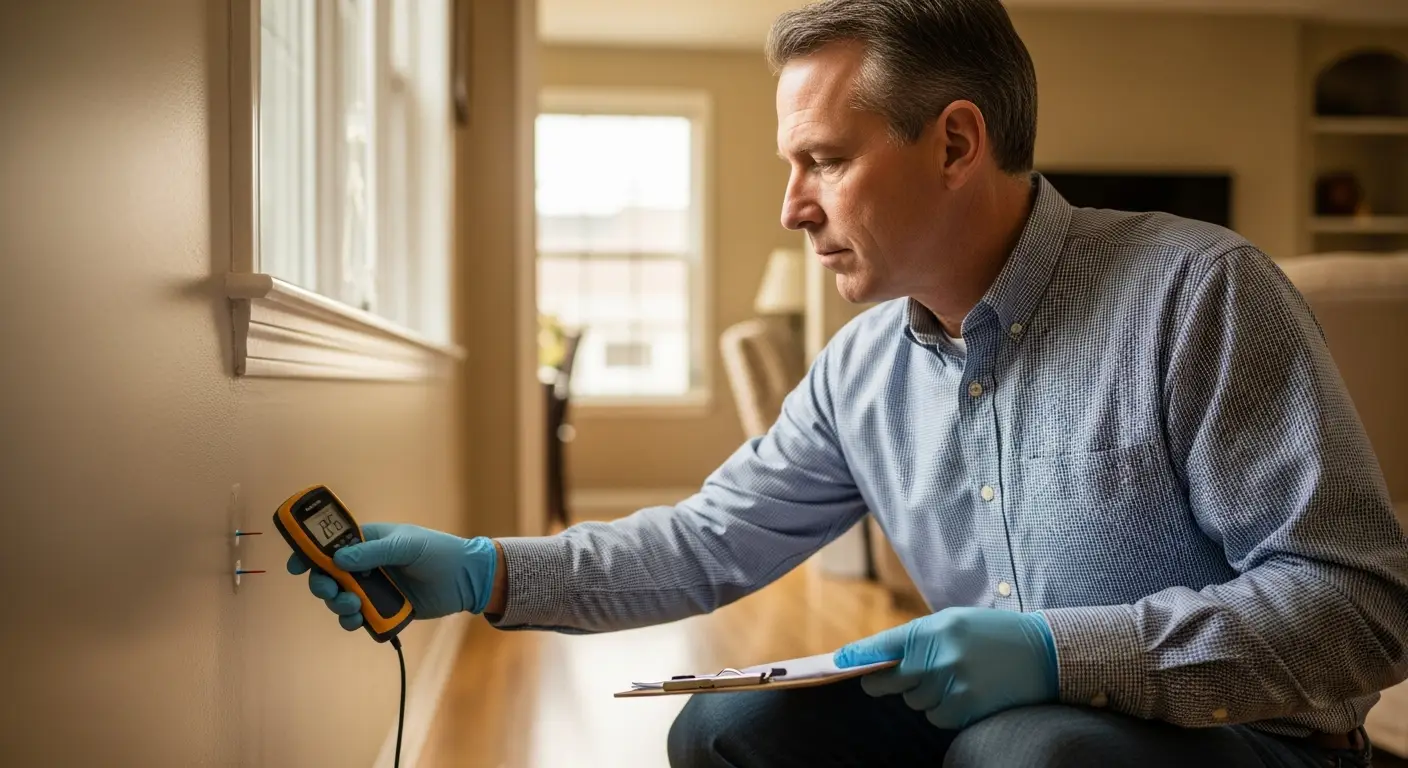
- Visual inspection. Examines all accessible areas for visible growth and water-damage history; basements, attics, around plumbing penetrations, behind appliances
- Diagnostic tools. Tramex Moisture Encounter Plus the inspector slides across drywall every 18 inches; thermal imaging camera that shows wet insulation as a dark cold patch on the screen, which is a temperature difference rather than a moisture measurement and wants confirming with the meter; borescope on a 3-foot semi-rigid wand for wall-cavity inspection
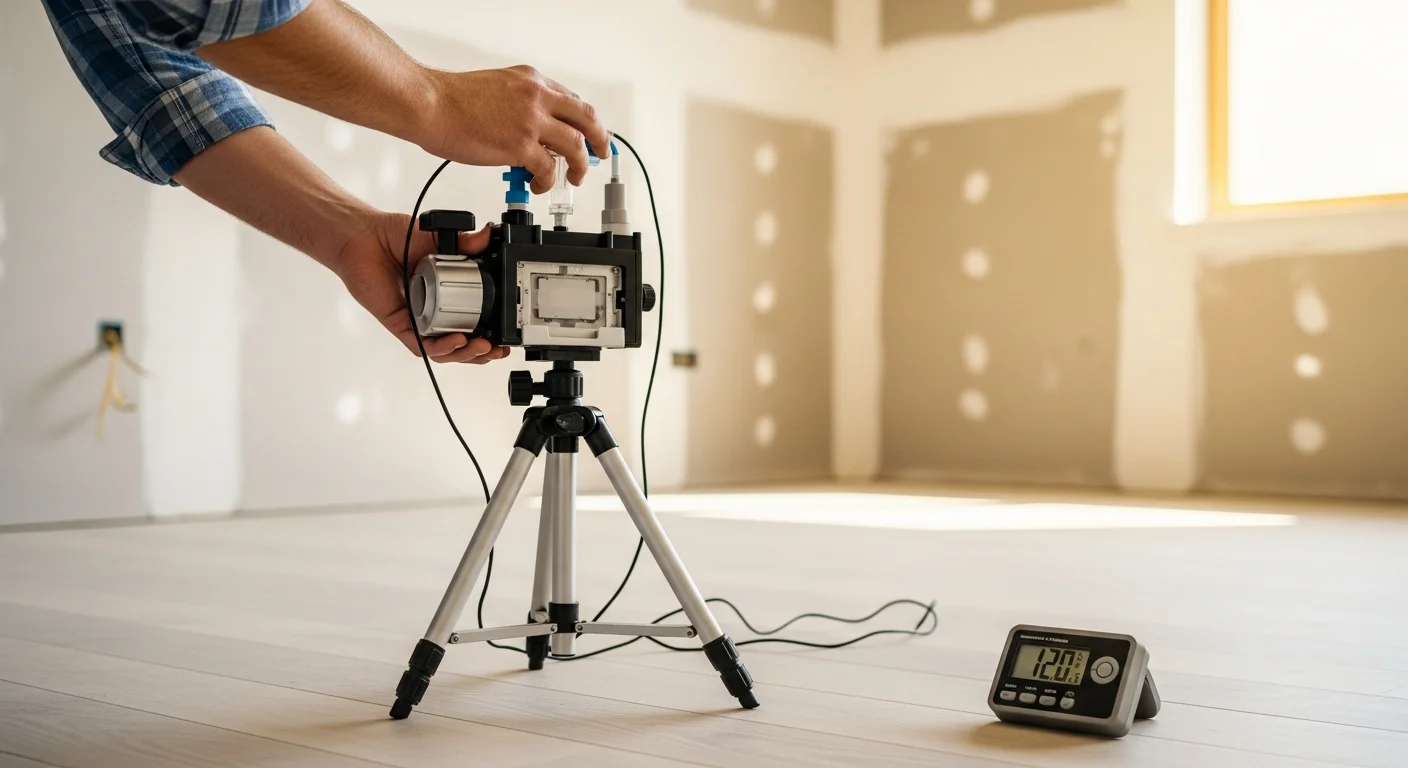
- Sample collection. 2-4 air samples via Air-O-Cell spore-trap cassette running at 15 LPM for 7-minute draws; surface swabs on visible growth when species identification matters
- Lab analysis. Sample shipping to an AIHA-accredited lab (EMSL Analytical is the most common); turnaround 2-5 business days for spore counts in spores per cubic meter (sp/m³)
- Moisture-source identification. The leak that's feeding the mold; without fixing this, remediation removes the growth and leaves the conditions that produced it
- Written report. 8-15 pages with annotated photos, moisture readings, lab results, and a remediation protocol the next contractor uses to scope and bid
- Post-remediation clearance testing. Returns after remediation to verify spore counts dropped to baseline; this is what determines whether the work was successful
For the testing-method depth, our guide on what testing actually measures covers each sampling protocol and what the spore counts mean once they come back from the lab.
When you need a mold assessor
When you need an assessor. Hire one when you suspect mold and can't pin down the extent, when you can smell musty odors and can't locate the source, after water damage when you want to confirm there's no growth, when you're buying a home, when you need documentation for an insurance claim, when you want an independent opinion before signing a remediation contract, or after remediation to verify the work was successful. If you've spotted visible growth and want to confirm what it is before deciding on next steps, what mold actually looks like covers the visual self-check that comes before the inspection call.
When you're ready to book the assessment, browse verified mold inspection companies, then confirm your pick doesn't also offer remediation before you hire.
What does a mold remediator do?
A mold remediator is a contractor who physically remediates mold-contaminated materials in a home, working from a written protocol provided by an independent mold assessor. The work covers containment, HEPA filtration, removal of porous contaminated materials, antimicrobial treatment, and drying. Remediators execute scope; they do not diagnose. Cost runs $500-$30,000+ depending on the size and complexity of the job.
The remediator's role
The remediator's role. A typical remediation runs through eight work blocks; the order varies by job complexity, but the steps don't.
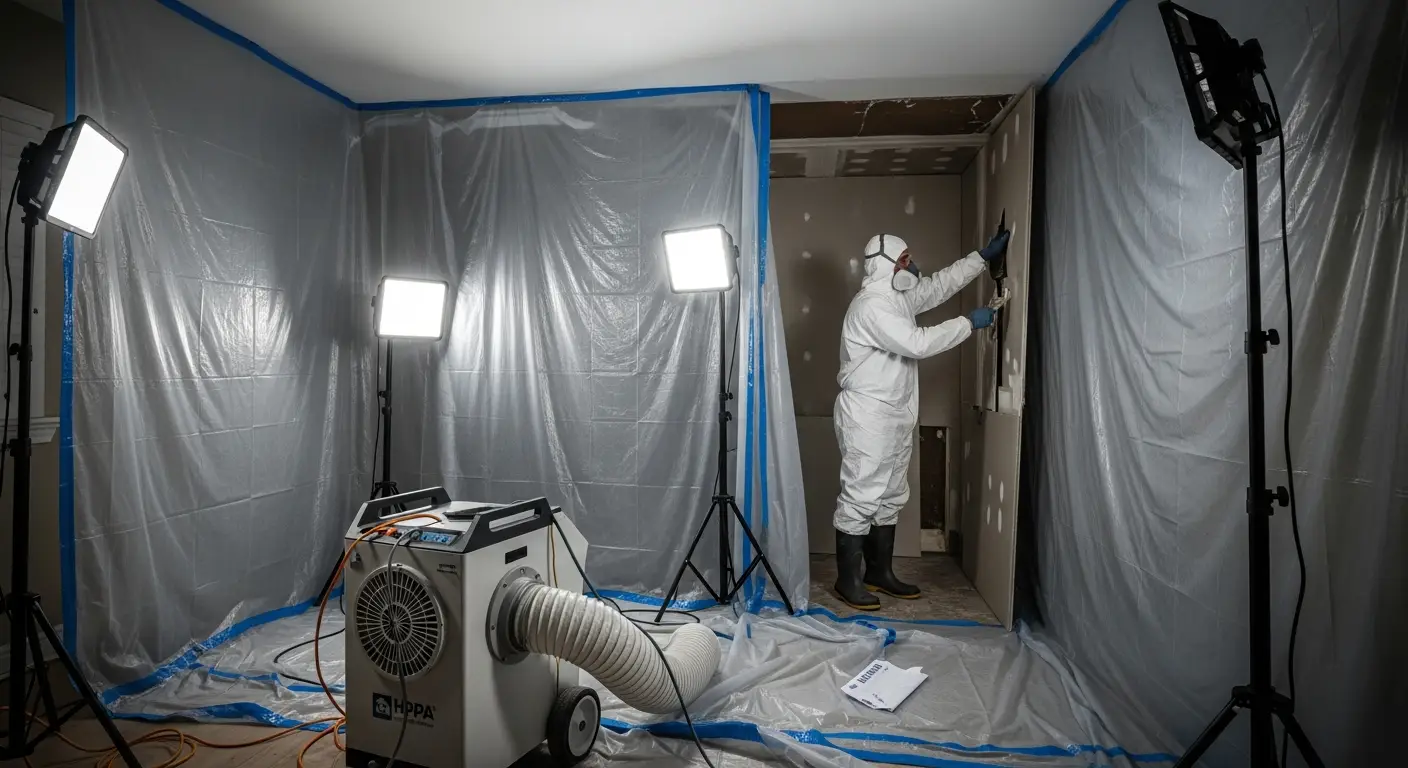
- Containment. 6-mil polyethylene taped across the work-area doorways with red builder's tape; isolates the work zone so spores don't migrate into clean parts of the house
- Negative air pressure. A negative-air machine the size of a small refrigerator running at 700 CFM pulls contaminated air out of the work zone, not in
- HEPA air filtration. Air scrubbers running for the full duration of the work; the filter catches particles down to 0.3 microns
- Material removal. Drywall, insulation, carpet; anything porous that's been contaminated gets cut out and bagged
- Surface cleaning. HEPA vacuuming and antimicrobial treatment of remaining framing, subfloor, and structural surfaces
- Disposal. Bagged waste removed under the regulations that apply in your state; not just dumpster-tossing
- Drying and dehumidification. The area has to be completely dry before any reconstruction starts; dehumidifiers run for 2-5 days post-remediation
- Coordination with other trades. Plumber to fix the leak that fed the mold; HVAC to clean the duct line if contamination spread through the system
When you need a mold remediator
When you need a remediator. Hire one after an independent assessment has confirmed mold requiring professional remediation, when growth exceeds about 10 sq ft, when contamination is in HVAC systems or inside walls, when structural materials (framing, subfloor) are affected, or when anyone in the household has mold sensitivities or respiratory issues. EPA's roughly 10 square feet is a homeowner-cleanup benchmark rather than a cutoff, and EPA does not say that crossing it requires a professional; our guide on DIY vs professional mold removal covers when a careful homeowner can handle the work and when the job needs a contractor.
The 3-step process: assessment, remediation, clearance
The proper sequence is assessment by an independent assessor, remediation by a different company that bids the assessor's protocol, and clearance testing by the original assessor (or another independent party) after the remediation is complete. Each step has a different company, a different cost range, and a different output; the sequence is what protects you from the conflict-of-interest mechanism above.
Step 1: Independent mold assessment
Step 1. Cost: $300-$700 (per what an independent inspection costs). Timeline: 1-3 days from booking to lab results, plus 2-5 business days for the written report. Output: a written remediation protocol that becomes your blueprint for getting comparable remediation bids. The assessor does the visual inspection, pulls 2-4 air samples through the Air-O-Cell cassette, sends them to an AIHA-accredited lab, and writes the protocol. They walk away when the report is delivered; they don't quote remediation work.
Step 2: Remediation by a different company
Step 2. Cost: $500-$30,000+ depending on scope (per what remediation costs after the protocol). Timeline: 1-7 days of active work plus 2-5 days of post-remediation drying. Process: containment, HEPA filtration, material removal, antimicrobial treatment, drying. The remediator bids your assessor's protocol; multiple remediators bidding the same protocol means apples-to-apples quotes you can actually rank. If a remediator wants to "do their own walkthrough" before quoting and adds scope beyond the protocol, that's the dual-role conflict trying to come back in through the side door.
Step 3: Post-remediation clearance testing
Step 3. Cost: $200-$400. Timeline: 1-2 days for sample collection plus lab turnaround. Performed by the original assessor or another independent assessor; never by the remediator. The clearance assessor pulls fresh air samples in the remediated area, confirms spore counts dropped to baseline (usually within 1.5x of the outdoor reading on the same species), checks moisture readings to confirm the area is dry, and writes a clearance report. That clearance report is the green light for reconstruction; without it, you're trusting the remediator's word that they did a thorough job, after they've already been paid.
Total timeline for the complete process
| Phase | Duration | Notes |
|---|---|---|
| Assessment | 1-3 days | Includes lab turnaround for samples |
| Getting remediation quotes | 3-7 days | Get 2-3 bids on the same protocol |
| Active remediation | 1-7 days | Varies by scope |
| Drying period | 2-5 days | Area must be fully dry |
| Clearance testing | 1-2 days | Includes lab turnaround |
| Total | 8-24 days | Faster on simple jobs |
Which jurisdictions require separation?
Mold-licensing rules differ sharply by state, and our 50-state mold licensing survey cites the statute or rule behind each answer. Five jurisdictions license mold remediation: Florida, Texas, New York, Louisiana and Washington DC, though Louisiana licenses mold remediation and not mold assessment. Four more name mold remediation inside a different credential: Tennessee and Mississippi in a contractor license classification, Connecticut in its home improvement contractor registration, and Virginia in a mold remediation certification. Illinois passed a registration law that is not in effect yet, and in the other 41 states we found no state credential that names mold remediation. Assessment is credentialed in five places as well, a different five: the four jurisdictions above that license both roles, plus New Hampshire, which requires a national certification for residential mold assessment.
Seven jurisdictions put a rule on the conflict itself, in three different shapes. Texas, New York, Louisiana and Oklahoma bar one company from doing both on the same job, Oklahoma with a small-dollar exception. Florida bars the remediation for 12 months after its own assessment. Maine and Washington DC require a written conflict-of-interest disclosure rather than a ban. Outside those seven, Kentucky has a narrower rule about who may verify a finished job. In the other 43 states nothing in law addresses the conflict, which is where the questions below do the work instead.
Florida (DBPR licensing)
Florida. Florida requires separate Mold Assessor and Mold Remediator licenses through the Department of Business and Professional Regulation (DBPR); both licenses require state-approved training, a state examination, and continuing education. Florida law allows the same person to hold both licenses, but restricts using them on the same job. Under Statute 468.8419 a mold assessor may not "perform or offer to perform any mold remediation to a structure on which the mold assessor or the mold assessor's company provided a mold assessment within the last 12 months". So it is a 12-month restriction rather than a permanent bar.
Who the restriction does not reach. That paragraph does not apply to a certified contractor classified under s. 489.105(3) as a Division I contractor, which covers certified general, building and residential contractors. In practice a Division I firm can assess and remediate the same property, legally, inside the 12 months. If the company quoting you holds a Division I license, the statute is not protecting you on this point and the conflict-of-interest question is entirely yours to ask. Verify any FL license at MyFloridaLicense.com; the state can suspend or revoke a license for misconduct. For the local-coverage detail by city, browse our verified assessors and remediators in your state to find the professionals working in your area.
Texas (TDLR codified separation)
Texas. Texas explicitly prohibits the same company from performing both mold assessment and mold remediation on the same project per TEX. OCC. CODE § 1958.155; the state recognized the conflict was costing homeowners real money and codified the separation. The Texas Department of Licensing and Regulation (TDLR) issues separate Mold Assessment licenses (Technician, Consultant, Company) and Mold Remediation licenses (Technician, Contractor, Company). Verify TDLR licenses at tdlr.texas.gov. Texas is the clearest example of state-codified separation; the rule isn't best practice in TX, it's the law.
New York (Labor Law Article 32)
New York. New York licenses three roles under Labor Law Article 32: mold assessor, mold remediation contractor, and mold abatement worker. Labor Law § 936(2) bars any licensee from performing both mold assessment and mold remediation on the same property, and § 936(3) bars anyone from owning an interest in both the assessment licensee and the remediation licensee on the same property. That is the same two-part rule Texas and Louisiana have, ownership included, and it reaches the corporate structure as well as the crew. New York then runs the job in sequence under §§ 945 to 947: the assessor writes the remediation plan, the remediator writes a work plan that carries it out, and the assessor returns to check the finished work and issue a written clearance report. The independent assessment is not only required, it is what defines the scope the remediator is allowed to bill for.
Other states
Washington DC. DC licenses the two roles separately, as Mold Assessor and Mold Remediator, through the Department of Energy and Environment. DOEE publishes a list of licensed mold professionals naming each licensee's role, so you can confirm both that a company is licensed and which job it is licensed for.
DC is the one licensing jurisdiction of the five that does not bar a company from doing both. DC Official Code § 8-241.03 requires certification and licensing to do either job and says nothing about doing both. The District's rules reach the conflict from a different angle: under 20 DCMR 3204.4(c) and 3204.5 a licensee must disclose any known or potential conflict of interest, may not assess or remediate property the licensee or the company holds a financial interest in, and may not pay or accept a referral fee. None of that stops the company that assessed your home from bidding the remediation. So in DC the license tells you the company is permitted to work and the disclosure tells you what it will put in writing; which firm does which job is still your question to ask.
Louisiana. Louisiana separates the roles through its contractor licensing law. Under RS 37:2158, it is a violation for a mold remediation contractor to "perform both mold assessment and mold remediation on the same property" or to "own an interest in both the entity which performs mold assessment services and the entity which performs mold remediation services on the same property". That is the same two-part rule Texas has, ownership included, enforced through the Louisiana State Licensing Board for Contractors rather than a dedicated mold board.
Other states. Maryland passed a mold remediation licensing law in 2008, but the Home Improvement Commission never issued the licenses, citing a lack of funding, and the program ended on July 1, 2019, so Maryland has no mold license today. Three states without a mold license still address the conflict in law. Oklahoma bars the same person or company from both inspecting for mold and doing the remediation unless the combined cost is $200 or less and the homeowner agrees (15 O.S. § 765.4). Maine requires a company that offers both mold assessment and mold remediation on the same project to give the owner a signed conflict-of-interest disclosure first (10 M.R.S. § 1480). Kentucky requires any sampling that verifies a finished remediation to be done by an independent indoor environmental professional the customer pays directly, and the form you get before signing says in so many words that the person checking the work should not be paid by the company that did it (40 KAR 2:330). Everywhere else, separation is not a legal rule, and it is our recommendation rather than a federal agency's: EPA's contractor guidance asks you to check experience and references and to have the work follow EPA, ACGIH or IICRC guidelines, and does not address who should assess versus who should remediate. The conflict-of-interest mechanism exists in every state; the difference is whether your local regulator codified it or left it to you.
How to verify credentials before you book
Before hiring any mold professional, verify the state license, insurance certificate, and certifications. The 90-second verification call below catches the conflict-of-interest dual-role companies and the credential-light operators in one pass; if you only ask one question, ask whether the company also offers remediation services.
State license verification
State license. Five steps catch the most common license-related issues; (1) ask for the license number on the phone, (2) check it against the state database (FL DBPR or TX TDLR portals return status in 30 seconds), (3) confirm the license type matches the job (assessor vs. remediator, individual vs. company), (4) check for disciplinary actions visible in the state record, (5) verify the license is current. A lapsed license in a state that requires one means the company is doing work it is not currently licensed to do.
Insurance verification
Insurance. Every mold professional should carry general liability insurance (covers property damage during the work), workers' compensation (required if they have employees), and professional liability / errors & omissions (covers errors in assessment or remediation). Request a certificate of insurance (COI) and verify it's current before any work begins; the COI should name the insurance carrier, the policy number, the coverage amounts, and the effective dates. A "we have insurance" answer without a COI is not insurance; it's a verbal claim with no policy behind it.
Certification verification
Certifications. Three certification bodies cover the credible mold-credential landscape; ACAC (American Council for Accredited Certification) names its credentials "Council-certified" and states that its CMI and CMC are accredited by the Council for Engineering and Scientific Specialty Boards (CESB); IICRC (Institute of Inspection, Cleaning and Restoration Certification) is the baseline credibility check for remediation companies, with IICRC Firm certification on the company itself signaling consistent training across the crew; NORMI (National Organization of Remediators and Microbial Inspectors) is a third option common in some markets. For the breakdown of which certs apply to which role, see the certification breakdown; for the IICRC-specific detail, our IICRC certification details glossary entry covers the WRT, AMRT, and Firm-level credentials.
Red flags that mean walk away
Red flags. Walk away if the contractor refuses to provide a license number, if the license doesn't verify in the state database, if their insurance has expired or they refuse to provide a COI, if they won't provide a written contract or scope of work, if they pressure you to sign immediately, if they request cash-only payment, if they won't provide references from recent jobs, if a "free inspection" is leading to a remediation quote from the same company, if they're making dramatic health claims to scare you into a quick decision, or if they "guarantee" they can "kill all mold" (impossible and a sign of ignorance about how mold biology works). For the complete contractor scam pattern guide, see common contractor scam patterns; for the full list of pre-hire questions, see the full question script.
Certifications by role
The certification landscape splits cleanly between assessor credentials and remediator credentials; a few certs cover both roles. The table below is the breakdown by role and issuing organization. Read the issuing body as part of the credential rather than as a footnote: ACAC and NORMI both issue a credential abbreviated CMR, ACAC's being the Council-certified Microbial Remediator and NORMI's the Certified Mold Remediator, on separate programs with different requirements.
| Certification | Organization | For Assessors | For Remediators |
|---|---|---|---|
| CMI (Council-certified Microbial Investigator) | ACAC | Yes | No |
| CMR † (Council-certified Microbial Remediator) | ACAC | No | Yes |
| CIE (Council-certified Indoor Environmentalist) | ACAC | Yes | No |
| AMRT (Applied Microbial Remediation Technician) | IICRC | No | Yes |
| WRT (Water Restoration Technician) | IICRC | Helpful | Yes |
| CMC (Council-certified Microbial Consultant) | ACAC | Yes | No |
| CMRS (Council-certified Microbial Remediation Supervisor) | ACAC | No | Yes |
| CMA (Certified Mold Assessor) | NORMI | Yes | No |
| CMR † (Certified Mold Remediator) | NORMI | No | Yes |
† Two organizations issue a credential abbreviated CMR, on separate programs with different requirements. Check the issuing body column, and ask which one a contractor holds.
Which certs to prioritize
Priority order. State license first (where required); ACAC second (its CMI and CMC are CESB-accredited, and its tiers are set by verified years of field experience); IICRC Firm certification third (the baseline credibility check for remediation companies and the most common credential signal across the industry). For the full breakdown of what each certification means and how to verify them, see the certification breakdown.
Can the same company do both?
Legally, yes in most states; practically, they shouldn't, and the dollar mechanism above is why. The conflict of interest is straightforward; a company that profits from remediation has a financial incentive to find more mold during the assessment phase. That doesn't mean every full-service company is dishonest; it means the incentive structure works against you, and the reliable filter is to use separate companies regardless of whether your state legally requires it.
Texas codified the rule. TEX. OCC. CODE § 1958.155 explicitly prohibits the same company from performing both mold assessment and mold remediation on the same project. The state recognized the conflict was costing homeowners real money and made the separation a licensing requirement. Most other states allow it. Florida lets the same company hold both assessor and remediator licenses but bars using them on the same structure within 12 months, and Louisiana, New York and Oklahoma restrict it in their own ways; however, industry best practice (and most insurance adjusters' preference) is still separate companies. The practical test. If a company offers you a "free mold inspection" and then hands you a remediation quote, you're seeing the conflict in action. An independent assessor charges $300-$700 for the inspection precisely because their revenue comes from the assessment, not from selling you remediation work.
Do I need an assessment first?
Yes, almost always. An independent assessment serves three load-bearing functions that protect your money on every remediation job over $1,500.
Objective scope. The assessor documents exactly what needs to be remediated; no more, no less. The written remediation protocol becomes your blueprint for getting comparable quotes from multiple remediators. Competitive bidding. Without a protocol, each remediator defines their own scope. You can't rank a $3,000 quote against a $12,000 quote if they're describing different work. With a protocol, every quote covers the same scope. Post-remediation verification. The assessor returns after remediation to perform clearance testing; air sampling and visual inspection that confirm the job was done right. Without this independent check, you're trusting the remediator to grade their own work.
The one exception. If you can clearly see a small area of mold (under 10 sq ft) on a hard surface and you plan to clean it yourself, you don't need a professional assessment. For anything beyond that (hidden mold, large areas, insurance claims, real estate transactions), start with an independent assessment. For the complete remediation walkthrough once you have the protocol in hand, see the complete remediation walkthrough.
Frequently Asked Questions
Frequently Asked Questions
What is the difference between a mold assessor and a mold remediator?
Should the same company assess and remediate mold?
What does the mold remediation process involve?
How do I verify a mold assessor's credentials?
What is mold clearance testing?
How much does an independent mold assessment cost?
Can the same company do mold testing and mold removal?
Do I need a mold assessment before remediation?
How do I find a mold assessor near me?
Once you understand the difference, the next step is hiring the right company. You can find a verified mold removal company on Verified Remediation. Every contractor is identity-checked, with licenses and insurance verified where available.
This guide is part of our Complete Mold Remediation Guide; your full resource for understanding, preventing, and remediating mold.
This guide is for educational purposes only. Licensing requirements change; always verify current requirements with your state licensing board. Professional advice should be sought for specific mold situations.