DIY vs Professional Mold Removal: The 10 Sq Ft Rule
EPA's 10 sq ft figure is a benchmark, not a cutoff, and EPA never says hire a pro above it. What it really says, and when size isn't the deciding factor.
Discovering mold in your home raises an immediate question: Can I handle this myself, or do I need to call a professional? The answer depends on several factors, and making the right choice is crucial for both your safety and your wallet.
This guide will help you make that decision with confidence, covering EPA guidelines, safety requirements, step-by-step DIY instructions, and clear indicators for when professional help is essential.
In This Guide
- When DIY is Appropriate: EPA guidelines and assessment checklist
- Safety Precautions: PPE and critical warnings
- DIY Step-by-Step: 6-step removal process
- When to Hire a Pro: Clear indicators for professional help
- Professional Process: What to expect and questions to ask
- Can I Remove Black Mold Myself?: When DIY is risky
- The EPA 10 Sq Ft Rule: What it actually says
- Next Steps: Getting started
When DIY Mold Removal is Appropriate
The Environmental Protection Agency, in A Brief Guide to Mold, Moisture, and Your Home, says that if the moldy area is less than about 10 square feet, roughly the size of a bathtub (about 3 feet by 3 feet), in most cases you can handle the job yourself. Those qualifiers are EPA's own, and they are the difference between a benchmark and a cutoff.
DIY-Appropriate Conditions
Before deciding to handle mold removal yourself, confirm all of these conditions are met:
- Size: The total affected area is under about 10 square feet
- Surface type: Mold is on non-porous surfaces (tile, glass, metal, sealed wood) or semi-porous surfaces (concrete, wood) where you can physically remove it
- Location: Mold is on visible, accessible surfaces, not inside walls, ducts, or structural materials
- Material and moisture history: The growth is not on porous material that has stayed wet, which holds contamination below the surface and usually has to come out rather than be cleaned
- Source: You've identified and fixed the moisture source
- Health status: No household members have compromised immune systems, severe allergies, or respiratory conditions
DIY Assessment Checklist
Use this checklist before starting any DIY mold removal:
- Measure the area: Is the mold growth under 10 square feet total?
- Identify the surface: Is it non-porous (tile, glass) or removable (bathroom caulk)?
- Check for moisture: Have you found and fixed the water/humidity source?
- Assess your health: Are you and household members healthy without respiratory issues?
- Check the moisture history: Has this material been wet repeatedly or for a long time, rather than dampened once and dried?
- Check HVAC proximity: Is the mold away from air ducts and HVAC systems?
If you answered "yes" to all of these, DIY removal may be appropriate. If any answer is "no," consider professional help.
Safety First: Essential Precautions
Even for small DIY mold removal projects, proper safety precautions are critical. Mold releases spores when disturbed, which can cause health issues if inhaled.
Required Personal Protective Equipment (PPE)
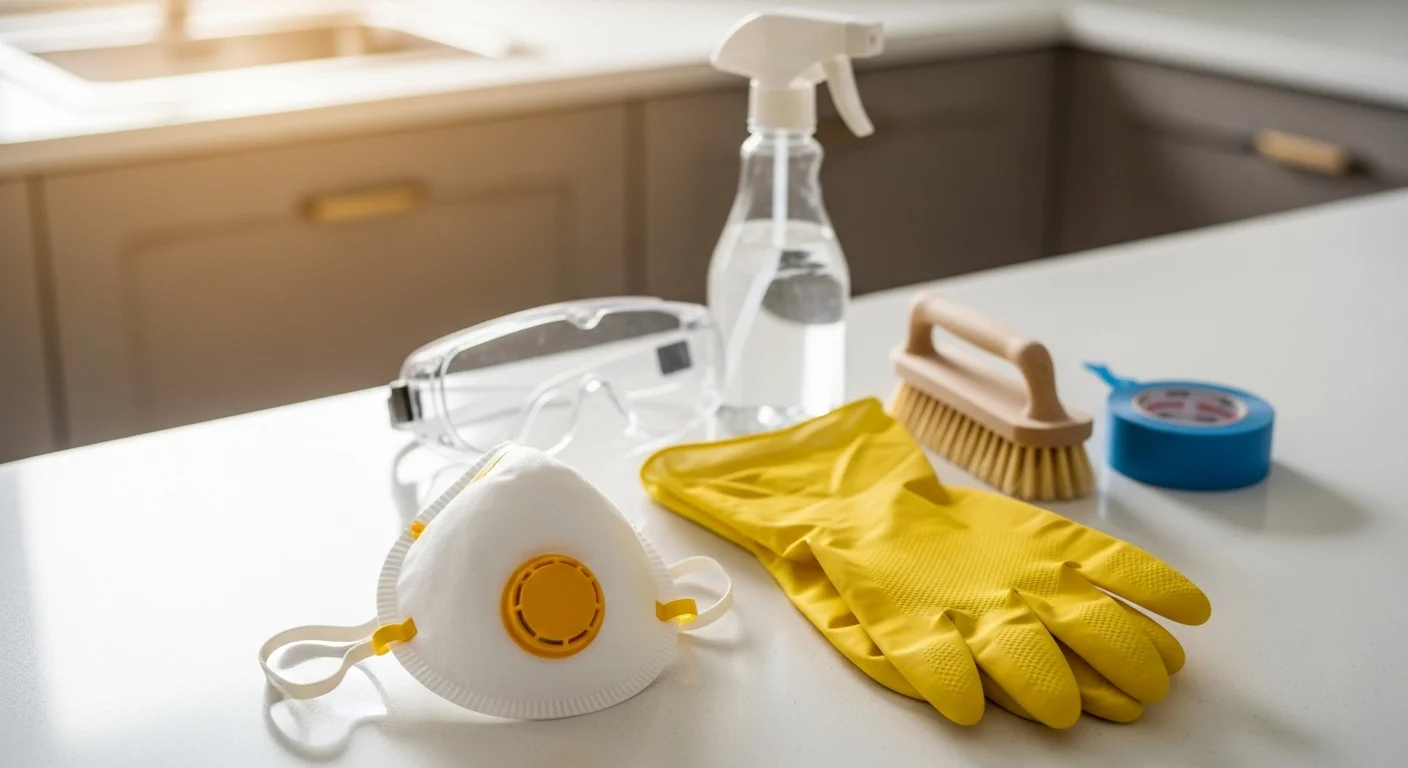
Before starting any mold removal, gather:
- N95 respirator mask (minimum), not a simple dust mask
- Safety goggles without ventilation holes
- Rubber gloves extending to mid-forearm
- Long-sleeved shirt and long pants
- Disposable shoe covers (optional but recommended)
Warning: Never use cloth masks or surgical masks for mold cleanup. These don't filter mold spores effectively. Always use at least an N95 respirator.
Critical Safety Warnings
Warning: chronically wet porous material. Don't attempt to remove mold growing on drywall, wood, insulation or ceiling tile that has stayed wet. This is our own precaution rather than an EPA or CDC rule, and the reason is not a species name. Material like that holds contamination below the surface, generally can't be cleaned back, and has to come out; cutting into it without containment spreads it through the house. Dark or slimy growth is often what people mean by black mold, and stopping is a fair call. What makes it a stopping point is the material and the moisture, not the color. CDC does not recommend testing to identify the species, on the reasoning that whatever type it is, it has to be removed.
Warning: Health Conditions. If anyone in your household has a compromised immune system, severe allergies, asthma, or other respiratory conditions, they should not be present during or immediately after mold cleanup. Consider professional remediation for added safety.
Warning: HVAC Systems. If mold is in or near your HVAC system, do not run the system until a professional has assessed it. A contaminated system can distribute spores or fragments beyond the source area.
How to Remove Mold Yourself
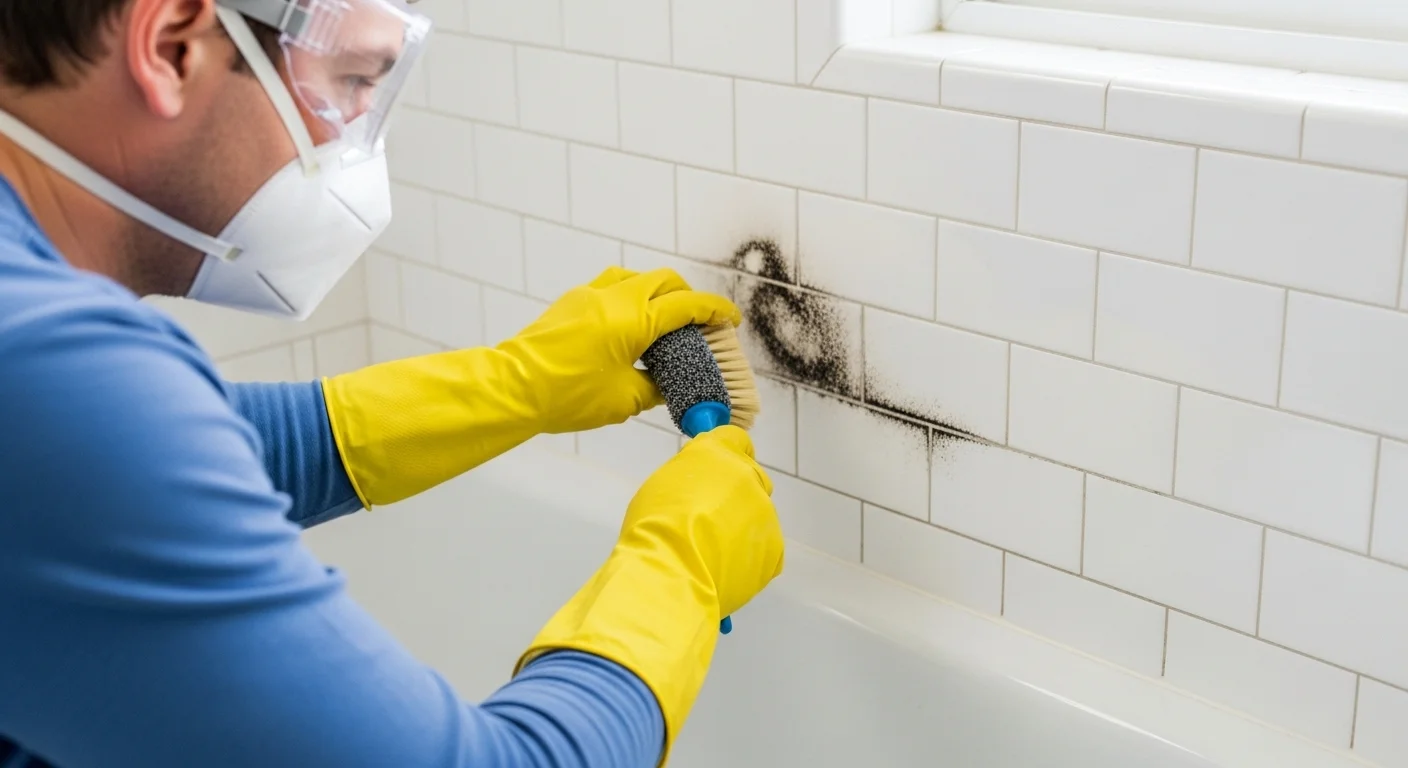
If your situation meets the DIY criteria and you have proper safety equipment, follow these steps for effective mold removal.
Step 1: Prepare the Area
- Turn off HVAC systems to prevent spore spread
- Open windows in the work area for ventilation
- Seal doorways to other rooms with plastic sheeting
- Remove or cover furniture and belongings in the area
- Lay plastic sheeting on the floor to catch debris
Step 2: Put on Protective Equipment
- Don your N95 respirator and ensure a proper seal
- Put on safety goggles
- Wear rubber gloves
- Put on long-sleeved clothing
Step 3: Dampen the Surface (Optional)
- Lightly mist the moldy area with water before you disturb it
- This suppresses dust and reduces how much goes airborne while you scrub. It does not stop airborne release, so it supplements the respirator rather than replacing it
- Dampen, don't soak, and skip it on porous or already water-damaged material. Adding water there works against you, and material in that condition is usually past cleaning anyway
Step 4: Remove the Mold
For hard, non-porous surfaces (tile, glass, metal, plastic):
- Start with detergent and water, EPA's baseline for a hard surface. If you want a disinfectant, CDC allows a solution of no more than 1 cup of household laundry bleach in 1 gallon of water, and never mixed with ammonia or another cleaner. A commercial mold cleaner or undiluted white vinegar are common household choices used per their own labels, not EPA or CDC protocols
- Apply the solution to the moldy surface
- Scrub with a stiff brush or non-scratch pad
- Rinse with clean water
- Repeat if necessary
For wood and semi-porous surfaces:
- Scrub with detergent and water
- Rinse, then dry thoroughly; moisture is what brings it back
- If staining remains, that is usually cosmetic rather than live growth. EPA notes that mold may cause staining and cosmetic damage, and that it may not be possible to clean an item so its original appearance is restored. Discoloration on its own is not a reason to reach for a stronger chemical
- If the growth itself comes back after cleaning and drying, the material is either still wet or colonized below the surface. That is a cut-out-and-replace situation rather than a stronger-cleaner one
For caulk, grout, and sealant:
- Caulk that is colonized through rather than surface-stained comes out and gets replaced. It is cheap, it is soft, and it does not clean back
- Grout is not automatic. Clean and dry it first, and replace it only if growth returns after that, or if the grout is failing anyway
- Clean the underlying surface and let it dry completely before you re-seal
- Apply new caulk or grout
Step 5: Clean Up Properly
- Place all cleaning materials in sealed plastic bags
- HEPA vacuum the entire work area
- Wipe down all surfaces with damp cloths
- Dispose of cleaning materials, gloves, and cloths in sealed bags
- Wash clothing separately in hot water
Step 6: Dry the Area
- Once the contaminated material is out or bagged, use fans and dehumidifiers to dry the area. Don't point a fan across mold you haven't dealt with yet; that moves spores around instead of drying anything
- Keep humidity below 60%, ideally 30 to 50%, which is EPA's target
- Run the dehumidifier until the materials are actually dry and the humidity holds in that range, rather than for a set number of days. How long that takes depends on the room, the season and how wet things got
- Check back afterwards for moisture, musty odor, or growth returning
Recommended Products and Equipment
Cleaning Solutions:
- Detergent and water: EPA's baseline for hard, non-porous surfaces, and enough on its own for most of them
- Household bleach at no more than 1 cup per gallon of water, CDC's stated ceiling. Never mix it with ammonia or another cleaner
- Commercial mold and mildew removers (look for EPA-registered products)
- Optional household approaches, used per their own labels rather than as EPA or CDC protocols: undiluted white vinegar, which works on some mold species and not others, and borax solution
Equipment:
- Dehumidifier (essential for prevention)
- HEPA vacuum cleaner
- Stiff-bristle brush or scrub pad
- Spray bottles
- Plastic sheeting
PPE:
- N95 respirator masks (stock multiple)
- Safety goggles without vents
- Long rubber gloves
- Disposable coveralls (optional)
Shop Recommended Products
Recommended Safety Equipment
N95 Respirator Masks (10-Pack)
Safety EquipmentNIOSH-approved N95 masks. Essential for mold cleanup. Filters 95% of airborne particles.
Safety Goggles (No Vents)
Safety EquipmentSealed safety goggles without ventilation holes. Prevents spores from reaching eyes. Anti-fog coating.
Long Rubber Gloves (1 Pair)
Safety Equipment26-inch PVC gloves extending past the elbow. Cotton lined, chemical resistant, and reusable.
Disposable Coveralls (5-Pack)
Safety EquipmentFull-body hooded coveralls with elastic cuffs. Protects clothing from mold exposure. Disposable after use.
Recommended Dehumidifiers
Portable 30-Pint Dehumidifier
DehumidifierIdeal for small spaces up to 1,500 sq ft. Quiet operation with auto-shutoff when tank is full.
50-Pint Dehumidifier with Pump
DehumidifierCovers spaces up to 4,500 sq ft. Built-in pump drains vertically or horizontally without emptying the tank.
Commercial 70-Pint Dehumidifier
DehumidifierHeavy-duty metal build for spaces up to 5,000 sq ft. Built-in pump, auto-defrost, and automatic restart after power loss.
Before buying a test kit, know what it can and cannot tell you. EPA's position on sampling is that in most cases, if visible mold growth is present, sampling is unnecessary: you already know you have mold, and it has to come out either way. There are also no EPA standards or threshold values for airborne mold, so an air-test number has nothing official to be measured against and no kit can tell you whether a home is safe. Where sampling does answer a specific question, EPA says it should be designed and interpreted by someone with experience in it. A moisture meter and a hygrometer will tell a homeowner more about this problem than a spore count will.
Recommended Mold Test Kits
Surface Mold Test Kit
Test KitDIY screen with surface, air, and HVAC sampling methods. Lab analysis is optional and costs extra.
Air Quality Mold Test Kit
Test KitSamples room air, HVAC, or surfaces. US-based lab analysis and return shipping are included in the price.
Comprehensive Mold Test Kit
Test KitAir, surface, and bulk sampling with one lab fee included. Analyzed by an AIHA-accredited lab, report in about 7 working days.
After Cleanup: Verification Tips
Don't assume the job is done just because visible mold is gone:
- Check back over the next week or two. That is a practical homeowner habit, not a defined verification interval. EPA's own checklist asks whether you revisited shortly after cleanup and found no sign of water damage or mold growth, which is an outcome rather than a schedule
- Check moisture levels with a moisture meter if available
- Smell test: musty odors may indicate hidden mold
- Watch for regrowth. Returning growth usually means the moisture source is still active
- Address the source: ensure the original moisture problem is truly fixed
If mold returns despite proper cleanup, this indicates an unresolved moisture issue or mold in locations you couldn't reach. At this point, professional help is necessary.
When to Hire a Professional
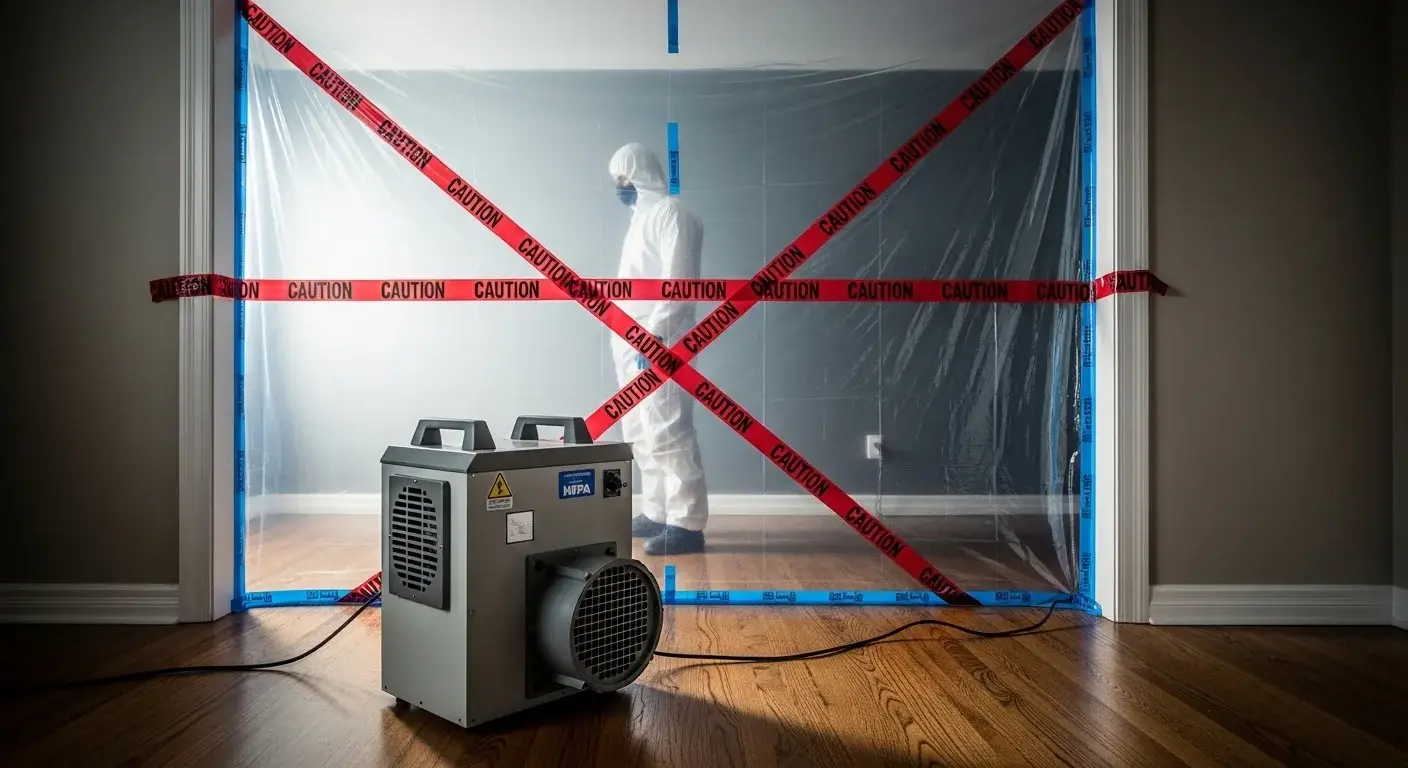
Certain situations require professional expertise and equipment. Don't attempt DIY remediation if any of these apply:
Size Exceeds 10 Square Feet
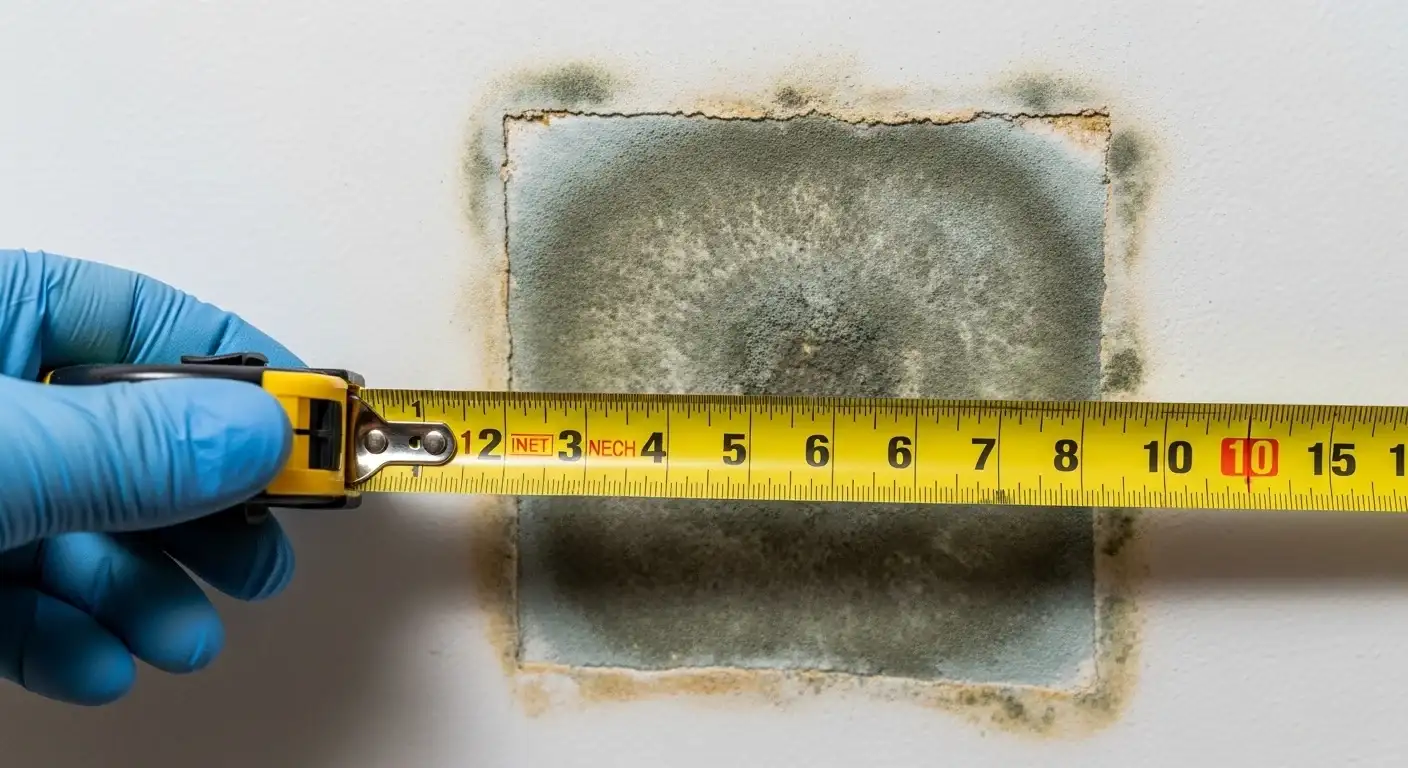
Once mold covers more than about 10 square feet, the job usually outgrows what a homeowner can control:
- Containment scales with the job. EPA's guidance for larger jobs uses limited containment from 10 to 100 square feet and full containment above that, and tells remediators to apply professional judgment in both cases.
- Area is a proxy, not the cause. What raises the potential for airborne release is the extent, density and disturbance of the material together. EPA says a heavy growth in a relatively small area could release more spores than a lighter growth over a relatively large one, and that its size-based guidelines exist to help remediators pick a technique rather than because research found a method that becomes appropriate at a particular square footage.
- The moisture problem behind it is usually larger too.
HVAC System Contamination
If mold is growing in or near your HVAC ducts, vents, or air handler:
- Running the system can carry spores or fragments beyond the source area
- Duct cleaning requires specialized equipment
- The entire system may need professional treatment
- Improper cleaning can make the problem worse
Structural Materials Affected
Professional help is essential when mold has reached:
- Framing and studs: load-bearing elements
- Subfloor: under tile, hardwood, or carpet
- Insulation: almost impossible to clean; must be replaced
- Drywall interior: contamination inside wall cavities
- Roof decking: structural integrity concerns (see attic mold guide)
Health Concerns in the Household
CDC lists these among the effects mold exposure can have. If anyone at home is dealing with:
- Coughing or wheezing
- A stuffy nose or sore throat
- Burning or irritated eyes
- A skin rash
- Asthma that is harder to control than usual
A pattern where symptoms ease when someone is away from the house and return when they come back is useful information, and worth telling a doctor. It does not on its own establish mold as the cause; that is a question for a healthcare provider, not a remediation guide.
What it does mean is that this is not the moment to disturb mold without containment. Bring someone in to assess before anyone starts cutting or scrubbing.
Chronically Wet Porous Material
The conditions that take a job out of DIY range:
- Drywall, wood, insulation or ceiling tile that has been wet repeatedly or for a long time
- Growth you cannot see all of, behind a wall, under flooring, or inside a cavity
- A moisture source you have not found or fixed
- Anything that has to be cut or torn out rather than wiped down
Don't disturb growth in those conditions. Professional remediators have containment and safety protocols that a homeowner does not. Color is not on that list on purpose: color and texture do not identify a species, and the species would not change what you do anyway.
Recurring Mold Despite Cleanup
If you've cleaned mold and it returns within weeks or months:
- The moisture source hasn't been fully addressed
- Hidden mold exists in areas you can't see, common in basements and crawl spaces
- The problem is more extensive than surface-level
- Professional moisture testing and inspection is needed
Water Damage Source Unknown
If you can see mold but can't identify where the water is coming from:
- A professional can use moisture meters and thermal imaging
- Hidden leaks may exist in walls or under floors
- Foundation issues may be allowing moisture intrusion
- Plumbing problems may be hidden
What Professional Remediation Involves
Understanding the professional process helps you evaluate quotes and know what to expect.
Initial Assessment
A qualified mold assessor, sometimes called an indoor environmental professional, will:
- Conduct thorough visual inspection
- Use moisture meters to find hidden water
- Take air and/or surface samples if needed
- Identify moisture sources
- Determine scope of contamination
- Provide written report with recommendations
Note: Licensing is not uniform, and neither is separation. Most states do not license mold assessors at all, and only a small number require the assessment and the remediation to come from different companies. Where it is not required, an independent assessment is our recommendation rather than a rule: the company that finds the problem should not be the one billing to fix it. Assessor vs remediator has the state-by-state detail.
Remediation Process
Professional remediation typically includes:
- Containment: Sealing off affected areas with plastic barriers
- Negative air pressure: Preventing spores from spreading
- Air filtration: HEPA air scrubbers running continuously
- Removal: Physical removal of contaminated materials
- Cleaning: HEPA vacuuming and antimicrobial treatment
- Disposal: Proper disposal of contaminated materials
- Verification: A post-remediation evaluation by the remediator, then a post-remediation verification by an independent indoor environmental professional where one is required or requested. ANSI/IICRC S520-2024 §12 says that can take in visual inspection, field data, odor detection, analytical testing or sampling, so testing is one method among several rather than the definition of success
Timeline and Costs
Typical project timelines:
- Small projects (10-30 sq ft): 1-3 days
- Medium projects (30-100 sq ft): 3-5 days
- Large projects (100+ sq ft): 1-2 weeks
- Full house remediation: 2-4 weeks
For detailed cost information, see our mold remediation cost guide.
Questions to Ask Contractors
Before hiring, ask potential contractors:
- Are you licensed, if your state licenses mold work? (Most states do not license the trade at all)
- Are you insured? (Should have general liability and workers' comp)
- What certifications do you hold? (IICRC, ACAC, or state-specific)
- Will you provide a written scope of work?
- What containment procedures do you use?
- How will you document that the work is complete, and what are the completion criteria? (S520-2024 §12 says those should be settled with the parties before the work starts, or as early as possible, and that at a minimum they cover return to Condition 1, materials dry, and the area free of visible dust, debris, malodor and growth)
- What's your warranty on the work?
- Can you provide recent references?
For the full list of questions organized by project phase (screening, assessment, remediation, and follow-up), see our questions to ask a mold company guide. And watch out for common scams when evaluating contractors.
Can I Remove Black Mold Myself?
This is the most common question homeowners ask, and the answer is more nuanced than a simple yes or no.
The EPA's 10 square foot rule doesn't distinguish between mold types. In theory, if black mold is on a hard surface and covers less than 10 square feet, the DIY guidelines apply.
In practice, black mold (Stachybotrys) presents unique challenges:
- It's rarely on an easy surface. Stachybotrys thrives on chronically wet cellulose materials: drywall, wood, ceiling tiles. These are porous materials that can't be fully cleaned with surface scrubbing. The affected section typically needs to be cut out and replaced.
- It indicates a serious moisture problem. CDC says constant moisture is required for Stachybotrys growth, on cellulose-rich material like drywall or ceiling tile. That does not rule out a single leak: one that never dried leaves material constantly wet just as effectively as a slow ongoing one. Either way water has been sitting somewhere long enough to matter, and finding it is the job.
- Disturbing it spreads spores. Without professional containment (plastic barriers, negative air pressure, HEPA filtration), cutting into mold-contaminated drywall sends spores well beyond the area you are working on.
The safe approach: If you suspect black mold, get a professional assessment first ($300-$700). An assessor can characterize the moisture conditions, map how far the contamination extends, and scope what the work involves, which is what actually decides whether this is a DIY job. What an assessment cannot sell you is certainty. Species identification is usually not needed for a cleanup decision, and CDC does not recommend testing to establish it. What you are buying is a smaller set of unknowns, not a guarantee.
What Is the EPA 10 Square Foot Rule for Mold?
Everyone calls it a rule. It is worth being precise about what it actually is, because EPA writes it with two qualifiers that almost every write-up drops.
What EPA actually says: if the moldy area is less than about 10 square feet (roughly 3 feet by 3 feet, about the size of a bathtub), in most cases you can handle the job yourself. Both "about" and "in most cases" are EPA's words. Neither is decoration.
Above 10 square feet, EPA does not tell you to hire a professional. This is the part most pages get wrong, including an earlier version of this one. What EPA says is to consult its own guidance for bigger jobs, Mold Remediation in Schools and Commercial Buildings, and separately that if you choose to hire a contractor, make sure they have experience cleaning up mold.
The practical reasoning still holds, with one correction. What drives airborne release is the extent, density and disturbance of the material together, not area by itself. EPA makes that point directly: a heavy growth in a relatively small area could release more spores than a lighter growth over a relatively large one. Area is the proxy its guidance uses because it is easy to measure, and EPA says so outright, describing its size-based guidelines as a way to help remediators choose a technique rather than a finding about health effects. None of it is an instruction to pick up the phone at 10.1 square feet.
So treat it as a benchmark, not a cutoff:
- Location matters more than size. A 5 sq ft patch inside a wall cavity is a harder job than a 12 sq ft patch on bathroom tile, because reaching it means cutting into the wall.
- Smaller can still mean professional. A patch well under the benchmark can warrant help depending on the water source, whether HVAC is involved, whether growth is hidden, what material it is on, and who lives in the house.
- HVAC mold is always professional. A contaminated system can distribute spores or fragments beyond the source area when it runs, whatever the affected area measures. If contamination is known or suspected, don't run the system until it has been evaluated.
- Health conditions change the equation. If anyone in your household has asthma, a mold allergy, or a compromised immune system, lower your threshold for calling someone.
Not Sure? Get Professional Help
When in doubt, a professional assessment is relatively affordable ($300-$700) and provides peace of mind. The cost of a professional evaluation is far less than the cost of health problems or property damage from improperly handled mold.
Your Next Steps
- Assess your situation using the DIY checklist above
- Measure the affected area to determine if it's under 10 sq ft
- Identify the moisture source: this must be fixed regardless of who does the cleanup
- Make your decision: EPA says an area under about 10 square feet can, in most cases, be handled by the homeowner. Consider professional help on either side of that benchmark when access, the affected material, moisture history, HVAC involvement, contaminated water, hidden growth, the extent of disturbance, or who lives in the house makes the job more complex
If you're leaning toward professional help, or just want a second opinion on your DIY situation, connect with verified professionals in your area.
Find a Verified Mold Professional
Don't trust your home and health to just anyone. Find a verified mold assessor or remediator in your area, then ask for proof of insurance and any license or certification before you hire.
📚 This guide is part of our Complete Mold Remediation Guide, your comprehensive resource for understanding, preventing, and removing mold.
Frequently Asked Questions
What kills mold permanently?
Is it safe to remove mold yourself?
How do you remove mold from walls permanently?
When should you hire a professional for mold?
Does bleach kill mold?
How much does professional mold removal cost?
Can I remove black mold myself?
What is the EPA 10 square foot rule for mold?
When the job is beyond DIY, you can find a verified mold removal company near you; every contractor is identity-checked before going live, with licenses and insurance verified where available.
This guide is for educational purposes only. Always prioritize safety and consult with certified professionals if you have any doubts about your mold situation. If you experience health symptoms, please consult a healthcare provider.