How to Test for Mold: When You Need It (2026)
Most homeowners don't need a mold test. When testing actually matters, DIY kits vs a pro inspection ($303 to $1,075 nationally), and what results mean.
You spotted something on the wall, smelled something musty after the last rain, or had a pipe leak last month and you're not sure what's growing back there. Now you're trying to figure out whether to spend money on a mold test, and which kind, and whether the at-home kit at Home Depot is actually telling you anything useful.
Here's the short version. Most homeowners who can see or smell mold don't need to test first; they need to find the moisture source and clean it up. Testing matters in a smaller set of situations, and when it does, the difference between a cheap petri dish and a professional inspection is significant.
Do You Actually Need a Mold Test?
Three separate authorities say roughly the same thing, and it is not what most pages assume. CDC says that if you see or smell mold you should remove it and that you do not need to know the type. EPA puts it plainly: "In most cases, if visible mold growth is present, sampling is unnecessary." And ANSI/IICRC S520-2024 §1.2.1 says that where the scope of work can be determined without sampling or an independent inspection, engaging a professional for assessment may not be necessary.
That stance contradicts most of what you'll find online, where every page assumes the answer is yes, run a test. So here's a clearer way to decide.
When testing is unnecessary
If you can see a patch of mold and you know where the water came from, testing first rarely changes anything. Confirming "yes, this is mold" with a kit does not change what you do next, which is to fix the water and clean or remove what it grew. Note that EPA's roughly 10 square feet is a benchmark for homeowner cleanup, not a threshold for whether to test; the two questions are separate.
When testing actually matters
A handful of situations make testing worth the money:
- Someone in the house has health concerns they associate with the building. A pattern of symptoms easing away from a building is useful exposure history to bring to a clinician rather than proof that mold is the cause, and ANSI/IICRC S520-2024 §1.2.1 says that where health issues are reported an independent professional should be engaged to assess
- You had recent water damage and need documentation for an insurance claim
- You're buying or selling a home and need an objective record
- You suspect hidden mold (musty smell, no visible source) and want to confirm before opening walls
- You just paid for remediation and want independent verification. ANSI/IICRC S520-2024 §12 says the completion criteria should be confirmed, to the extent possible, with the owner and the independent professional before remediation begins or as early in the process as possible. EPA notes surface sampling may be useful to determine whether an area has been adequately cleaned
If none of those apply and you can already see what mold actually looks like, spend the money on cleaner and a dehumidifier instead.
The CDC stance and why it matters
The reasoning is not laziness. Mold spores are present in every building, so their presence is not the question. CDC's stated position is that it is not necessary to determine the type of mold and that all molds should be treated the same for health risk and removal, which is why a test that names what you can already see does not change the response.
How Do You Test for Mold? Two Real Options
If you've decided testing is warranted, you have two paths. Be honest with yourself about which one fits your situation.
DIY testing kits
There are two kinds of DIY kits and they're not equivalent.
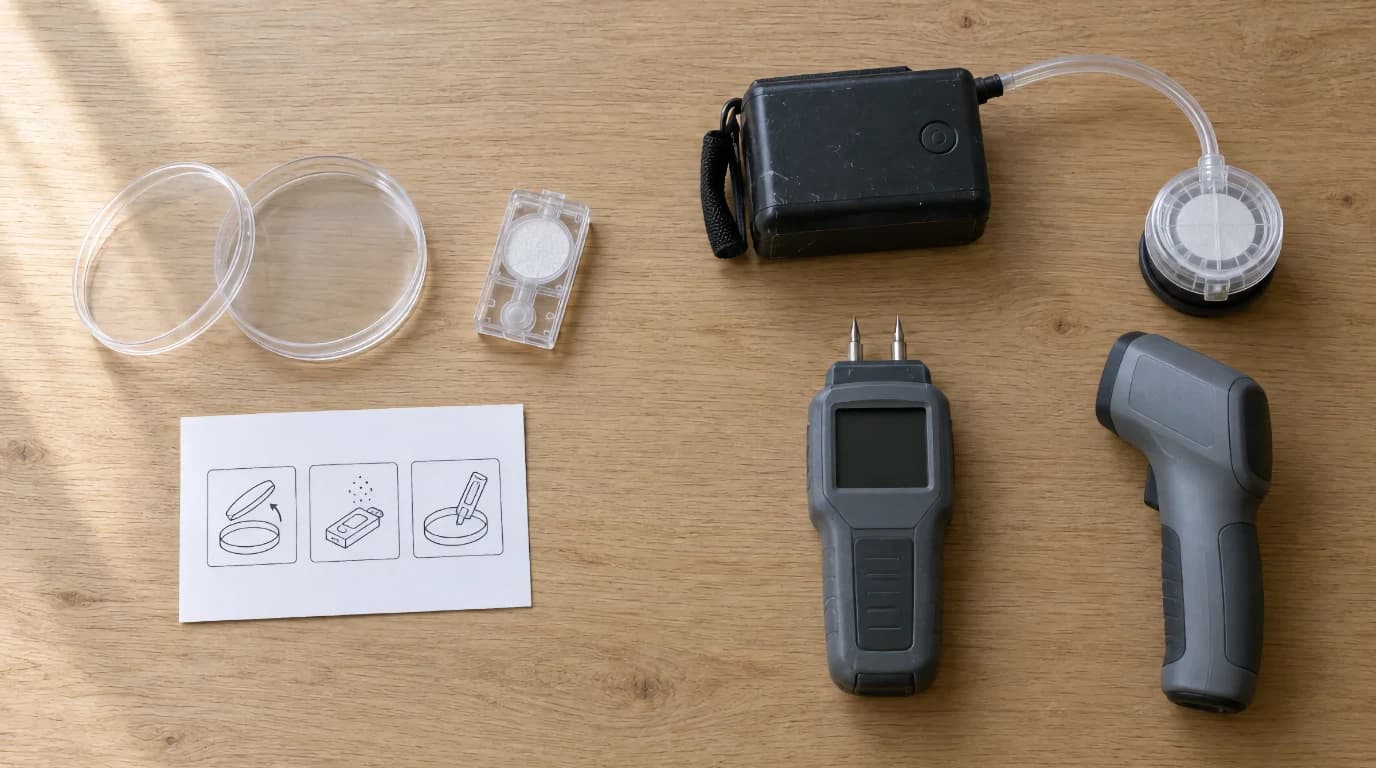
The cheap petri dish kits ask you to leave a culture plate open on the counter for an hour, then mail it in. These are nearly useless. They confirm spores exist, which is true in every house in America. They don't tell you concentration or location, and knowing that spores are present is not information you can act on.
The cassette kits collect air samples that go to a lab. The lab counts spores per cubic meter and reports the fungal groups it can resolve. That's limited snapshot data, and it shouldn't be relied on by itself to decide whether your house has a mold problem, to rule hidden growth in or out, or to define what needs remediating. These kits may lack calibrated flow, a comparison sample and anyone to interpret the result, and EPA says sampling for mold should be done by professionals with specific experience designing sampling protocols and interpreting results. If you buy one anyway, check which lab it uses and whether that lab holds current AIHA LAP EMLAP accreditation for the fungal method being run, since accreditation is specific to a method and scope rather than a phrase on a box. Accreditation speaks to the lab's analysis. It doesn't validate how the sample was collected or what the numbers mean.
Professional mold inspection
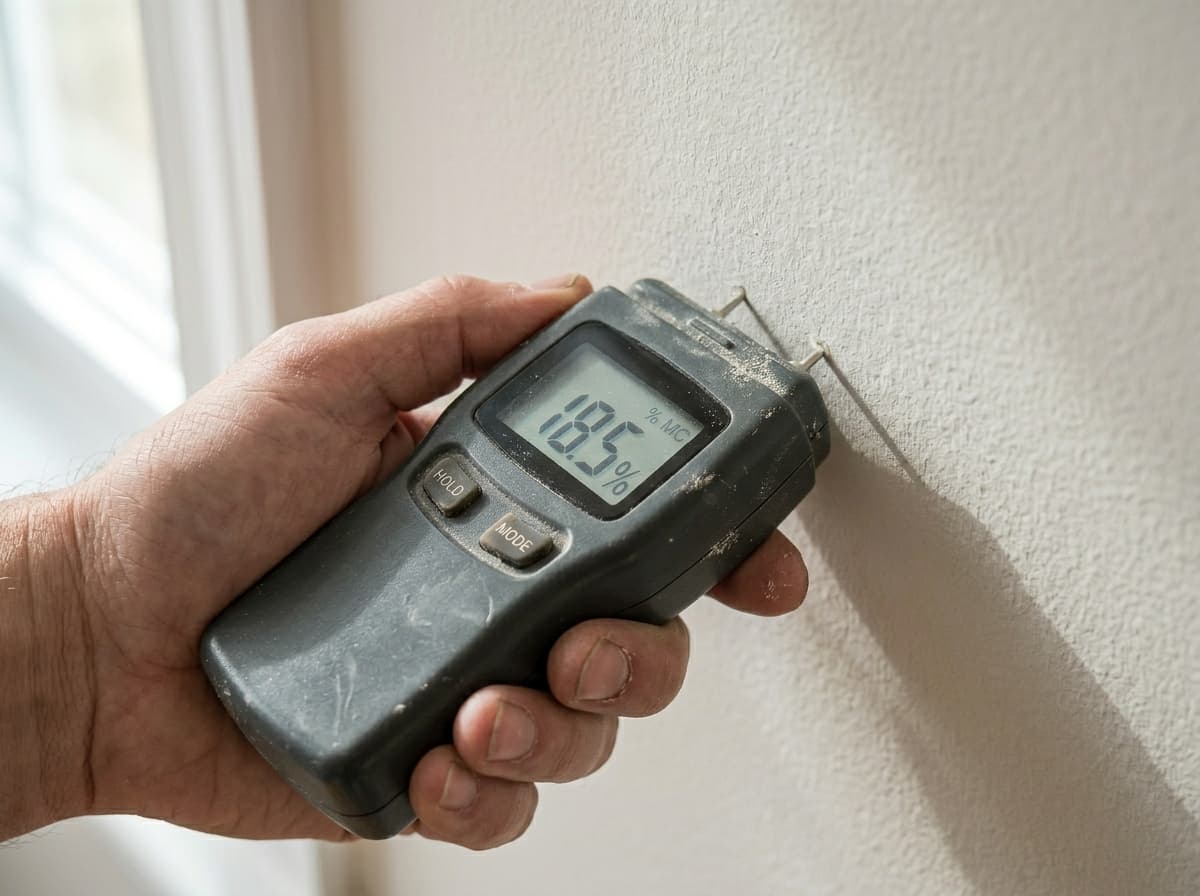
A professional assessment starts with the building's history, a visual inspection and a moisture investigation, using moisture meters on suspect surfaces and thermal imaging to point at temperature anomalies that may indicate moisture and want confirming with an actual moisture reading. ANSI/IICRC S520-2024 Section B defines assessment the same way: history and inspection first, and a sampling plan only if necessary. When sampling is needed to answer a defined question, the assessor chooses the method, whether that's a calibrated pump pulling a measured volume of air through a spore trap alongside comparison samples, surface samples such as tape lifts and swabs, or both. The lab analyzes what's collected, and the assessor interprets it against what the inspection found.
Cost depends on what you ask for. Nationally, an inspection costs $303 to $1,075, with an average of $689, from 8,354 costs reported to HomeAdvisor. Firms price the parts differently: one Austin assessor publishes $250 to $400 for a visual inspection with no samples and $150 to $300 per air sample. See what professional mold testing typically costs for the full breakdown by scope and sample count.
When you're ready to book, browse verified mold inspection companies; every pro listed is identity-checked, with state licenses verified where we hold the state's license records.
A cheaper first step most people skip
Before you spend on spore tests, spend a little on a hygrometer and a moisture meter. The hygrometer tells you indoor humidity. EPA recommends keeping it below 60%, ideally between 30 and 50%. A reading above 60% points to conditions that can favor condensation or mold growth, not proof that anything is growing. The moisture meter reads moisture in the material its pins go into. Compare the suspicious spot with the same material somewhere you know is dry, because the number depends on the meter and its scale, how deep the pins reach and what the material is. If both come back normal, you might be looking at a cosmetic stain from an old leak, though one normal spot reading doesn't rule out moisture that comes and goes or sits deeper in the wall.
If there is visible growth rather than just a stain, read mold vs mildew before you test: flat, powdery growth on tile or grout is a cleaning job, not a testing one, whichever word you use for it.
What About Mold Toxicity Tests in Your Body?
This is a category where the marketing is well ahead of the science. Be careful what you buy.
What doctors actually test for
A regular allergist can test for mold-specific IgE via skin prick or blood draw. A positive result shows sensitization, meaning your immune system recognizes that allergen; it does not establish that mold in a particular building is causing your symptoms, which takes clinical and exposure history together. IgG panels are not a validated test for mold-related illness, and neither are urine mycotoxin tests, which are covered in the next section.
If you suspect mold is making you sick, start with your primary doctor and talk through whether targeted allergy evaluation or mold-specific IgE testing makes sense for your history and symptoms. If you want to go further, find a board-certified allergist or immunologist, not a wellness influencer with a brand deal.
At-home mycotoxin kits: what they claim vs deliver
The home mycotoxin tests sold as "find out if mold is poisoning you" are not validated for that use. CDC reported in 2015 that there is no FDA-approved test for mycotoxins in human urine, and that urine mycotoxin tests are not approved by FDA for accuracy or for clinical use. Spend that money on a doctor's visit and a professional look at the building instead.
How to Find a Mold Tester You Can Trust
This is where most homeowners get burned. The mold testing industry has a structural conflict of interest that no one tells you about until you are looking at a remediation quote from the same company that ran the test.
Assessor vs remediator
A mold assessor tests. A mold remediator removes. They should be different companies, with no shared ownership and no referral kickbacks, because where the same business gets paid for both jobs the incentive runs one way. Read the difference between an assessor and a remediator for why this matters and what to ask before hiring.
State-by-state licensing
Licensing and separation rules vary by jurisdiction, and some states expressly bar the same licensee, or related firms, from doing both jobs on the same property or project. They don't all write the rule the same way. Florida 468.8419 bars a company from remediating a property it assessed, and assessing one it remediated, within 12 months, with exemptions for certain Division I certified contractors. It is a 12-month bar rather than a permanent one. Texas Occupations Code §1958.155 goes further: a license holder may not perform both assessment and remediation on the same project, and a person may not own an interest in both the assessment company and the remediation company on that project.
Check current law in your state before you hire, and ask the question yourself either way: "Do you also do remediation work, and if so, who refers you?" The standard has a view even where the law does not. ANSI/IICRC S520-2024 §13 says a professional engaged to assess the problem or verify the work should be unbiased and independent of the remediator, and that one who isn't should disclose that to the client in writing as a deviation from the Standard.
Questions to ask before hiring
A short list, before you sign anything:
- How do you decide whether sampling is needed, and if you sample, what equipment and comparison samples do you use?
- Which accredited lab analyzes the samples, and does its analysis follow AIHA or ACGIH methods? (EPA points to both.)
- Do you also do remediation, or only assessment?
- Do you carry professional liability (E&O) insurance, and can you send proof? (ANSI/IICRC S520-2024 §13 recommends it.)
- Can I see a sample report from a recent job?
- What's included in the price, and what triggers a charge above the quote?
If they hesitate on any of these, find someone else.
What Do Mold Test Results Actually Mean?
The lab will hand you a PDF with spore counts per cubic meter, a breakdown of the fungal groups found, and (usually) no interpretation. Reading it without getting fleeced takes a few specific moves.
Indoor vs outdoor spore counts
Your own outdoor air is the usual reference, and a good assessor takes both samples on the same day in similar weather so the comparison means something. It is one interpretive input, not a verdict. An indoor count several times higher than outdoor is a reason to look harder for a source. A count at or below outdoor does not certify the air, because the reading depends on when and where the sample was taken, what the weather was doing, and what the inspection found on moisture and visible growth. EPA is explicit that no federal limits have been set, so sampling cannot be used to check a building against a federal standard.
What the fungal group names on the report are good for
A lab report will name fungal groups, and it is tempting to read the names as a severity ranking. CDC's position is the opposite: it is not necessary to determine the type of mold, and all molds should be treated the same for health risk and removal. What the names are genuinely useful for is pointing at conditions. Stachybotrys and Chaetomium are associated with materials that have stayed wet a long time, so seeing them indoors is a reason to look hard at a chronic moisture source rather than a verdict about danger. Aspergillus, Penicillium, Cladosporium and Alternaria are common indoors and out, so their presence says little on its own and their levels have to be read against the inspection.
Why there's no universal "safe" threshold
There is no federal standard for indoor mold spore concentration. EPA states that threshold limit values for airborne mold have not been set and that there are currently no EPA regulations or standards for airborne mold contaminants. It does not publish a reason, so treat the absence as an absence rather than as a judgment about safe levels. What follows practically is that a qualified assessor reads your numbers against the building and its history, not against a pass/fail line that does not exist.
After You Test, What Now?
Three scenarios, three different next moves.
Results show no clear indoor elevation
Indoor counts are at or below outdoor levels and nothing on the report points at a chronic wet material. That isn't an all-clear. A short-term air sample that isn't elevated doesn't rule out hidden or intermittent mold, so read it alongside the inspection, the moisture findings and the conditions on the day it was taken. Don't celebrate by ignoring the moisture source that prompted you to test. Fix the leak, run a dehumidifier, recheck humidity readings monthly. Mold is a moisture problem first.
Results show elevated counts
The order matters: find the source, fix the source, then remediate, then verify. ANSI/IICRC S520-2024 §12 treats sampling as one possible verification method rather than the definition of success, and sets the minimum as a return to Condition 1 with materials dry and the area free of visible dust, debris, malodor and growth. Skipping straight to remediation without finding and fixing the moisture source leaves the conditions that grew the mold in place, so it can come back. Hire a remediator that's separate from your assessor, ideally IICRC-certified (WRT for water restoration, AMRT for applied microbial remediation).
Results unclear
If the report is ambiguous or doesn't match what you're seeing, get a second opinion from a different assessor with no business relationship to the first. A second assessor who inspects the building and its moisture history independently is more useful than another round of samples read the same way.