Mold Identification: 13 Types, Color Chart & Photos (2026)
Identify 13 common household molds by color, texture, and location. Mold identification chart, photo guide, and what looks like mold but isn't.
You spotted something fuzzy. It's on a wall, behind the sink, or on the ceiling, and now you're trying to figure out what it is before you decide what to do about it.
Good news: most mold you'll find in a house is ordinary and something you can handle yourself. Bad news: a small number of types are serious and shouldn't be touched without the right gear. This guide covers both, with photos, a color chart, and a section on the half-dozen things that look like mold but aren't.
Start Here: 60-Second Triage
Most people arrive at this page standing in front of the thing, phone in hand. Three questions, in this order.
1. Is it actually mold? Mold sits raised off the surface: fuzzy, velvety, or slimy. Dirt, soot, water stains, and efflorescence lie flat. Dab a drop of household bleach on the spot and wait two minutes. If it lightens, it's mold or mildew. If nothing changes, you're probably looking at one of the six lookalikes.
2. Is it the dangerous kind? Dark greenish-black, slimy when wet and powdery once dry, on drywall or ceiling tile that's been wet for days. Treat that as possible Stachybotrys, and don't touch it, wipe it, or point a fan at it. All three put spores in the air.
3. Do you clean it or call someone? Smaller than a sheet of paper, on a hard surface, with no musty smell elsewhere in the house: DIY is reasonable. Bigger than about 10 square feet, inside the HVAC, coming back after you clean it, or someone in the house has symptoms: bring in a professional.
Then match what you're seeing: black · green · white · pink · orange · yellow · brown or gray · side-by-side chart
In This Guide
- What is Mold?: how mold grows and spreads
- Common Types: 8 types including black, green, white, and more
- Mold Identification Chart: quick-reference comparison table
- Surface by Surface: what mold looks like on walls, wood, carpet, and furniture
- Mold vs mildew (quick summary): the short version, plus the full breakdown
- What Looks Like Mold But Isn't: common lookalikes
- Where Mold Grows: high-risk and hidden locations
- Health Risks: symptoms and who's at risk
- When to Call a Pro: professional assessment guide
- How to Identify Mold: visual, bleach test, smell test, ID apps, and DIY kits
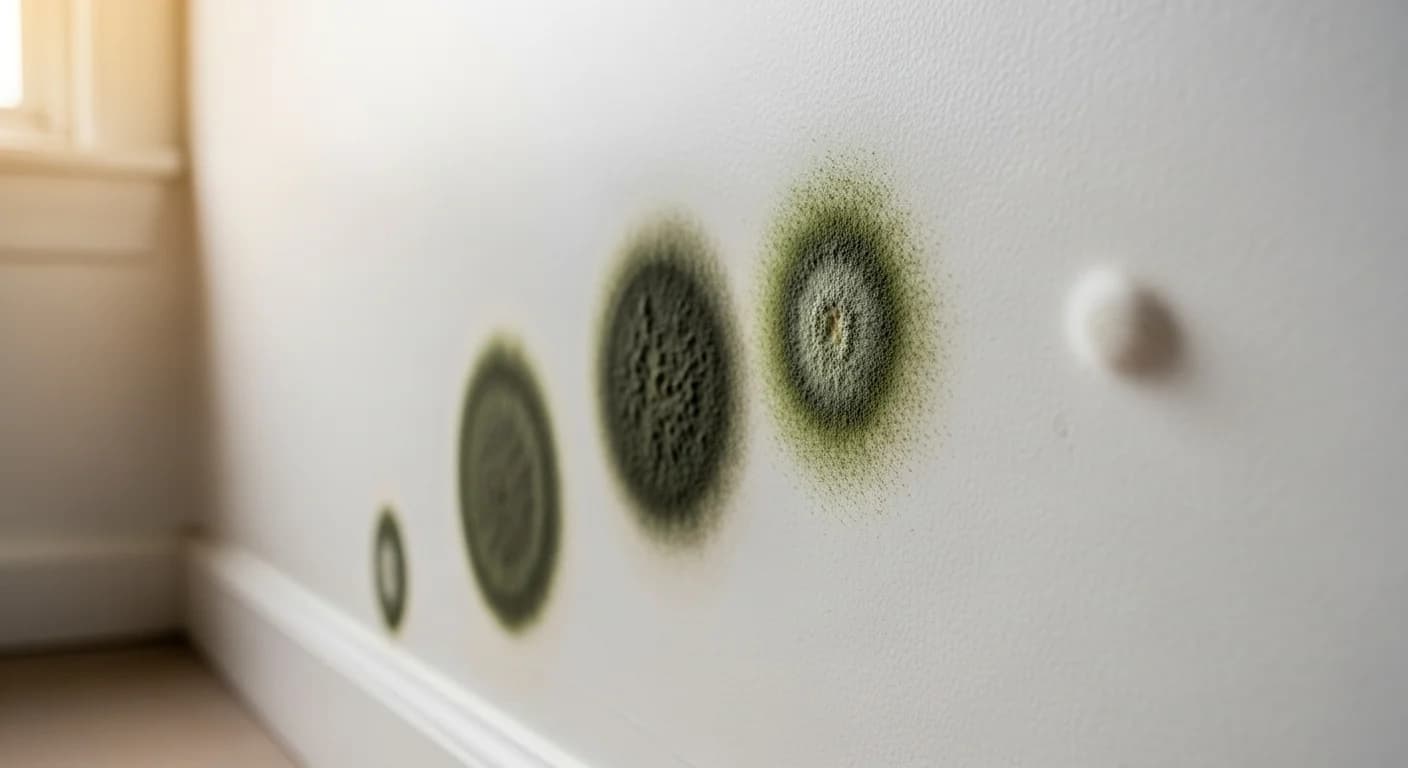
What is Mold?
Mold is fungus. It's outside right now, on every fallen leaf and piece of dead wood within a hundred feet of you, and that's supposed to be there; that's its job. The problem starts when it finds its way inside, lands on something damp, and stays.
How Mold Spreads
Mold makes spores, which are small enough that you're breathing some in at this exact moment. Nothing to panic about; they're in the air everywhere, indoors and out. They only turn into a visible mold patch when they land somewhere wet and don't get dried out fast enough.
What Mold Needs to Grow
Mold needs four things. Take away any one of them and it can't grow.
Moisture. This is the one that matters. If your house is genuinely dry, you don't have a mold problem. Full stop.
Something to eat. Drywall, wood, paper, fabric, even the dust on the back of your TV. If you've got a house, you've got mold food.
A comfortable temperature. 60 to 80°F. The same range you're sleeping in.
Stagnant air. Basements, crawlspaces, that corner of the closet you never open, behind the couch that's been pushed against an exterior wall since you moved in.
Common Types of Household Mold
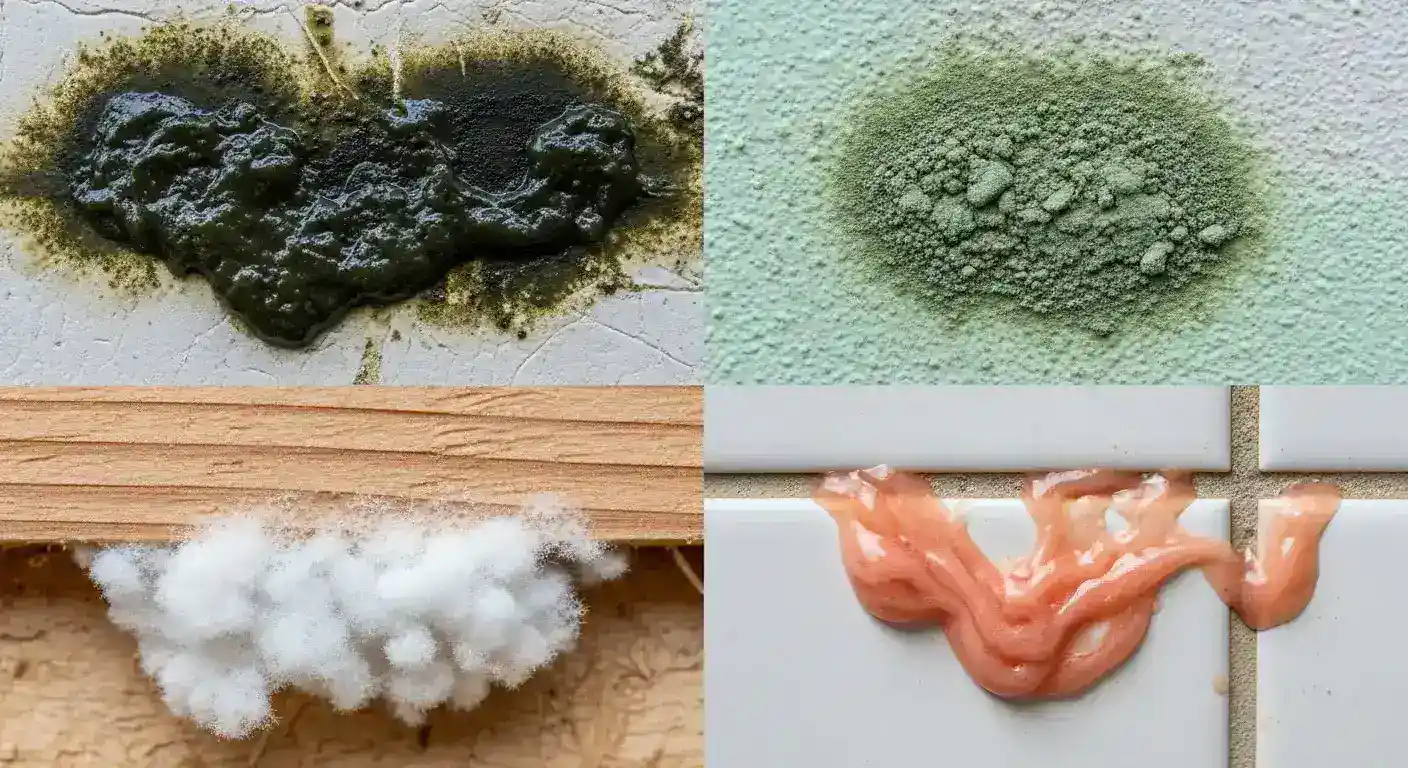
Color and texture tell you a lot before anyone takes a sample. Here's what the most common household molds actually look like, and where they tend to show up.
The CDC lists the most common indoor molds as Cladosporium, Penicillium, and Aspergillus. All three are covered below, and none of them is Stachybotrys. That's worth holding onto before you assume the worst about a dark patch.
Black Mold (Stachybotrys chartarum)
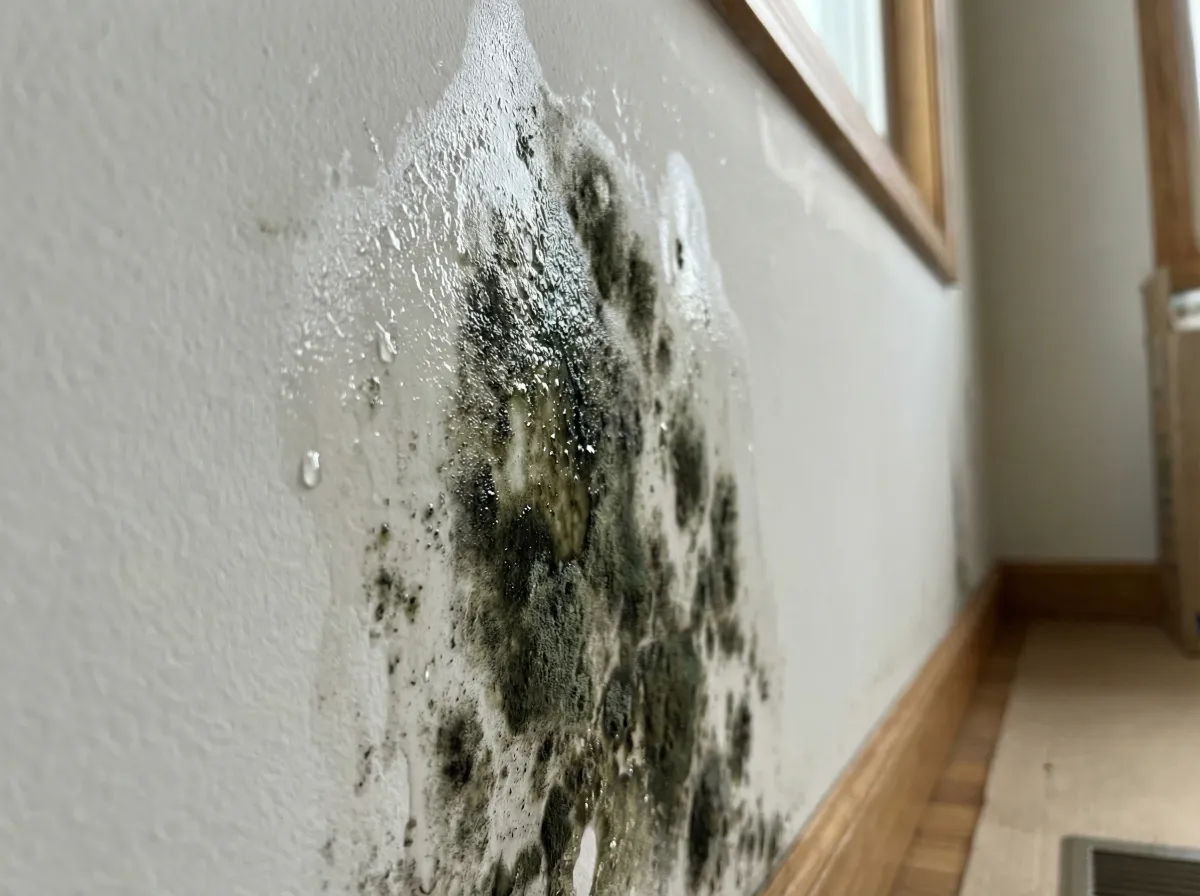
This is the one people mean when they say "toxic black mold." Stachybotrys chartarum is the most concerning mold you're likely to find in a house, and it's the one you shouldn't try to clean yourself.
Warning: If you think you're looking at black mold, don't poke it, don't try to wipe it, and don't run a fan anywhere near it. All three aerosolize the spores. Call a mold assessor. That's the professional who tests, not treats, and they'll confirm what it actually is.
Black mold reads as dark greenish-black, slimy when it is actively growing and powdery when it dries, and it takes hold on cellulose like drywall, ceiling tiles, and wood that has stayed wet for days. Color alone cannot confirm the species, so treat any black patch as worth taking seriously and confirm with a test rather than by sight.
For the full visual breakdown, including what black mold actually looks like, surface by surface and how to tell it apart from soot, water stains, and other look-alikes, see the dedicated appearance guide.
Green Mold (Aspergillus and Penicillium)
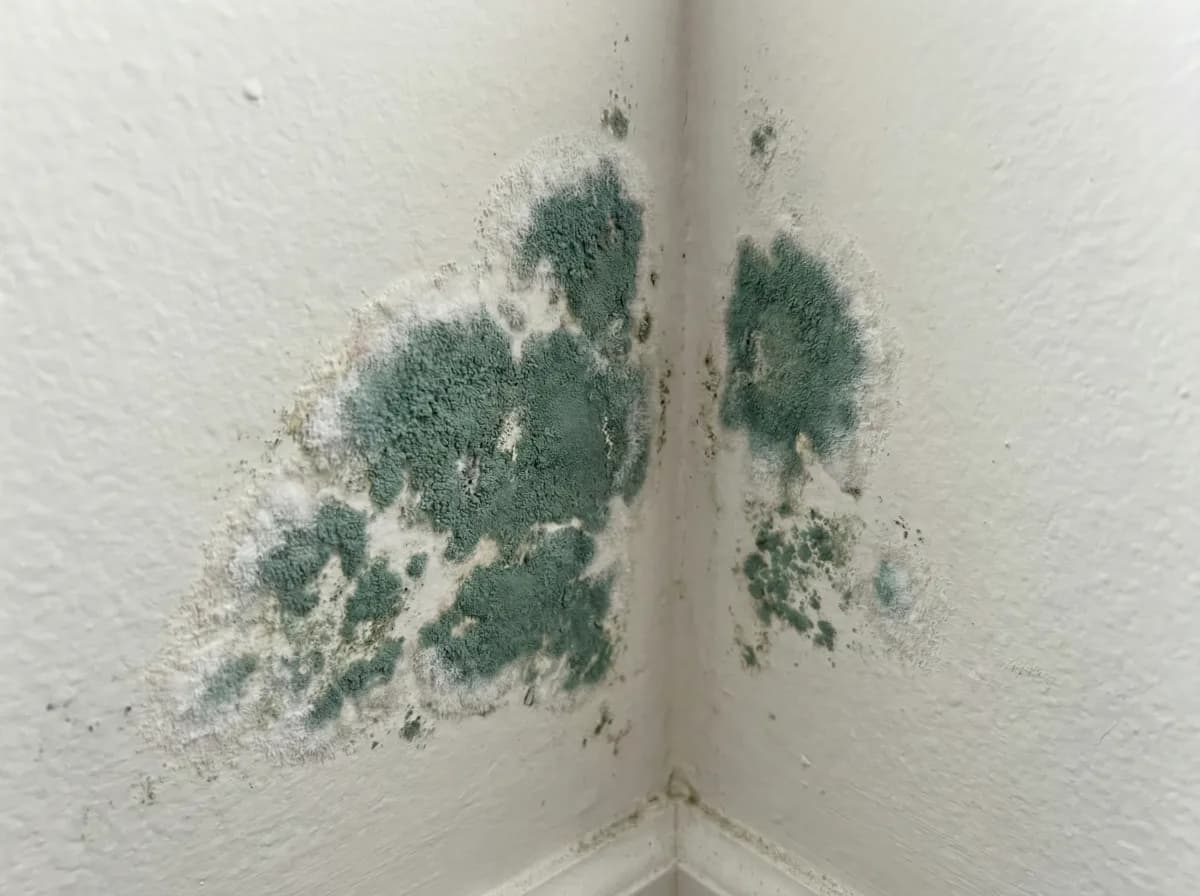
"Green mold" is usually Aspergillus or Penicillium. You've almost certainly met both already; Penicillium is the one behind blue cheese and penicillin. It runs from light green to dark olive, sometimes blue-green or yellow-green, powdery or fuzzy, with paler edges where it's actively spreading. In a house, Aspergillus and Penicillium turn up on food, on damp walls and insulation, in fabric and carpet, on wallpaper and painted surfaces, and cycling through the AC and ductwork (more on HVAC mold in the remediation guide). It spreads fast and covers ground quickly. Most strains are fairly harmless, but some set off allergies or breathing trouble, especially if you've already got asthma or hay fever.
White Mold
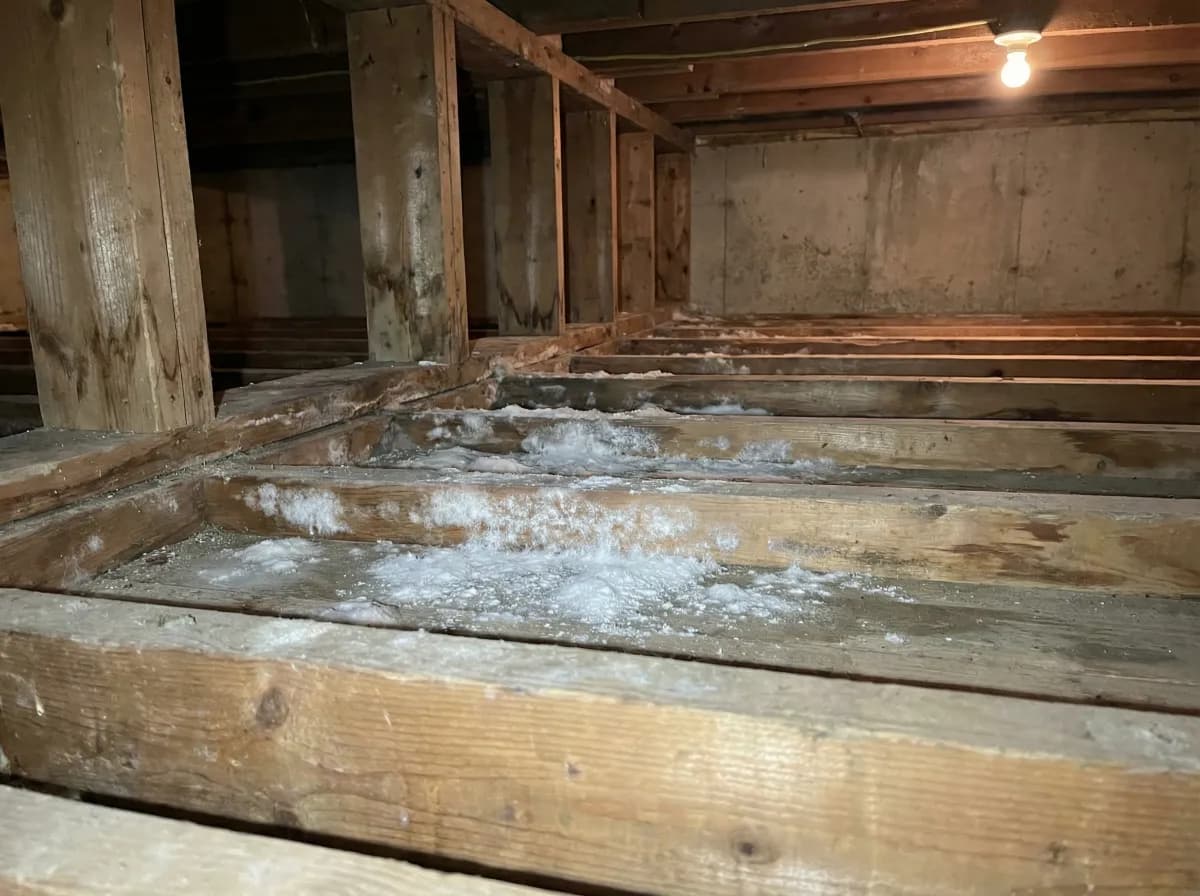
"White mold" isn't one species. It's either a mold that stays white its whole life or one that hasn't turned green, gray, or black yet. Finding it early is the useful part; it's usually the first visible sign of a moisture problem. It shows up white to light gray, powdery or fluffy, sometimes with a faint musty smell, and on concrete it's easy to mistake for efflorescence (the mineral deposits left when water wicks through masonry). Look on basement walls and floors, around wood framing, in attics and crawl spaces, on furniture, and in closets that never get air. The tell is that it appears in humid spots with no obvious leak. If it's on your basement framing, something is keeping that wood damp even if you can't yet see what. And it won't go away on its own: the growth stops when the moisture stops, and what's already there still has to come off.
Pink Mold (Aureobasidium pullulans and Serratia marcescens)
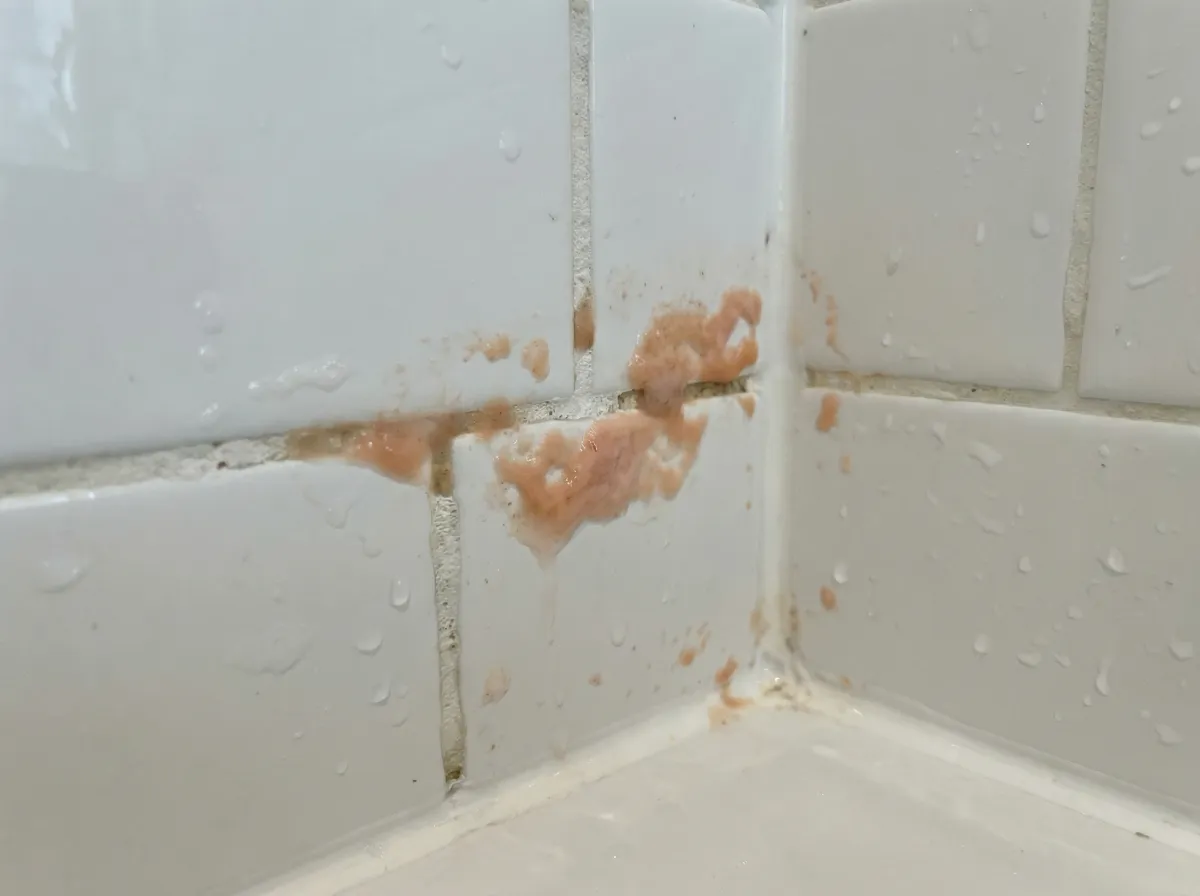
The pink ring in your shower isn't technically mold. Most of the time it's Serratia marcescens, a bacterium that feeds on soap scum and stays wet in the steam off your showerhead. It looks like mold, acts like mold, gets treated like mold, so people call it pink mold and move on. It's pink, orange, or reddish, slimy, usually in rings or spots, and it can darken toward brown or black as it ages. You'll see it on tile and grout, shower curtains and liners, around faucets and drains, on shampoo bottles and soap dishes, and on window sills in humid rooms.
Is pink mold harmful? For most healthy people, no. Cleveland Clinic describes it as a pink film that grows in showers and toilet bowls and says healthy people rarely pick up an infection from it at home. The risk sits with people who have a weakened immune system, an open wound, or an indwelling medical device like a catheter, and for them it can cause real infections. If someone in your house is in that group, don't wave it off because it looks harmless.
Is pink mold as bad as black mold? No, and they aren't the same kind of problem. The pink shower film is a bacterium living on soap residue on a hard, wet surface, and it comes off with a scrub. The black mold worth worrying about is Stachybotrys, a fungus that grows into drywall and ceiling tile that has stayed wet for days, and the advice for that is don't touch it and call a professional. Where color still matters: pink or red growth on carpet, fabric, or wallpaper rather than in the shower can be a true mold, Aureobasidium on caulk and window frames or Fusarium on water-damaged carpet, and that gets the same treatment as any other mold on a porous material.
Sometimes it really is mold. Aureobasidium pullulans, the fungus in this section's name, starts pink on caulk, window frames, and painted wood before darkening to black, which is how it ends up mistaken for Stachybotrys. The bleach test doesn't separate the two; the location usually does.
Cleaning it and keeping it gone is one job. Any household bathroom cleaner scrubs the film off tile, grout, and curtains, and CDC's guidance for hard surfaces is household cleaning products or a diluted bleach solution, never mixed with anything else. What brings it back is the water. It returns on the same schedule the shower stays wet, so squeegee the walls, run the fan, wash the curtain, and it stops coming back.
Cladosporium
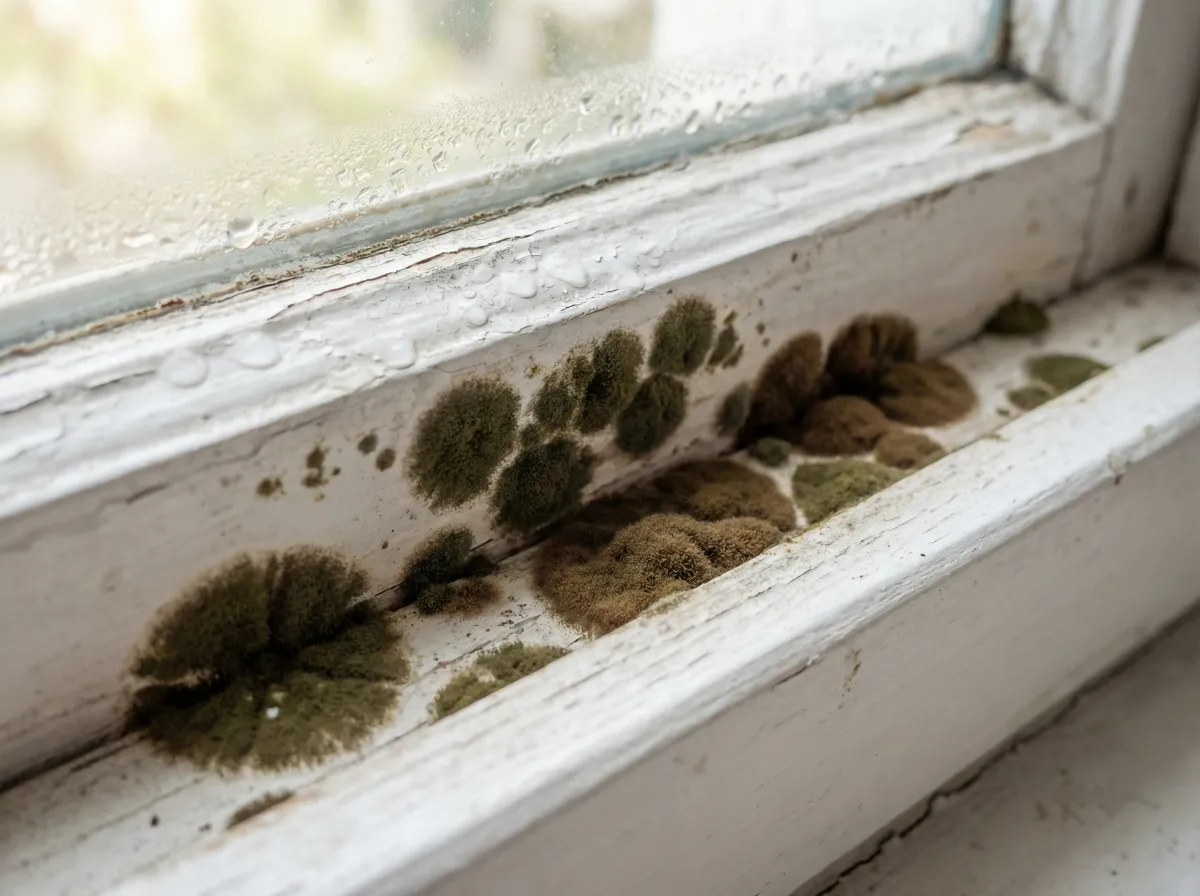
Cladosporium is the one you probably already have somewhere. It's among the most common molds in the world, indoors and out, with a trick most molds lack: it keeps growing in the cold, which is why it turns up inside refrigerators. Color runs olive-green to brown or black, the texture is suede-like or velvety, and it grows as clusters of small spots that spread outward, sometimes on both faces of a surface. Check window sills and frames, damp bathroom walls, HVAC ducts and air filters, fabric and carpet and upholstery, and under sinks around the plumbing. The standout trait is that cold tolerance, paired with being one of the top triggers for hay fever and asthma flare-ups. If allergy season feels worse inside your house than out, Cladosporium is a prime suspect.
Alternaria
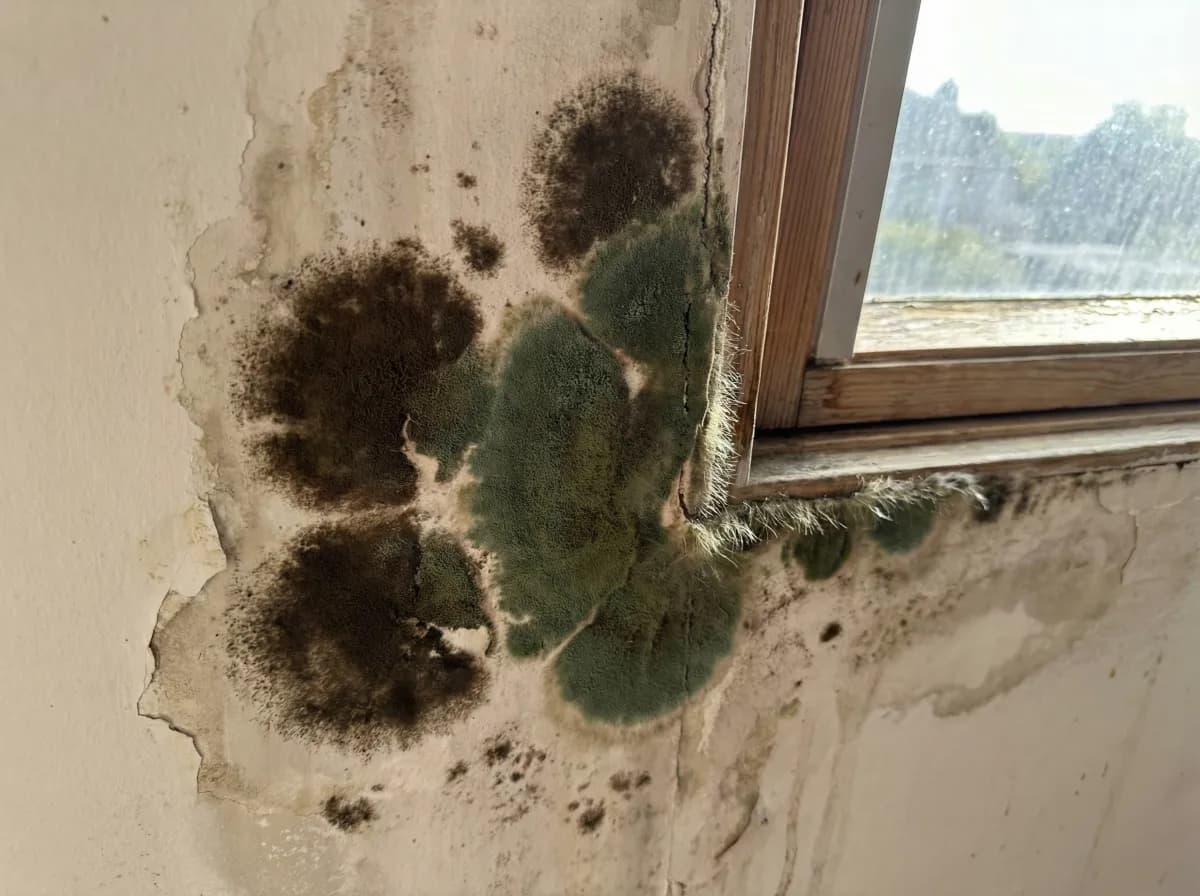
Alternaria is the mold most responsible for household allergies. It hitches in on open windows, clothes, and pets, then settles wherever it finds damp, usually around condensation on windows or on a wall after a leak. It's dark brown to dark green or gray, velvety with hair-like filaments, and it spreads into large colonies with a distinctive fuzzy border. Look in showers and tubs and under leaking sinks, around window frames that sweat, in kitchens near the sink and dishwasher, on walls and ceilings after water damage, and inside AC systems. It's fast; it can take over a damp surface in a few days. It's strongly tied to allergic reactions and asthma attacks, and kids tend to react to it harder than adults do.
Chaetomium
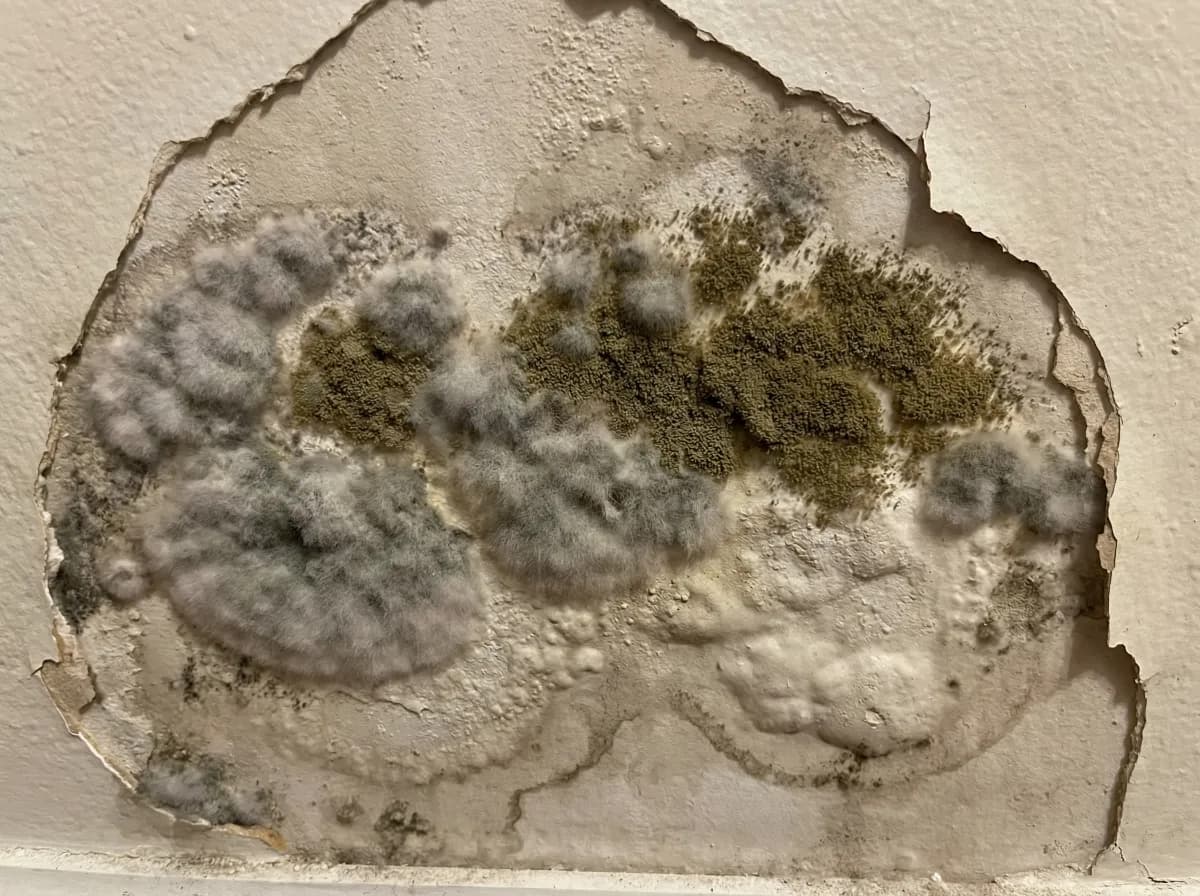
Chaetomium is the mold that tells you something's leaking before you've found the leak. See it and don't just clean it; track down the water, because it'll grow back until you do.
It starts white or gray and darkens to olive-green or brown as it ages, with a cottony, fuzzy texture and a strong musty odor, and it often shows up next to other water-damage molds like Stachybotrys. It favors water-damaged drywall and wallboard, roof leaks and the area around skylights, basement walls after a flood, plumbing leaks inside wall cavities, and wet cardboard or paper. The giveaway is the smell; people usually notice Chaetomium before they see it, and that musty odor is often the first sign of a hidden water problem.
Mucor
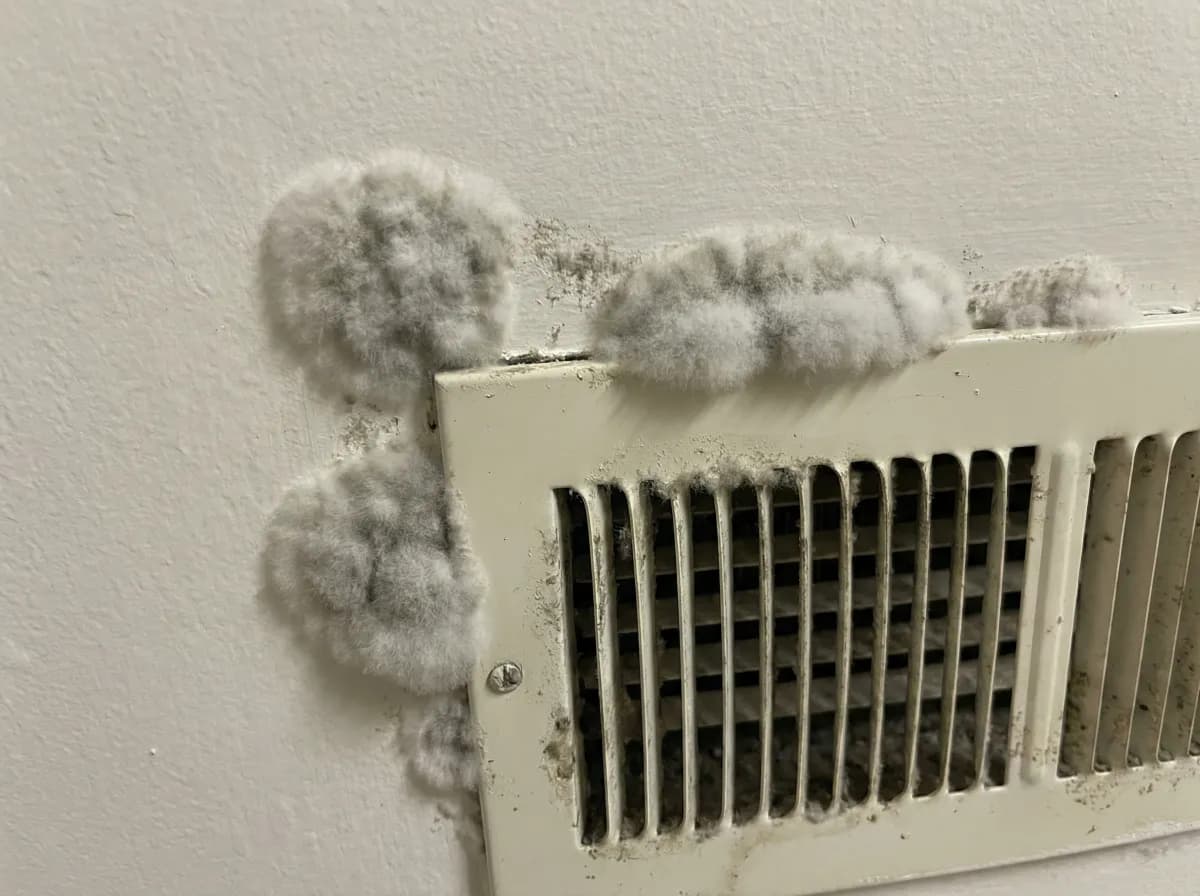
Mucor looks almost like a pile of wet cotton balls. It forms thick, fluffy patches that cover ground fast, especially near HVAC vents and anywhere condensation pools, and it shows up most in homes with inconsistent climate control. It's white or grayish, yellowing to brown with age, thick and cotton-like, growing in big patches rather than little spots and turning almost pillow-like when mature. You'll find it near HVAC systems and ducts, on carpet and padding, in condensation-prone spots like cold windows and uninsulated walls, around decaying organic material, and in the soil of an overwatered houseplant.
It grows fast in warm, humid air. For most households it's a nuisance, not an emergency; but in rare cases it causes mucormycosis, a serious infection that mainly hits people with weakened immune systems, so for anyone immunocompromised it's worth taking seriously.
Orange Mold
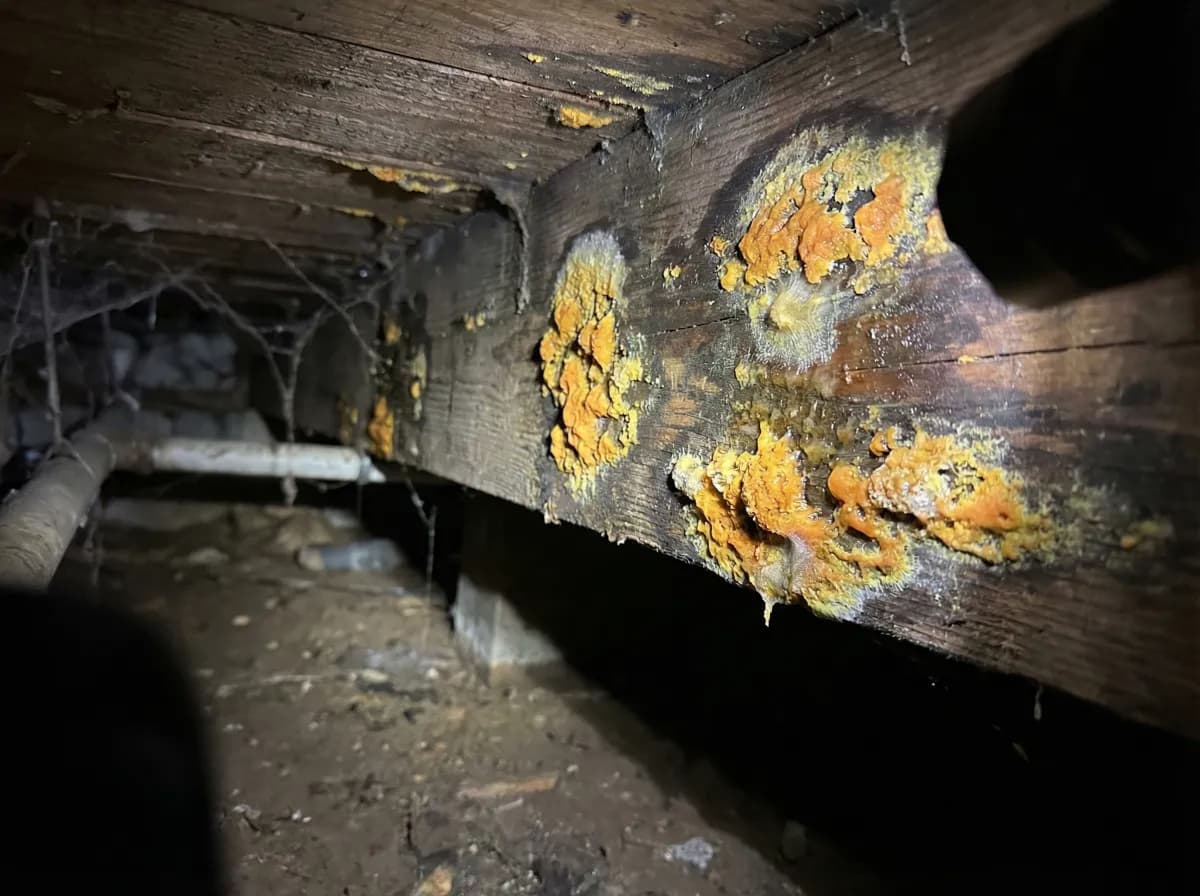
Orange growth on a joist, a damp wall, or the rim of a shower drain worries people faster than black does, because it looks alive. It usually isn't one thing. "Orange mold" is the name people give to three different organisms that all turn orange in a wet house: a bacterium, a handful of true molds, and slime mold. Where you found it tells you which one you've got.
In the shower, around a drain, or on a dishwasher seal. That slimy pink-to-orange film is almost always the same bacterium as pink mold, Serratia marcescens, living on soap residue and standing water. It isn't a fungus at all. Scrub it, dry the surface, and fix whatever keeps it wet, because it comes back on the same schedule the moisture does.
On wood, drywall, or basement framing. Fuzzy, powdery, or crusty orange patches on a porous surface are true mold. Acremonium is one of the household molds that can grow orange, though it's more often white or gray; the same organism lives in humidifier tanks, cooling coils, and drain pans, which is why an orange patch near an air handler deserves a look inside it. Yellow-orange sheets spreading across a beam are a different problem entirely: that's Serpula, which is dry rot, and a structural question more than a health one.
On mulch, crawl space soil, or wood that stays wet outdoors. A bright yellow-to-orange mass with the texture of scrambled egg or spilled jelly is slime mold, most often Fuligo septica. It isn't a mold, and for most people it isn't a health problem. What it is, is proof that something has been wet for a while.
So is it dangerous? Less often than black, and color still won't tell you. The bathroom film is a nuisance for most people; the pink mold section above covers who it does put at risk. The true molds behave like any other mold: irritation and allergy symptoms in people who are sensitive, and worse for anyone with asthma. Slime mold is the least of the three. What all of them really have in common is the moisture, and that's the part that does the damage.
What to do about it depends on the surface. On tile, glass, or a drain rim, clean it, dry it, and keep it dry. On wood or drywall the fix is taking out what's contaminated and drying the cavity behind it, not soaking the surface; EPA doesn't recommend bleach as a routine practice during mold cleanup, and what actually kills mold explains why a surface that looks clean isn't the same as a wall that is. Under about 10 square feet on a hard surface, that's a Saturday job. Bigger than that, inside the HVAC, or back again after you've cleaned it, and it's time to bring in a professional.
Yellow Mold
Yellow growth indoors is usually one of the molds above at a different stage or on a different surface. Aspergillus runs yellow-green, Serpula runs from yellow-orange to red-brown, and Fuligo septica is a brighter yellow than orange while it's fresh. You'll also see it on food and inside refrigerators, which is ordinary spoilage. Bright yellow powder on damp wood or the back of a bookcase is worth the bleach test; a flat yellow-brown stain that doesn't change is water, and the lookalikes section covers the rest.
Brown and Gray Mold
Most of the time brown or gray mold isn't a separate species at all; it's one of the molds above in a different life stage. Mold shifts color as it matures, so a colony that started white can go green, then brown, then black over a few weeks. Expect anything from light tan to dark brown or silvery gray, in a texture that might be powdery, velvety, or slimy, usually in irregular patches that can read like a dark stain or old water damage. Treat it like any other mold: find the moisture source first, then deal with the growth. Color on its own doesn't tell you much.
Less Common Indoor Molds
The sections above cover most of what turns up in houses. A few others are genuinely indoor molds and worth being able to name.
| Mold | Looks like | Where you'd find it | Worth knowing |
|---|---|---|---|
| Ulocladium | Black to dark gray, suede-like, dense colonies that spread fast | Kitchens, bathrooms, basements, anywhere chronically wet | Routinely mistaken for Stachybotrys; only a lab tells them apart |
| Acremonium | Moist at first, then powdery; white, gray, orange, or pink | Humidifiers, cooling coils, drain pans, window sealants | Lives in the wet parts of HVAC equipment |
| Aureobasidium | Pink or brown, darkening to black as it ages | Window frames, caulk, wallpaper, painted wood | The same organism named in the pink mold section above; listed again here because the pink stage is the one people recognize and the black stage is the one they misread as Stachybotrys |
| Trichoderma | White with green patches, woolly | Damp wood, wet carpet, HVAC filters | Usually turns up after flooding |
| Fusarium | Pink, red, or purple, woolly | Water-damaged carpet, humidifiers | Keeps growing in cool conditions |
| Serpula | Yellow-orange to red-brown, in wavy sheets | Structural timber, floors, beams | This is dry rot, a structural problem more than a health one |
One thing to skip past: you'll find Cryptococcus neoformans and Histoplasma capsulatum on plenty of "types of mold in your house" lists. They're soil organisms associated with bird and bat droppings. They matter if you're clearing out a pigeon-infested attic. They're not what's on your bathroom wall.
Mold Identification Chart
If you've got a spot and want to narrow it down fast, match what you're seeing against the table below.
| Mold Type | Color | Texture | Common Locations | Risk Level |
|---|---|---|---|---|
| Black mold (Stachybotrys) | Dark greenish-black | Slimy when wet, powdery when dry | Chronically wet drywall, ceiling tiles, behind wallpaper | High; call a pro |
| Green mold (Aspergillus/Penicillium) | Light to dark green, blue-green | Powdery or fuzzy | Food, HVAC systems, walls, carpets | Moderate; can cause allergic reactions |
| White mold | White to light gray | Powdery or fluffy | Basements, attics, crawl spaces, wood framing | Moderate; early sign of moisture problems |
| Pink mold (Aureobasidium/Serratia) | Pink, orange, reddish | Slimy | Bathroom tiles, grout, shower curtains, drains | Low to moderate; infections in immunocompromised |
| Cladosporium | Olive-green to brown or black | Velvety or suede-like | Window sills, HVAC ducts, fabrics, damp bathrooms | Moderate; common allergen and asthma trigger |
| Alternaria | Dark brown to dark green | Velvety with hair-like filaments | Showers, sinks, window frames, after water damage | Moderate to high; strong allergen, fast grower |
| Chaetomium | White to olive green (darkens with age) | Cottony or fuzzy | Water-damaged drywall, roof leaks, basement walls | Moderate; strong sign of water damage |
| Mucor | White to grayish, yellows with age | Thick, fluffy, cotton-like | HVAC systems, carpet, condensation areas | Moderate to high; can cause mucormycosis in immunocompromised |
One note: Color alone isn't a reliable way to pin down the exact species. Molds shift colors as they age, and the only way to know for sure is lab testing. When you need certainty, get a professional mold assessment.
What Mold Looks Like, Surface by Surface
The chart sorts by species. Most people don't start there; they start with a wall, a joist, or a corner of carpet that smells wrong, and want to know whether the thing in front of them is mold. The same four tells apply on every surface: color, texture, the pattern it grows in, and what it's done to the material underneath. What changes is which one gives it away first. One more thing worth knowing before you look: dried-out or "dead" mold doesn't look dead. It looks like the live version gone dull and powdery, and it's still an allergen, so it counts.
On Walls
Mold on a wall shows up as clusters of dark specks that grow into irregular patches, in black, green, brown, gray, or white, and now and then pink or yellow. Fresh growth is fuzzy or velvety; on a wall that's still wet it can look slimy, and on one that's dried out it turns powdery. The pattern follows the water. Look along baseboards after a leak, in the cold corners of exterior walls, behind furniture pushed up against them, and around window frames that sweat. Paint that bubbles, cracks, or peels over the patch, or drywall that gives under your thumb, means the moisture is inside the wall and not just on it.
Two things get mistaken for it. Soot and candle smoke sit in a flat gray-black film that wipes off on a cloth; a water stain has a hard tan ring at its edge and no texture at all. The mold on walls guide covers what each growth pattern means and whether you scrub it or cut it out.
On Wood
Wood carries three different fungal problems, and only one of them is mold. Mold sits on top of the surface: white, green, or black fuzz and speckling on joists, studs, subfloor, and the unfinished backs of furniture, usually somewhere the air never moves. Blue-black streaks that run with the grain and won't wipe off are sapstain, a fungus that discolors lumber without weakening it. Dry rot is the one that matters structurally: wood gone brown and brittle, cracked into small cubes, sometimes with a cottony white or yellow-orange growth spreading over it. Press a screwdriver into the wood. Mold-covered wood is still hard underneath. Rotted wood crumbles.
On Carpet
By the time you can see mold on carpet, the padding underneath has usually been wet for days. The earlier tells are a musty smell that's strongest at floor level, a patch that feels damp or spongy when everything around it is dry, and discoloration in green, black, or white in the low-traffic spots where water sits: under a window, along an exterior wall, beside a slab crack. Lift a corner. A stained or crumbling pad, or growth on the back of the carpet, settles it. EPA's rule of thumb is to get wet materials dry within 24 to 48 hours. Carpet that has grown visible mold is hard to save, and the pad under it almost never is; the remediation guide covers what comes out and what can stay.
On Furniture
Wood furniture grows mold on the surfaces you don't look at: the back panel that's been against an exterior wall, the underside of a drawer, the unfinished inside of a wardrobe in a closet that never gets air. It looks like a white or green powdery bloom, sometimes with a few black specks, and it smells musty the moment you pull the piece away from the wall. Upholstery and mattresses show it as spots or a general grayish tinge on the fabric, usually with the smell arriving first. One lookalike is worth knowing about. Leather sometimes throws a white, waxy film called spue, which is fat from the tanning process working its way to the surface; it wipes off with a dry cloth and doesn't smell. Mold on leather is fuzzy, comes back after you wipe it, and does.
Mold vs Mildew (Quick Summary)
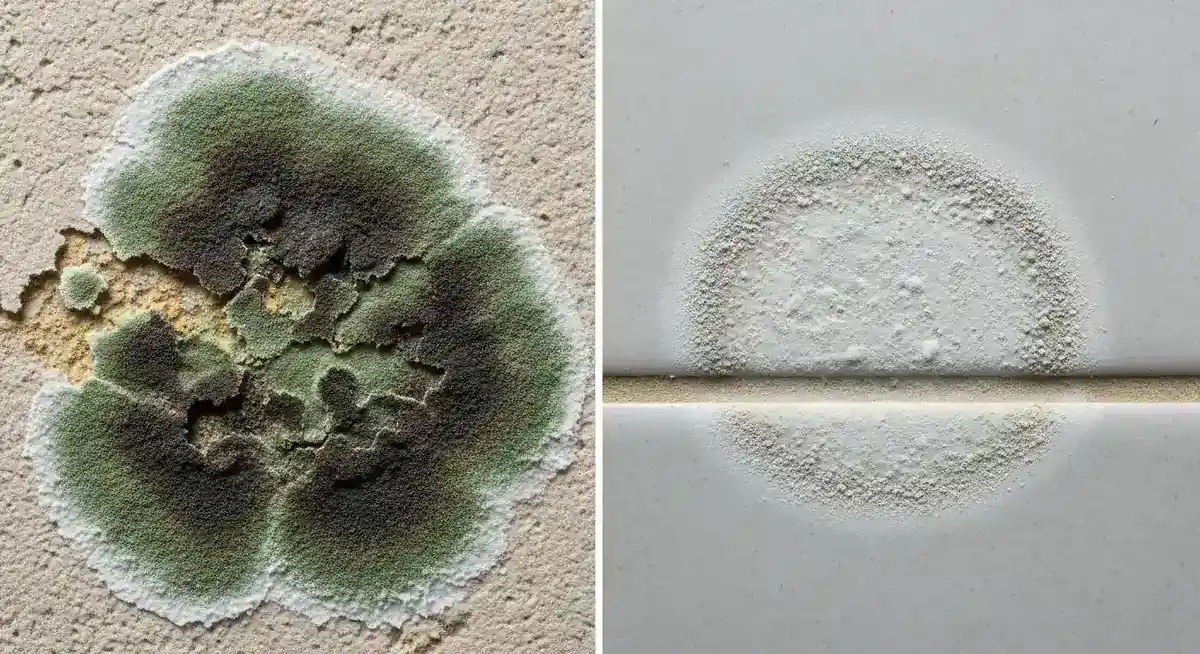
People use "mold" and "mildew" interchangeably, but they aren't quite the same. Both are fungi, and mildew is really a flat, surface-level form of mold: white or gray, powdery, and easy to wipe off a hard surface. What people call mold is the fuzzy, raised growth that works into drywall, wood, and ceilings and usually needs more than a wipe.
The shortcut: mildew sits on top. Mold goes in. If it's raised, fuzzy, or dark, treat it as mold. You can always downgrade your concern later if it turns out to be mildew, but it's harder to undo the other direction.
For the side-by-side table on color, texture, smell, and health risk, plus a simple at-home test and surface-by-surface guidance, see the full mold vs mildew breakdown.
What Looks Like Mold But Isn't
A handful of ordinary household things get mistaken for mold all the time. Match what you're seeing against the six below before you start pulling anything apart.
Before you start pulling off drywall, check whether you’re actually looking at mold.
Efflorescence
Mineral salts carried to the surface as water evaporates through masonry. Most "white mold in the basement" is this.
Dissolves in water. Mold doesn’t.
Dirt and soot
Dark buildup near vents, windows, and high-traffic spots.
Feels gritty and lies flat. Mold is raised.
Soap scum
White to gray film on bathroom surfaces.
Wipes off easily, and there’s no musty smell.
Water stains
Brown or yellowish rings left by an old leak.
Flat discoloration, not raised growth. Still worth chasing the moisture.
Iron bacteria
Rust-colored staining from iron-oxidizing bacteria in the water supply.
Shows up around drains, toilets, and fixtures, not on walls.
Pollen
Fine yellow-green powder during allergy season.
Wipes away and stays gone, unless more blows in.
Still not sure? The bleach test settles most of these. Dab a drop on the spot; if it lightens within two minutes, it’s mold or mildew.
People usually ask this by color, so here it is by color.
Mistaken for black mold. Soot and candle smoke, which sit in a flat gray-black film and wipe off on a cloth; a water stain, which has a hard tan ring and no texture; and three real molds that read as black without being Stachybotrys: Cladosporium, Alternaria, and Aureobasidium in its dark stage. Color can't separate those from black mold. A lab can, and the location usually narrows it first.
Mistaken for white mold. Efflorescence on concrete and masonry, the mineral salts left behind when water wicks through, which dissolves in water where mold doesn't; ordinary dirt and dust, which feel gritty and lie flat; mildew, a flat surface mold that wipes off a hard surface with household cleaner; and on leather, a waxy white bloom called spue that wipes off with a dry cloth and doesn't smell.
Mistaken for pink mold. The reverse problem: most of what gets called pink mold isn't mold. The slimy pink film in a shower is usually the bacterium Serratia marcescens. Iron bacteria make orange-pink rings around drains, toilets, and fixtures, and soap scum holds both in place. The genuine pink molds, Aureobasidium on caulk and window frames and Fusarium on water-damaged carpet, are fuzzy or powdery rather than slimy. A smooth film that comes back fast in a wet spot is bacteria. Fuzzy, powdery, or growing into a porous material is mold.
Two of these are worth a second note. A water stain still means a moisture problem that will grow mold if you ignore it, so don't dismiss it just because it isn't mold yet; and if what's on the ceiling is raised and fuzzy rather than flat, that's what mold on a ceiling actually means. Efflorescence is the opposite case: fix the moisture and it's gone for good.
How to Tell the Difference
The bleach test is the fastest way to rule things in or out. Dab a drop of household bleach on the suspicious spot. If it lightens within one or two minutes, you're looking at mold or mildew. Dirt, efflorescence, and mineral deposits won't change color.
Other signs it's mold and not a lookalike:
- Fuzzy, slimy, or raised texture
- Musty or earthy smell in the area
- The discoloration keeps coming back after you clean it
- The spot has a history of moisture problems or past water damage
When the bleach test is inconclusive and the smell test isn't giving you much, a professional mold assessor can take samples and give you a definitive answer.
Where Mold Commonly Grows
If you're trying to track down where mold is likely to be hiding, start with the places that stay damp the longest.
High-Risk Areas
- Bathrooms. Near showers, tubs, toilets, under sinks, and on the ceiling above the shower. Bathroom mold guide → · Bathroom ceiling mold →
- Kitchens. Under sinks, around refrigerators, and near dishwashers.
- Walls. Along baseboards after leaks, in cold exterior corners, behind furniture. Mold on walls guide →
- Basements. On walls, floors, and around foundation cracks. Basement mold guide →
- Attics. Near roof leaks, around vents, on insulation. Attic mold guide →
- Laundry rooms. Behind washers and around dryer vents.
- Crawl spaces. On floor joists, vapor barriers, and supports. Crawl space mold guide →
Hidden Locations
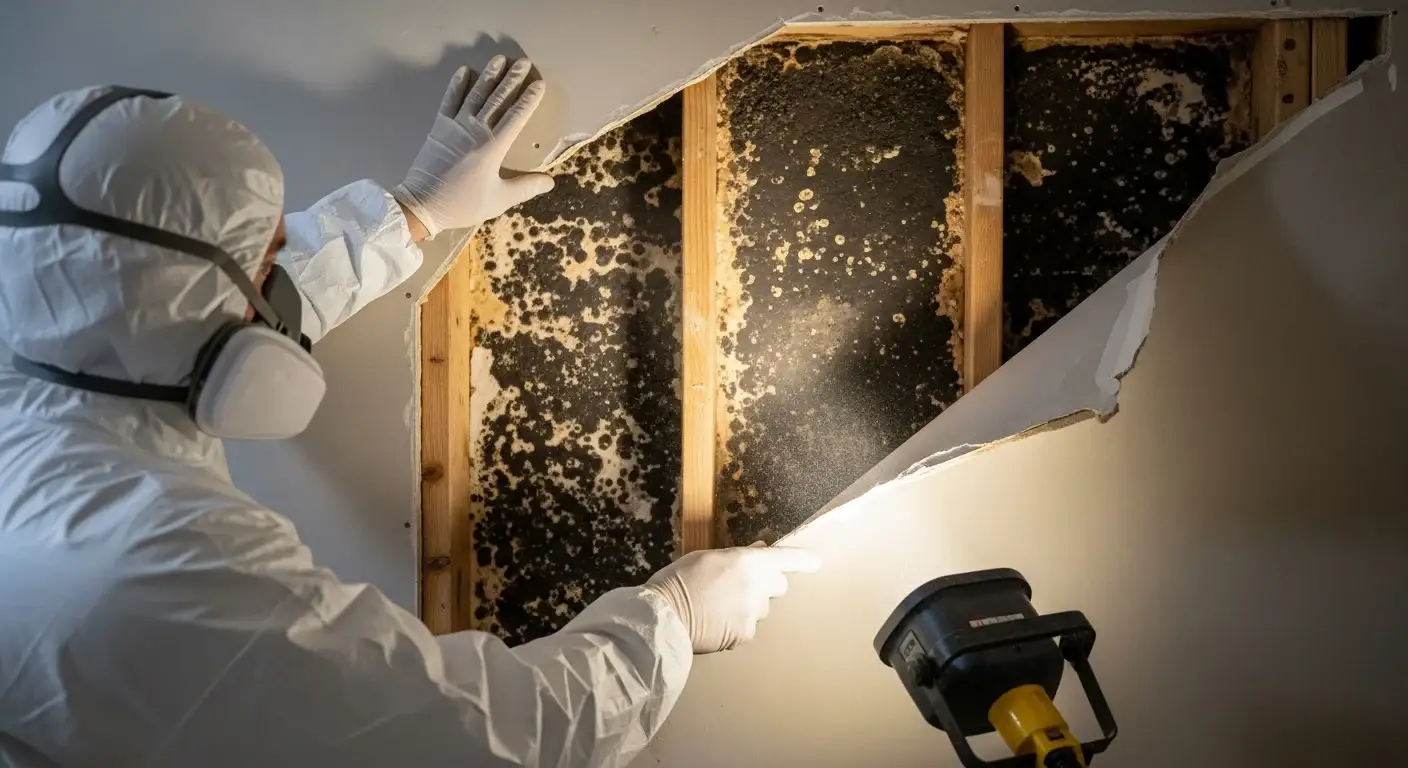
A lot of mold grows where you can't see it:
- Behind drywall and wallpaper
- Inside HVAC ducts and systems
- Under carpeting and padding
- Behind cabinets and furniture
- Inside wall cavities around plumbing
- Beneath flooring materials
Signs of Hidden Mold
You can't see it, but these are the signs it's there:
- Persistent musty or earthy odors
- Visible water stains on walls or ceilings
- Peeling or bubbling paint or wallpaper
- Warped or buckled flooring
- Chronic allergy symptoms that improve when away from home
Health Risks Associated with Mold
How mold affects you depends on three things: how sensitive you are, how much exposure you've had, and which mold it is. For a fuller breakdown of symptoms by mold type, short-term vs. long-term effects, and when a doctor visit is warranted, see our mold exposure symptoms guide.
Common Symptoms of Mold Exposure
Most people get mild symptoms:
- Nasal congestion and runny nose
- Sneezing
- Eye irritation (redness, itching, watering)
- Skin rashes or irritation
- Throat irritation
- Coughing
- Headaches
More Serious Reactions
Some people get hit harder:
- Difficulty breathing or shortness of breath
- Fever
- Chronic fatigue
- Memory problems or difficulty concentrating
- Persistent sinus infections
If you're in a high-risk group (compromised immune system, chronic respiratory condition, severe allergies, or asthma), you're at much higher risk from mold exposure. Don't try to handle anything beyond a small patch yourself, and see a doctor if symptoms develop.
When to Call a Professional
A patch under 10 square feet is usually something you can handle yourself. Bigger than that, or in the situations below, you need a pro. Not sure which side of the line you're on? DIY vs. professional removal →
How Big Is Too Big?
Ten square feet is hard to picture when you're staring at a wall. Here's the same threshold in things you already have around the house, drawn to scale.
- Index card3 × 5 in
Scattered spots and speckles on a hard surface
Wipe it down, fix the humidity, keep an eye on the spot
- Sheet of paper8.5 × 11 in
A single patch
DIY with gloves, an N95, and the windows open
- Door36 × 80 in
A wall section
The upper limit of DIY; get advice before you start
- Larger than a doorover 10 sq ft
Over 10 square feet, or spread across several surfaces
Professional containment, not a spray bottle
Square footage isn't the only trigger, though. The situations below call for a professional at any size.
Call a Professional Immediately If:
- The patch is bigger than 10 square feet. Larger growth needs professional containment, not a spray bottle.
- You think it's black mold. The health risk is too high to gamble on a DIY cleanup.
- It's in your HVAC system. A contaminated system can carry spores or fragments beyond the source area. Don't run it until it has been evaluated.
- There's been sewage backup or contaminated water. That stacks a category of health hazard on top of the mold.
- It keeps coming back after you clean it. Something is still feeding it with moisture.
- Someone in the house has symptoms, especially respiratory ones.
- You can smell it but can't find it. Hidden mold takes professional detection to locate.
When you're not sure, call someone. A professional mold assessment is affordable and it's a lot cheaper than the health or property damage that comes from guessing wrong.
What a Professional Assessment Actually Involves
A certified mold assessor will:
- Conduct a thorough visual inspection
- Use moisture meters to detect hidden water issues
- Collect air and/or surface samples if needed
- Identify the moisture source causing the problem
- Provide a detailed report with remediation recommendations
Choosing the Right Professional
Here's what to look for:
- State licensing (required for mold assessors in many states)
- Current insurance coverage
- Verifiable certifications from recognized organizations like IICRC
- Detailed written assessments, not just verbal opinions
- No conflict of interest. The assessor shouldn't also be doing the remediation (here's why that matters)
For the full process, see our hiring guide, along with questions to ask and scams to avoid.
How to Identify Mold in Your House
Mold identification comes down to three things: what it looks like, where it's growing, and whether it passes a simple test.
Visual clues:
- Fuzzy or slimy texture. Mold is raised from the surface; dirt and stains lie flat.
- Irregular patches. Mold spreads outward from a moisture source in organic, splotchy patterns.
- Color. Green, black, white, brown, orange, or gray. Use the chart above to narrow it down.
- Growth pattern. Mold follows water. If the discoloration is clustered around pipes, windows, HVAC vents, or old water stains, you're probably looking at mold.
The bleach test. Dab a drop of household bleach on the spot. If it lightens within 1–2 minutes, it's mold or mildew. Dirt and mineral deposits won't change color.
The smell test. Mold has a distinctive musty, earthy odor. If a room smells damp even after you've cleaned it, there's probably hidden mold behind a wall, under flooring, or in a ceiling cavity. For a fuller breakdown, including what different molds smell like and the everyday odors people mistake for mold, see what mold smells like.
When you still can't tell. A professional mold assessor has moisture meters, thermal imaging and sampling, and can establish whether there is a moisture problem and how far it reaches. What that will not usually give you is a species: routine spore-trap analysis reports broad fungal groups, and CDC's position is that the type does not need identifying to decide on cleanup. That's when it's time to bring one in anyway, because the moisture question is the one worth answering.
Is There an App That Can Identify Mold?
Yes, more than a dozen of them, and most arrived in the last year or so. Point your phone at a patch and you get back a species name and a confidence score.
Read their own documentation and the picture gets clearer. Mold Scanner AI's methodology page describes what it does as "AI-assisted visual screening," and states plainly that a screening label is not confirmation that mold is present or active, that the tool does not determine species or active growth, and that dirt, shadows, mineral deposits, and water marks can all look alike in a photograph. It tells you to consult a licensed or certified inspector for anything that matters.
That's an honest description, and it points straight at the real limit. The ceiling here isn't the app. It's the photograph.
- The answer isn't in the picture. Aspergillus, Penicillium, and Cladosporium all present as green. Stachybotrys, Cladosporium, and Ulocladium all present as black. A trained assessor standing in the room can't separate those by eye either. A camera has strictly less to work with than the assessor does, and better software can't add information the photo never captured.
- A photo only shows the surface. What's on the drywall is the symptom. The moisture behind it is the problem, and nothing you can photograph will show you that.
The apps say as much in their own disclaimers, which describe results as estimates rather than diagnoses. That's accurate, and it's the part people scroll past.
Before you pay for one, try the same photo in a general AI assistant you already have on your phone. You'll get the same kind of answer: a reasonable read on color and texture, and no way to confirm a species.
So ask a different question. Which tool you use matters far less than what you ask it:
- "What kind of mold is this?" Nothing answers this from a photo. Not the app, not a general AI assistant, not a professional looking at the same image.
- "Is this raised and fuzzy, or is it flat?" Any of them handles that fine, and it's the question that actually decides what you do next.
One boundary to hold onto: use these tools to rule something in, never to rule it out. If a model looks at your wall and says that looks like mold, believe it and deal with it. If it says probably nothing, that isn't an all-clear. It hasn't seen behind the drywall, and it can't tell Stachybotrys from Cladosporium any better than you can.
Are DIY Mold Test Kits Worth It?
Usually not, and the reasons are specific.
The settling-plate kits sold in hardware stores work by leaving a petri dish open in a room and seeing what grows on it. Something almost always grows, because mold spores are in the air of every building on earth. A positive result mostly confirms that you live indoors.
From there the problems stack up:
- No baseline. Without a matched outdoor sample taken at the same time, an indoor spore count has nothing to be compared against, so the number on its own means very little.
- It only grows what's still alive. Dead spores still trigger allergic reactions, and a culture plate won't show them at all.
- No accredited lab, no chain of custody. Results without documented handling from an accredited lab carry little evidentiary weight, which matters if you're building an insurance claim, a landlord dispute, or a disclosure before a sale.
- Sampling stirs it up. Taking your own surface sample means agitating the colony, and a dust mask isn't adequate protection for your eyes, skin, and airways.
The CDC goes further than we would: it doesn't recommend mold testing at all, on the reasoning that you don't need to know the species to know you need to remove it. For most household situations that's right. Testing earns its cost when you need documentation for somebody else: an insurer, a landlord, a buyer, or a doctor.
Next Steps
If you're pretty sure you've got mold, here's the order of operations:
- Document what you see. Photos and measurements of the affected area.
- Find and fix the moisture source. Mold can't survive without water. If you don't fix the leak, nothing else matters.
- Don't disturb it. Poking, wiping, or fanning mold aerosolizes the spores.
- Measure the patch. Under or over 10 square feet?
- Decide your approach. EPA puts a patch under about 10 square feet within homeowner reach in most cases. Consider a professional on either side of that when the material is porous and has stayed wet a long time, the growth is hidden, HVAC is involved, or someone in the house is already reacting.
Find a Verified Mold Professional
Your home and your health are both on the line, so don't hire the first name that shows up. Find a verified mold inspection company in your area. Every listing is identity-checked, with state licenses verified where we hold the state's license records.
📚 This guide is part of our Complete Mold Remediation Guide. Your full resource for understanding, preventing, and removing mold.
Frequently Asked Questions
What does mold look like on walls?
How can you tell the difference between mold and mildew?
Is all black mold toxic?
Can mold be hidden behind walls?
What does mold smell like?
How quickly should you address mold in your home?
What does early stage mold look like?
How can you tell if it's mold or dirt?
Can mold grow on concrete?
What color mold is the most dangerous?
What is the most common mold in a house?
Is there an app that can identify mold from a photo?
Is orange mold dangerous?
What does orange mold look like?
Is pink mold harmful?
Is pink mold as bad as black mold?
What can be mistaken for mold?
What can be mistaken for pink mold?
If what you found needs a pro, you can browse verified mold remediation companies. Every contractor is identity-checked and tier-ranked, with licenses, insurance, and reviews verified where available.
This guide is for educational purposes only. Always consult with certified professionals for specific mold situations in your home. If you experience health symptoms, please consult a healthcare provider.