Mold Inspection Cost: $300–$900+ by Size & Sample Count (2026)
Mold inspection costs $300–$900 with most paying $400–$600. Why $50–$100 more for an independent assessor saves thousands. 6-question script.
A cheap petri-dish kit will grow something. It will not tell you how far the problem extends, where the water is coming from, or what the work should cost, so the money spent on it is usually spent again on a real inspection. That is the most common trap in this category, and the sections below cover the rest of what moves an inspection quote.
A mold inspection is a 1-3 hour assessment that combines visual walkthrough, moisture-meter readings, and 2-4 air-sample collections sent to an AIHA-accredited lab for spore counts. Most homeowners pay $300 to $700; larger homes (over 3,000 sq ft) run $500 to $900+. DIY kits run $10 to $150, with the catch buried in the math. Before you book, the single biggest filter is whether the inspector also offers remediation; the quote will be different by 30% depending on the answer.
If you've already gotten one quote and aren't sure if the lab fees on the invoice are normal, or you're trying to figure out if a $200 inspector and a $700 inspector are doing the same job, the breakdown below is the part most cost guides skip.
In This Guide
- Quick Cost Reference
- Average inspection cost
- What's actually included
- DIY testing, true cost
- The assessor independence rule
- Hidden costs to ask about
- State licensing variance
- When more inspection is worth it
- Quality signals & red flags
- Certifications worth checking
- How long it takes
- How to get accurate quotes
- FAQs
Quick Cost Reference
The grid covers DIY through post-remediation clearance. Most homeowners land at standard inspection plus air samples for $300-$600.
| Inspection Type | Cost Range | Best For |
|---|---|---|
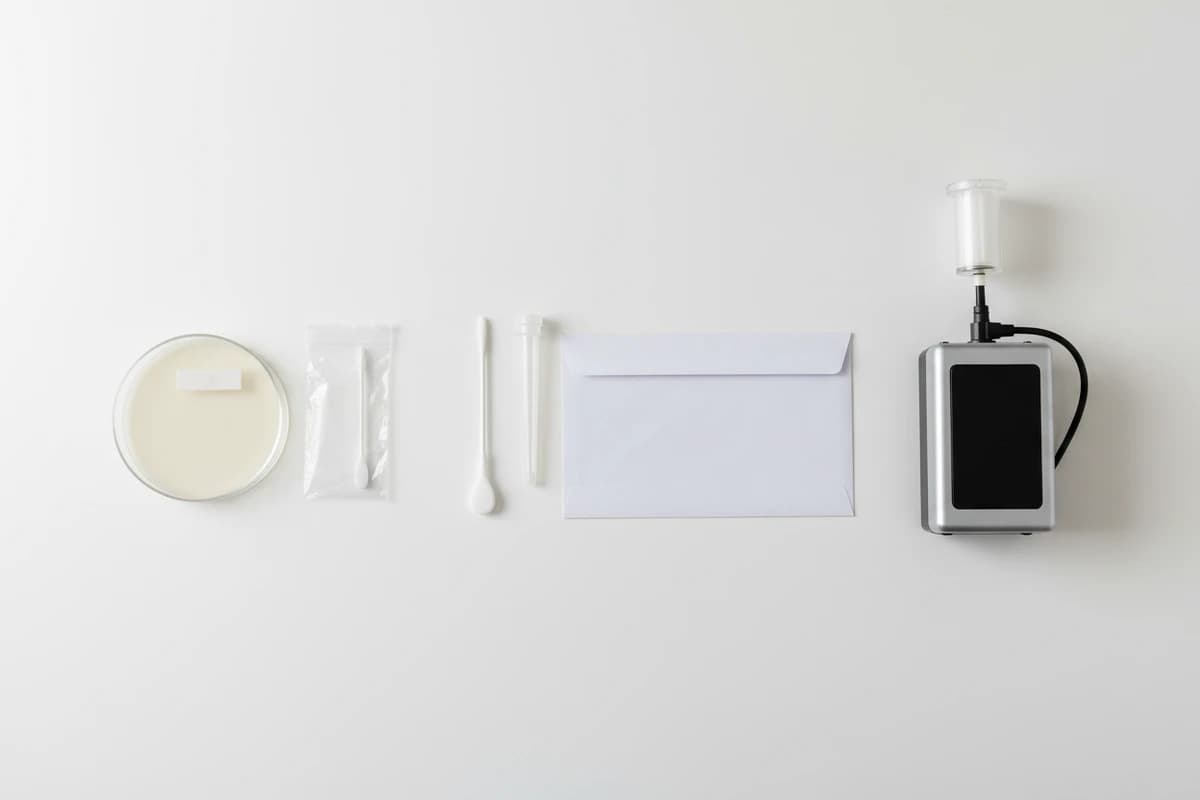
| DIY petri-dish kit | $10-$30 | Basic screening (limited value) |
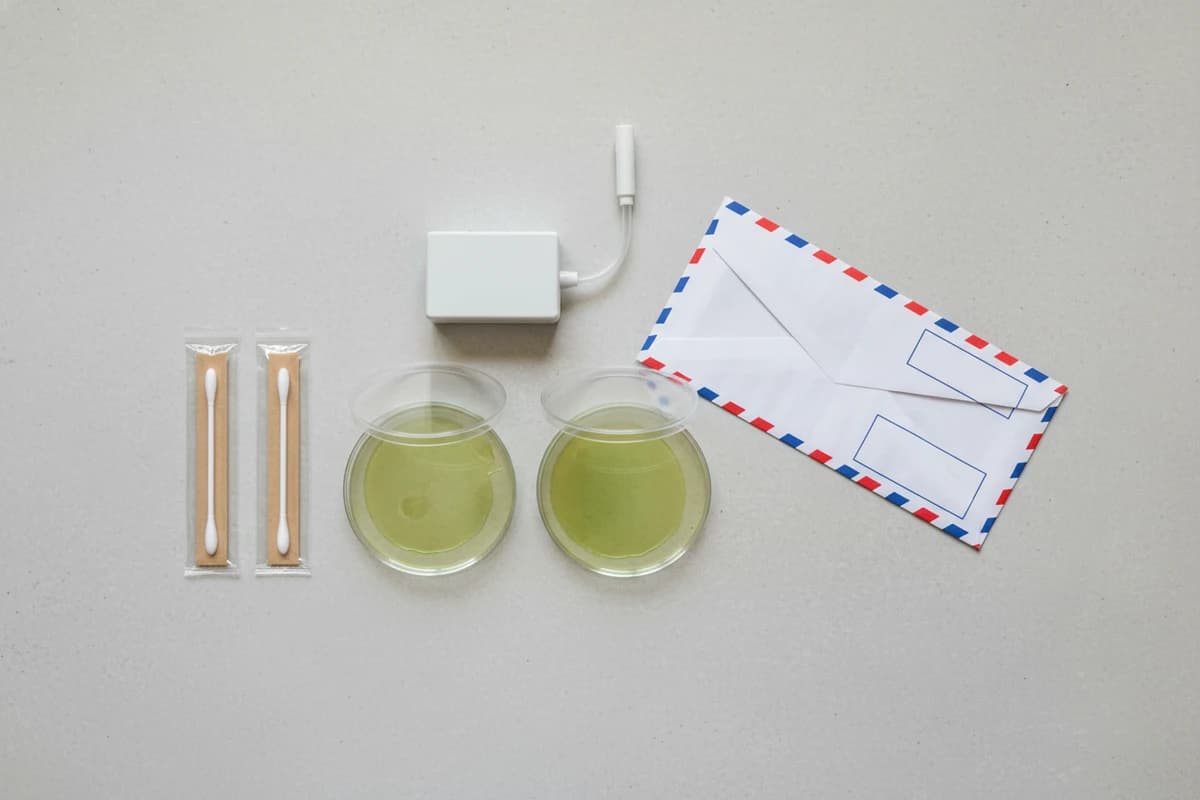
| DIY swab test + lab | $15-$40 | Species ID of visible growth |
| DIY air quality kit | $30-$150 | Spore counts with lab analysis |
| Visual inspection only | $150-$300 | Professional walkthrough, no samples |
| Standard inspection + air samples | $300-$600 | Most homeowners |
| Full-scope inspection | $500-$900 | Larger homes, complex issues |
| Post-remediation clearance | $200-$400 | Verification after remediation |
If you're curious about visual signs before paying anyone, our guide on what mold actually looks like before you call anyone covers the self-check that comes before any of these numbers apply.
How much does a mold inspection cost on average?
A mold inspection costs $300 to $700 for most single-family homes. Most homeowners pay $400 to $600 for a standard inspection that includes a visual walkthrough, moisture readings, and 2-4 air samples with lab analysis. Larger homes over 3,000 sq ft run $500 to $900+. Variation comes from five drivers; size, sample count, geography, urgency, and scope.
Cost by property size
Cost by property size. Property size drives the largest share of inspection-price variation. Under 1,500 sq ft: $300-$450. 1,500-3,000 sq ft: $400-$600. 3,000-5,000 sq ft: $500-$750. Over 5,000 sq ft: $700-$1,000+.
| Home Size | Typical Cost |
|---|---|
| Under 1,500 sq ft | $300-$450 |
| 1,500-3,000 sq ft | $400-$600 |
| 3,000-5,000 sq ft | $500-$750 |
| Over 5,000 sq ft | $700-$1,000+ |
Larger homes usually need one or two extra air samples to cover the additional rooms; the inspector slides the Tramex Moisture Encounter Plus across drywall every 18 inches, so double the wall surface means double the time on the floor.
Cost by number of samples
Cost by number of samples. Each air sample adds $50 to $75 to the base price; surface swabs add $25 to $50; bulk samples add $50 to $100. Most inspections include 2-4 air samples in the base quote. The 2-sample minimum covers one indoor sample plus one outdoor baseline; the 4-sample setup adds an indoor control sample and a second problem-area sample. If the inspector finds visible growth, expect a recommendation for one or two surface swabs on top.
Cost by geographic location
Cost by geographic location. Northeast and West Coast inspections run 15-25% above national average. Midwest runs 5-15% below. Urban areas typically cost more than rural because of operating overhead. A $400 inspection in rural Indiana lands closer to $550 in San Francisco or Boston for the same scope.
Cost by urgency
Cost by urgency. Standard scheduling (3-7 days out) runs the base rate. Priority scheduling (1-2 days) adds a 25-50% premium. Same-day emergency runs 50-100% above base. Real-estate timelines drive most of the rush requests.
Cost by scope
Cost by scope. Single room or area: $150-$250. Whole house: $300-$600. Commercial property: $500-$2,000+ depending on building size. A single-room scope is usually the post-event check after a fixed leak; whole-house is the standard pre-purchase or post-symptom inspection.
What's actually included in a professional mold inspection?
A professional mold inspection includes four work blocks; visual walkthrough, moisture detection, air sampling, and a written report. Total on-site time runs 1-3 hours; total turnaround from booking to written report runs 4-10 business days once lab time is included.
Visual assessment
Visual assessment. A professional visual assessment runs 30-60 minutes of a 1-3 hour inspection at no additional charge beyond the base. The inspector walks every accessible room with a flashlight and moisture meter, photographing visible growth and water-damage history. High-risk areas get extra time; basements, attics, bathrooms, crawl spaces, and around plumbing penetrations are where most contamination shows up first. Old water stains, efflorescence, and soft drywall get flagged as "areas of concern" even when no sample is pulled there.
Moisture detection
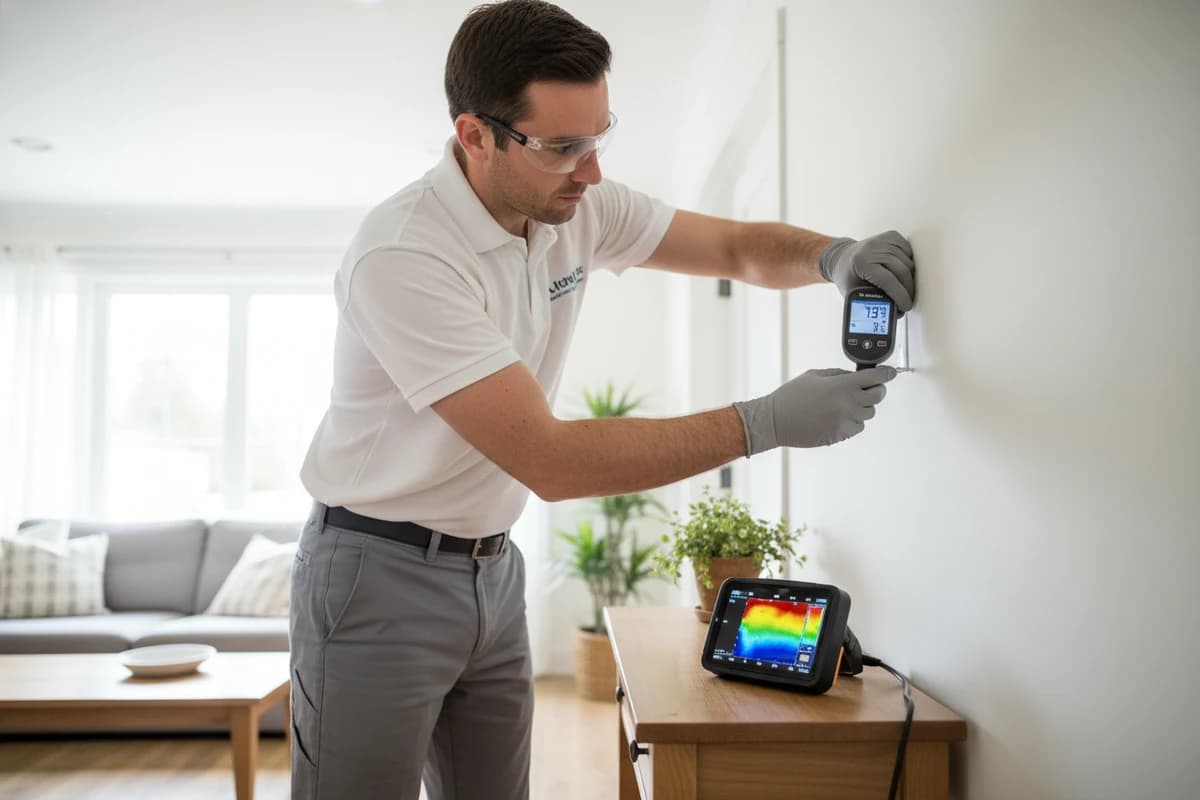
Moisture detection. Moisture meter readings cost nothing extra and run continuously through the visual walkthrough. Thermal imaging adds $50 to $150 in some cases when there's a specific suspected cavity. The Tramex Moisture Encounter Plus the inspector slides across drywall every 18 inches catches water that visual inspection misses; the FLIR thermal camera shows wet insulation as a dark cold patch on the screen, which is a temperature difference rather than a moisture measurement and wants confirming with the meter. Look for actual moisture readings in the report (15.4% in the bathroom wall, 22% behind the dishwasher), not just "elevated moisture detected."
Air sampling (the part that costs the most)
Air sampling. Air sampling costs $50 to $75 per sample, and most inspections include 2-4 samples; one indoor problem area, one indoor control, one outdoor baseline. The Air-O-Cell spore-trap cassette runs at 15 liters per minute for 7-minute draws, then ships overnight to an AIHA-accredited lab like EMSL Analytical for spore counts and species identification. Lab returns counts in spores per cubic meter (sp/m³); when indoor counts run 2-3x the outdoor reading on the same species, that's the data that drives a remediation recommendation. Rush turnaround (24-48 hours) adds $50 to $150 per sample.
Written report
Written report. A quality report runs 8-15 pages and arrives 2-5 business days after sample collection at no extra cost beyond the base inspection fee. It includes annotated photos, moisture readings with reference ranges, lab spore counts, and specific remediation recommendations; not a pass/fail. A two-page report that reads "mold found, remediation recommended" with no spore counts means you paid for a sales document, not an inspection. That's the wedge the next section is built around.
What does DIY mold testing actually cost?
DIY mold testing costs $10 to $150 upfront depending on the kit type. The actual decision-grade cost is higher once you factor in the professional follow-up most homeowners need to interpret unclear results.
Petri dish kits ($10-$30)
Petri dish kits. Petri-dish kits cost $10 to $30 and are the cheapest DIY option. The dish ships with a malt-extract-agar (MEA) settle plate you leave open for an hour, then seal and watch for 3-7 days. Results are essentially meaningless for a remediation decision; every home has spores, the dish almost always grows something, and without a spore count or species ID (which costs $40-$75 extra at a lab), there's no actionable information. Once you pay for lab analysis on top, you're at $50-$105 for less data than a single $50 air sample.
Surface swab tests ($15-$40)
Surface swab tests. Surface swab tests cost $15 to $40 with prepaid lab analysis included and identify mold species on visible growth within 5-7 days. A swab is useful when you have a specific patch (a black-streaked grout line, a fuzzy spot behind the washing machine) and want to confirm the species before deciding on remediation. If the swab confirms Stachybotrys, our how to get rid of black mold guide covers the removal protocol. Where swabs fail is detection; they tell you nothing about hidden contamination behind walls, in ducts, or in the crawl space.
DIY air quality kits ($30-$150)
DIY air quality kits. DIY air quality kits cost $30 to $150 and provide spore counts via lab analysis after you collect the sample yourself. Better than petri dishes because they capture air-column data; however, results depend heavily on collection technique. Most consumer kits use a passive cassette or battery-powered pump that doesn't run at the controlled 15 LPM that professional Air-O-Cell sampling uses for the standardized 7-minute draw, so the spore count arrives without the moisture investigation that drives a real remediation recommendation.
The DIY math nobody tells you
The DIY math nobody tells you. $30 air kit + 5 days waiting + $400 professional follow-up = $430 total spend, plus the delay. Many homeowners pay $100 to $200 across two or three DIY kits trying to triangulate, get unclear results, then hire a professional anyway; the all-in cost doubles versus going pro on the first call. For a deeper breakdown of what testing actually measures versus what kits give you, the testing guide covers each method.
The assessor independence rule (and why it's worth $50-$100 more)
An independent assessor (one who only inspects, not remediates) typically charges $50 to $100 more than an inspector who also offers remediation. That premium is the cheapest insurance you'll buy on the project. The inspector who pulls samples knowing they'll quote the remediation has a different sample-counting protocol than the assessor who hands you the report and walks away. Same data, different incentives.
Why "the inspector also does remediation" is a $4,500 problem
Why the conflict matters. An inspector who finds 50 sq ft of mold and also offers remediation will quote you $4,500 to fix what they found. An independent assessor who finds the same 50 sq ft hands you the report and walks away. Same square footage, two different numbers, because the all-in-one shop is pricing you for the next six weeks of their crew's work, not the inspection. The dual-role inspector also has a financial incentive on sample count; more sampling stations, more rooms flagged, bigger remediation footprint, bigger total ticket. An independent assessor pulling samples for a written report has no downstream incentive to spread the findings.
Which jurisdictions require licensed assessors
Where the rule is law. Five jurisdictions license mold work at all: Florida, Texas, New York, Louisiana and Washington DC. Florida, Texas, New York and Louisiana also separate the two roles by law, each in a different way, which is why an inspection in those states comes from a company that cannot bid the remediation it recommends. Washington DC licenses the work without separating it. In the other 46 states no mold license exists, so separation is our recommendation rather than a legal requirement. The statutes and how each one works are in why the inspector and the remediator should be different companies.
How to verify independence before you book
The 90-second verification call. Three questions before you schedule, and honest answers tell you everything; (1) Do you also offer remediation services or refer to an in-house remediation crew? (2) Will you provide a written report I can take to other contractors for quotes? (3) What's your sample-collection protocol when you find visible mold? The right answers: "No, we only do assessment and refer remediation out"; "Yes, the report is yours to quote any IICRC-certified firm with"; "Outdoor baseline plus indoor control plus problem-area sample within 6 feet of the visible growth." If you get hedging on any of the three, hang up and call the next assessor on your list.
Hidden costs to ask about before you book
The base inspection price you're quoted on the phone often excludes lab fees, travel charges, additional samples if contamination is found, and rush deliverables. These line items can add $100-$400 to a quoted $300 inspection. Four questions before you book catch the surprises.
Lab fees the quote might exclude
Lab fees. Lab fees run $25 to $75 per sample on top of sample collection in some pricing models. A few inspectors quote a low base ($200-$300) then add $200-$400 in lab fees on the invoice; the all-in number lands closer to standard pricing; however, the quoted rate looked great on the phone. Ask: "Is lab analysis included in the quoted price, or charged separately?" Both pricing models are legitimate; what matters is knowing the all-in number before the inspector shows up.
Travel charges past the service radius
Travel charges. Inspectors typically charge $0.50 to $1.00 per mile past 20-30 miles, or a flat fee for distant locations. Most metro inspectors absorb travel within their normal coverage area; surcharges show up when you're rural, on an island, or across a river crossing that adds 30 minutes to the route. Ask: "Do you charge a travel fee to my zip code?" Expect a flat $50-$150 surcharge if the inspector is more than an hour from your house.
Additional samples if contamination is found
Additional samples. If significant contamination is found during the inspection, the inspector may recommend additional samples at $50 to $200 each. Get a clear explanation of why each additional test is necessary; legitimate recommendations specify which finding drove the request ("visible growth on the bathroom ceiling joist requires a separate sample because the bathroom is on a different HVAC zone"). Vague recommendations ("we should sample three more rooms to be safe") are a sign the inspector is upselling rather than diagnosing.
Rush report delivery and printed copies
Rush deliverables. Rush report delivery: $25 to $50. Printed copies: $10 to $25. Detailed remediation protocol document: $100 to $300. Most inspectors include the standard digital report in the base quote and charge for the rest as add-ons. The remediation-protocol document (square footage, removal scope, containment requirements, target post-remediation spore counts) is what you give three remediation bidders so they're all quoting the same job apples-to-apples.
State licensing variance (and Atlanta-specific cost factors)
State mold-licensing rules differ sharply. Five jurisdictions license mold work (Florida, Texas, New York, Louisiana and Washington DC) and the other 46 states issue no mold license at all. Where licensing exists it changes inspection cost by 5-15% on average, because licensed-state inspectors carry higher insurance and certification costs that get passed through.
Jurisdictions that require licensed mold professionals
Mandatory licensing states. Florida, Texas, New York, Louisiana and Washington DC license mold work; all but Washington DC also separate assessment from remediation by law. Maryland does not license mold and is often listed as though it does, including in older versions of this guide. Inspections in these states run 5-15% above the national average for the licensing-cost pass-through; lab fees are roughly the same nationally. In states without licensing, IICRC Firm certification or ACAC certification is the next-best proxy for technical competence.
Why Atlanta-area inspections cost more than national average
Atlanta cost variance. Atlanta inspections run 10-20% above national average due to humidity-driven mold prevalence and consolidated metro labor pricing. The Atlanta market also has a higher density of older homes with finished basements, which adds inspection time per square foot. For a deeper breakdown including basement-specific inspection costs and historic-home considerations, see our Atlanta mold testing cost guide.
When is paying more for inspection worth it?
Paying $600 to $900 for a full-scope inspection (versus $300 to $400 for a standard one) is worth it in three scenarios; real-estate transactions, insurance claims with health symptoms, and large or complex properties.
Real-estate transactions
Pre-purchase inspections. Pre-purchase mold inspections cost $400 to $700 and become the most important $500 you spend on the house. Request the seller's existing mold inspection report (if any) before scheduling your own; if findings differ significantly, you have a real basis for renegotiating the closing price. At closing, post-remediation clearance testing typically costs $200 to $400 and confirms the seller's repairs hold up. Pay at the higher end if you'll be renegotiating: you need a report that holds up to a counter-bid from the seller's contractor, which means more samples, full moisture mapping, and a remediation-protocol document attached.
Insurance claims with health symptoms
Insurance-grade documentation. If household members have respiratory symptoms or visible mold and you're filing an insurance claim, premium pricing is justified. Insurance carriers typically require lab-backed assessments with spore counts, species ID, moisture readings with reference ranges, and the inspector's professional opinion on whether the contamination is consistent with a covered water-loss event versus long-term humidity. Expect to pay $500 to $800 for the level of documentation insurers want; the visual-only $300 inspection won't have any of that.
Larger or complex properties
Properties over 3,000 sq ft. Properties over 3,000 sq ft, multi-story homes, or commercial buildings need more samples and more inspector time. A standard 2-sample inspection in a 4,500 sq ft house misses contamination on the second floor about a third of the time; the 4-sample inspection at the same property catches it for an extra $100-$150 in samples. Cutting corners on a $5,000 contamination scenario to save $200 on inspection is false economy.
When basic inspection is enough
When to keep it simple. Small visible mold patch, post-remediation verification on a contained job, or peace-of-mind check on a property with no symptoms; basic inspection at $300 to $400 covers it. The judgment call is whether you're trying to detect (do I have mold) or confirm (I know what I have, is it gone). Confirmation runs $300 and change; detection on a complex property does not.
What separates a thorough inspection from a superficial one?
A thorough inspection takes 1.5 to 3 hours on site, uses moisture meters and thermal imaging, includes lab-analyzed air samples, asks pointed questions about your water history and health symptoms, and produces an 8-15 page report with annotated photos and reference-range readings. A superficial one is in and out in 30 minutes with a verbal "looks fine" and no lab work.
Time on site (1.5-3 hours)
Time on site. A proper inspection of an average home takes 1.5 to 3 hours at the standard $300-$700 price point. Walkthrough takes 30-60 minutes; moisture readings add 15-30; sample collection adds 15-30 per area. A 30-minute inspection means the inspector is cutting corners; the price drop you're celebrating is the cost of work that didn't happen.
Equipment that should be in the truck
Equipment checklist. A real inspector arrives with moisture meters (both pin and pinless), a thermal imaging camera (FLIR or Seek), calibrated air sampling pumps, and a borescope on a 3-foot semi-rigid wand for wall-cavity inspection. The borescope gets threaded through a 3/8-inch test hole drilled below the baseboard. If the only tool they're carrying is a clipboard, the inspection is the visual walkthrough only.
Questions a good inspector asks YOU
Questions you should hear. Good inspectors want to know your water history (any recent leaks, flooding, summer humidity issues), health symptoms in the household (respiratory issues, headaches, allergies that flared after moving in), your areas of concern, and your HVAC system age and last maintenance date. The interview takes 10-15 minutes before they pull a single sample. The inspector who skips the interview is sampling on instinct rather than data.
Report quality (8-15 pages, annotated)
Report quality. A quality report runs 8-15 pages and includes clear photos with annotations, actual moisture readings (specific percentages with reference ranges, not just "elevated"), lab results with normal-range comparisons, and specific actionable recommendations rather than a vague pass/fail.
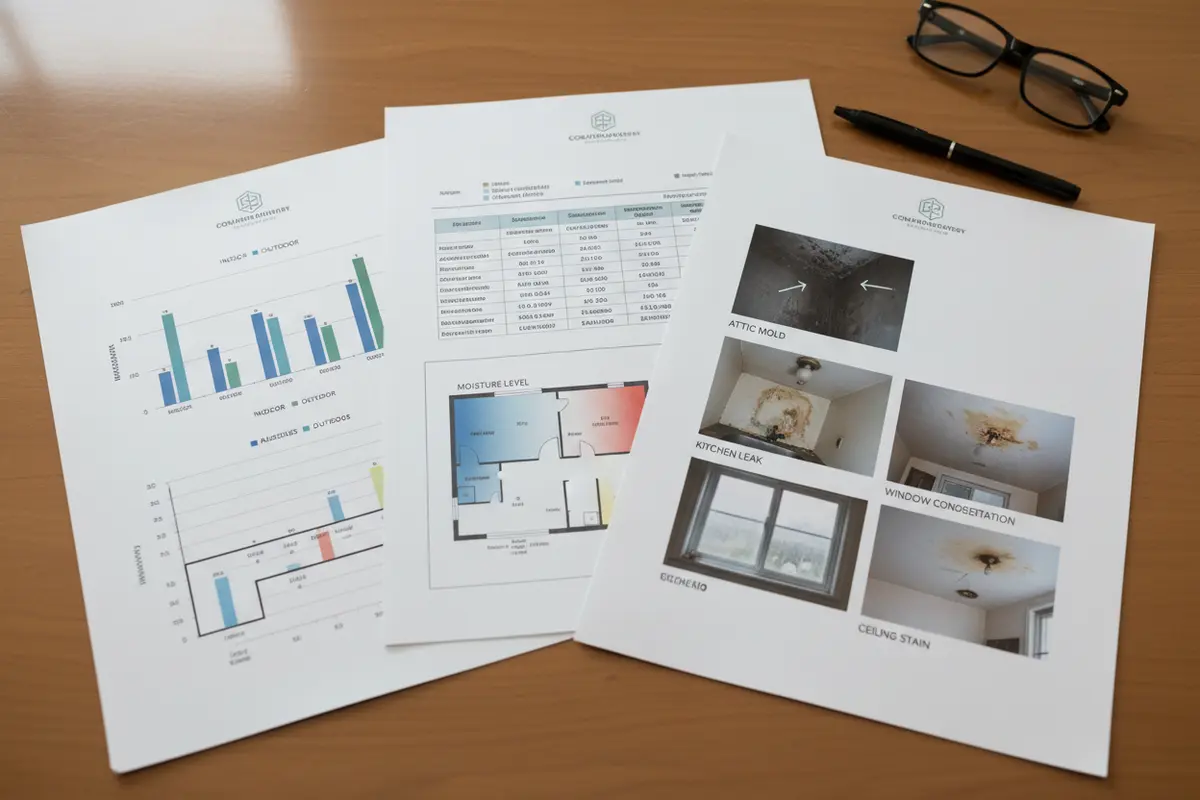
A two-page report that reads "mold detected, remediation recommended" gives you no way to verify the finding, no way to bid remediation accurately, and no documentation that holds up for an insurance claim. That's a $400 receipt for nothing useful.
Five red flags that mean walk away
Five red flags. Walk away if the inspector also offers remediation services, declines to send samples to a lab, prices a full inspection under $200, refuses to provide a written report, or pressures you to decide on remediation before the report is even compiled. The under-$200 price tag is the trickiest because it sounds like a bargain; the math doesn't work, lab fees alone on a 2-sample setup run $50-$150, and the bait price gets you in the door for the upsell.
Is certification worth paying more?
State licensing (where required) and IICRC Firm certification are worth paying more for; voluntary individual certifications add 5-15% to the inspection price for the credentialing pass-through. The certifications most worth checking are state license, ACAC, IICRC, and CMI.
State licensing (where required)
State licensing. Florida, Texas, New York, Louisiana and Washington DC require mold professionals to be licensed at the state level; no other state does. Licensing typically requires training hours, a competency exam, and proof of insurance; where a state licenses mold work you can verify status through its database for free (Florida DBPR and Texas TDLR portals return status in 30 seconds). A state license is a meaningful filter because the state actively suspends licenses for misconduct, and a lapsed license in a mandatory-licensing state voids the inspector's insurance.
Industry certifications worth checking
Industry certifications. Three certifying bodies are worth checking. ACAC (American Council for Accredited Certification) issues the CMI, the Council-certified Microbial Investigator, which requires a rigorous examination plus two or more years of verified field experience; ACAC states its CMI and CMC are accredited by the Council for Engineering and Scientific Specialty Boards (CESB), and its tiers are set by verified experience rather than by coursework alone. NORMI issues its own assessor credential, the CMA (Certified Mold Assessor), on a separate program. IICRC certifications focus more on remediation than assessment; however, an IICRC Firm designation on the inspection company is useful as a baseline credibility check.
What certification doesn't guarantee
Certification limits. Certification doesn't guarantee years of experience, quality of work, or fair pricing. A newly certified inspector with six months of fieldwork has the same credential on the wall as a 20-year veteran. Pair the certification check with a review check; state licensing plus 4.5+ stars across 20+ Google reviews is a meaningfully different signal than the credential alone.
How long does a mold inspection take?
A mold inspection takes 1-3 hours on site and 4-10 business days from booking to final written report. The on-site visit is the fast part; lab analysis is what stretches the timeline.
On-site work (1-3 hours)
On-site work. On-site work runs 1-3 hours including visual walkthrough (30-60 minutes), moisture readings (15-30 minutes), air-sample collection at 7-minute draws per sample (15-30 minutes), and a wrap-up walkthrough with the homeowner (15-30 minutes). Larger homes push toward the 3-hour end; the moisture-meter sweep alone takes longer when there's more wall surface to cover.
Lab analysis (2-5 business days)
Lab analysis. Lab analysis runs 2-5 business days for standard turnaround at AIHA-accredited labs like EMSL Analytical. Rush turnaround at 24-48 hours adds $50 to $150 per sample. The lab returns spore counts in spores per cubic meter (sp/m³) along with species identification; that's 2 business days minimum for any sample, regardless of how much you want to pay.
Total inspection-to-report timeline (4-10 business days)
Total timeline. Total inspection-to-report timeline runs 4-10 business days at standard pricing. Schedule with this in mind for real-estate closings, insurance claims, or health concerns where the report needs to be in hand by a specific date. If you have a hard deadline, ask for the rush option upfront and budget the additional $50-$150 per sample.
How to get accurate quotes from inspectors
Comparing mold-inspection quotes apples-to-apples requires telling each inspector the same property details and asking the same six questions. The right script gets you back three quotes you can actually rank rather than three numbers with three different scopes.
What to tell the inspector when calling for a quote
Information to provide. Tell each inspector the same four things; property type and approximate square footage, reason for inspection (visible mold, smell, real-estate purchase, post-symptom check), specific areas of concern, and your timeline. Variation in what you describe is the most common source of variation in the quotes that come back; standardize the input to standardize the comparison.
The 6 questions to ask before booking
Six questions. Six questions before you schedule, and the answers tell you everything; (1) What's included in the quoted price? (2) How many samples are included in the base? (3) Is lab analysis included or charged separately? (4) How long is the inspection and when can I expect the report? (5) Are you licensed and insured? (Ask for proof.) (6) Do you also perform remediation? (Prefer "no.") Question 6 is the wedge question; if you only ask one of these, ask that one.
Once you have the inspection in hand and remediation is on the table, our mold remediation cost guide covers what remediation costs after the inspection, including how the lab data on your report translates to a contractor's quote. To find a vetted inspector in your area, browse verified mold inspection companies; every pro listed is identity-checked before going live, with state licenses verified where the state licenses mold work.
Frequently Asked Questions
Frequently Asked Questions
How much does a professional mold inspection cost?
Is a mold inspection worth the cost?
How much do DIY mold test kits cost?
What is included in a professional mold inspection?
Should mold inspectors also do remediation?
How long does a mold inspection take?
Is a home mold inspection different from a home inspection?
Does insurance cover mold inspection cost?
Who pays for mold inspection in a real estate transaction?
How much does it cost for a professional to test for mold?
What is the average cost of mold testing?
How much does a mold inspection cost in Florida, Texas, or California?
Need a professional? You can browse verified mold remediation companies. Every contractor is identity-checked before going live, with licenses and insurance verified where available.
This guide is part of our Complete Mold Remediation Guide; your full resource for understanding, preventing, and remediating mold.
This guide is for educational purposes only. Prices reflect national averages and may vary by location, market conditions, and specific property requirements. Always obtain multiple quotes for accurate local pricing.