How to Get Rid of Mold: The Step-by-Step Protocol (2026)
Step-by-step mold protocol: find the moisture source first, then DIY for under 10 sq ft on hard surfaces, then call a pro. Cost $500 to $30,000+.
You found mold. Most homeowners' first move is to spray something on it. The right first move is to find the leak.
Mold without water dies in 24 to 72 hours. Mold with water comes back within a week of any cleaner you spray on it. The cleaning protocols below work only after the moisture source is fixed; if you skip that step, you're going to do this twice.
Below: a 6-step protocol that starts with the moisture audit, then the visual ID, then the DIY-vs-pro decision threshold, then the actual cleaning protocol with surface-specific instructions, then when to stop and call a remediator, then how to keep it from coming back. Most household mold under 10 square feet on hard surfaces is a homeowner job per the EPA. Anything bigger, anything porous, anything in your HVAC, or anything Stachybotrys is a professional job.
Drew Fuller, who reviews this guide, runs Restoration 365, an IICRC-certified remediation firm in Willow Grove, PA. Per the IICRC S520 standard he works to, bleach doesn't penetrate porous materials like drywall, wood, and grout; the chlorine evaporates and only the water remains, which can feed the mold roots beneath the surface. He has watched homeowners spray three bottles of bleach on a wall over a month and watch the mold come back darker every time, because the leak inside the wall was still active. Step 1 of getting rid of mold isn't a cleaner. It's a moisture meter.
In This Guide
- Step 1: Find and fix the moisture source (the audit before any cleaning)
- Step 2: Identify what you're dealing with (visual ID + species)
- Step 3: Decide DIY vs professional (the EPA threshold + 5 other call-a-pro triggers)
- Step 4: The DIY protocol (under 10 square feet on hard surfaces)
- Step 5: When to call a professional
- Step 6: Prevent return (humidity control + monitoring)
- Where mold hides, room by room
- Health risks
- Cost ranges
Step 1: Find and fix the moisture source
Mold is a moisture problem. Cleaning the visible growth without finding the water source is what makes mold come back. Per the EPA's "A Brief Guide to Mold, Moisture, and Your Home," fixing the underlying moisture problem is the first published action in the official guidance, ahead of any cleaning step.
The 24 to 72 hour rule
Mold spores are everywhere; they're in your house right now. They only colonize when they find moisture and stay wet for 24 to 72 hours. Dry the surface within that window and the spores die. Leave it wet past 72 hours and you have a problem. This is why prompt water-damage cleanup is the single most useful action a homeowner can take after a leak, flood, or burst pipe.
Common moisture sources by location
The visible mold tells you where to look. The actual leak is usually behind the wall, above the ceiling, or under the floor. Ceiling growth points upward almost every time, so the cause behind mold on a ceiling is where to start before you clean anything.
Bathrooms. Exhaust fan that vents into the attic instead of through the roof. Caulk failure around the tub or shower. Toilet flange leak weeping into the subfloor. If the growth sits on the ceiling itself, mold on the bathroom ceiling has its own diagnosis path; read the pattern before you clean.
Bedrooms on exterior walls. Window condensation pooling on the sill. Insufficient insulation creating cold spots where humid air condenses behind drywall. HVAC supply-air register dripping from cold-line condensation.
Basements. Foundation crack water intrusion. Dryer vent disconnected inside the wall cavity. Sump pump that's failing intermittently. Cold-line condensation off uninsulated copper plumbing.
Kitchens. Dishwasher supply line slow leak. Refrigerator water line leak behind the appliance. Garbage disposal seal failure under the sink.
Attics. Roof leak after a hailstorm; ridge-vent failure; bathroom exhaust fan venting into attic insulation; ice dam damage from last winter.
Crawl spaces. Ground-vapor migration through unsealed earth; failing vapor barrier; HVAC duct condensation; foundation seepage.
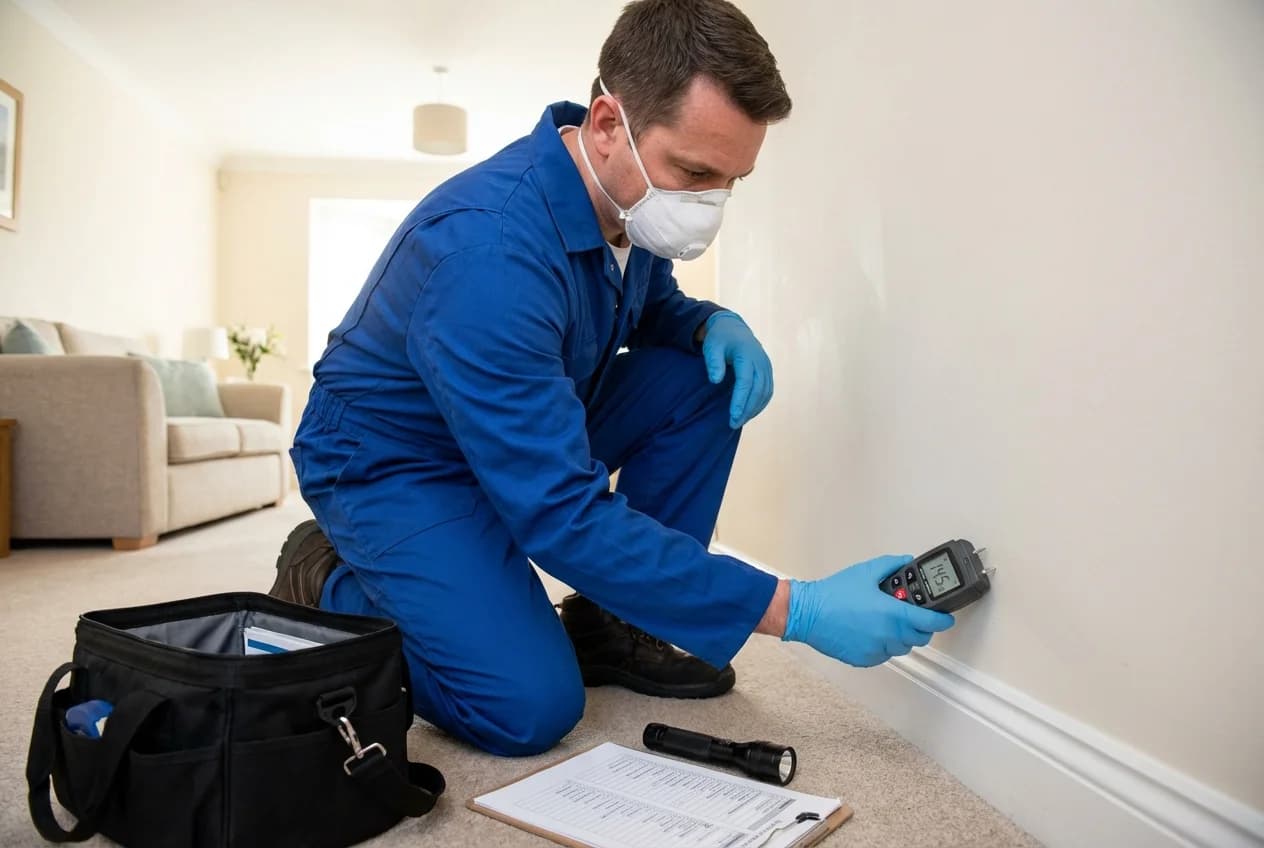
The moisture-meter check
Before you clean anything, confirm the surface is actually dry. The Tramex Moisture Encounter Plus is the pin-less meter remediators use across drywall every 18 inches; reading above 17% on drywall is wet. A Lowe's pin-style meter at $30 will tell you whether the spot is wet behind the surface; reading above 20% is wet.
A hygrometer reads ambient humidity in the room. The EPA's recommended target is RH 30 to 50%. Anything above 60% supports mold growth across the whole space, not just the visible spot. If your hygrometer shows 65 to 70% RH for weeks at a time, you have a building-wide moisture problem, not a wall-spot problem.
If the moisture meter reads dry and the hygrometer reads under 50%, the moisture source is fixed. Now you can clean.
If either reads wet, fix the source first. The cleaning is wasted effort until then.
Do you also need to test the air?
Moisture metering tells you whether the wall is wet. Spore-trap air sampling tells you what species and concentration are floating in the room. They're different tests with different jobs. Most homeowners with visible mold don't need air testing first; per CDC guidance, if you can see mold, the action is removal, not confirmation. Air sampling becomes useful when symptoms point at mold but visible growth is hidden, or when a real estate transaction or insurance claim requires documentation. What testing actually measures and what professional assessment costs cover the testing-side decision in detail.
Step 2: Identify what you're dealing with
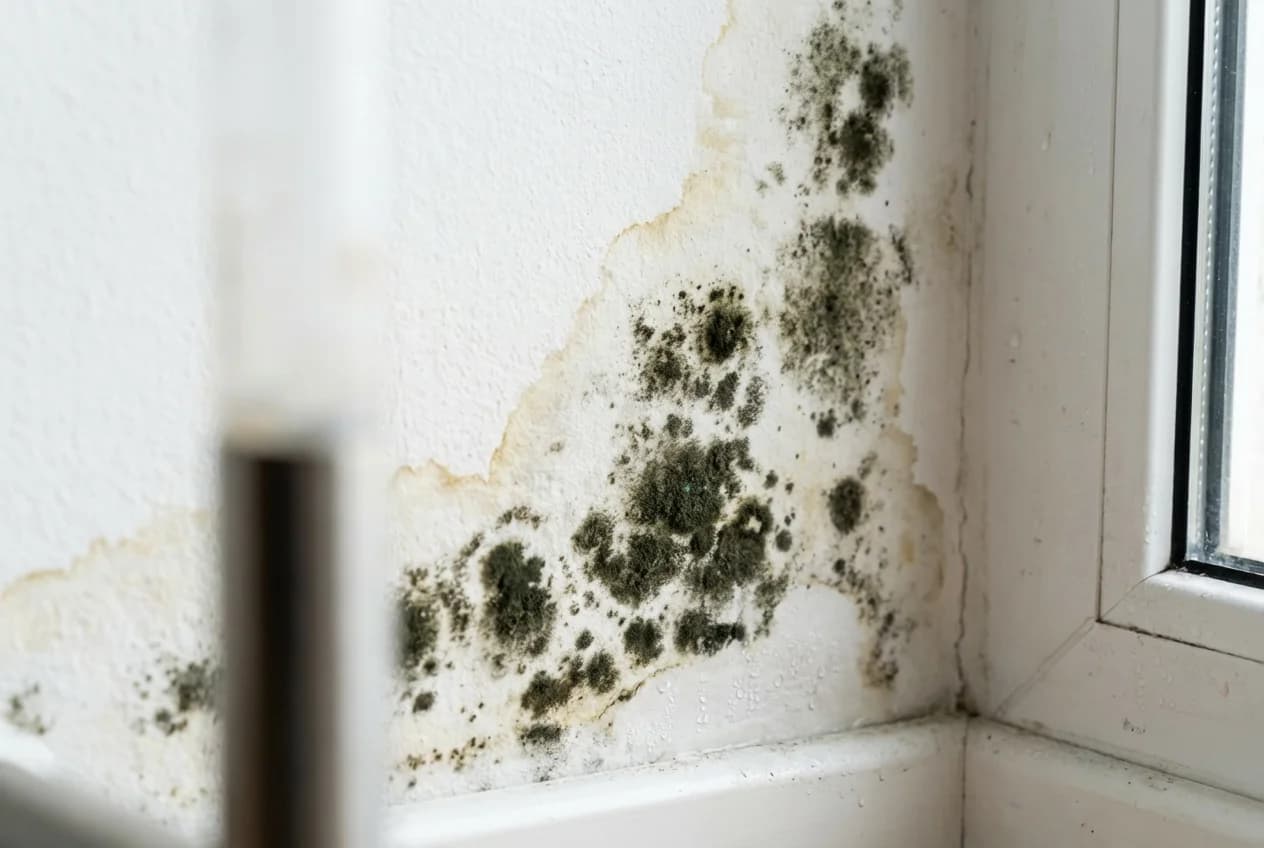
Different molds need different protocols. Most household mold is ordinary species you can clean yourself; a few are serious enough that you should stop, contain, and call a professional. Visual identification gets you 80% of the way; lab analysis on a surface swab gets you the rest.
The most common indoor species:
Stachybotrys chartarum (black mold). Dark green-black, often slimy, almost always paired with chronic water damage on drywall, ceiling tile, or paper-faced insulation. Produces mycotoxins per CDC's mold facts page. Don't disturb without containment.
Aspergillus. Common indoor mold; shows up on HVAC supply ducts, attic spaces with poor ventilation, and basement walls with chronic minor moisture. Can be black, green, white, or yellow depending on species.
Cladosporium. Olive-green to brown; common on window sills, in bathrooms, and inside HVAC condensate pans. One of the few molds that grows in cooler temperatures.
Penicillium. Blue-green velvety surface; common on water-damaged paper, wallpaper, and insulation behind walls.
Alternaria. Dark green to black, fast-growing, common under sinks and around windows that condensate every winter morning.
What mold actually looks like has the full visual identification guide with species photos.
If you see dark, slimy mold near chronic water damage, treat it as Stachybotrys until lab results say otherwise. Don't disturb it. The black mold protocol below applies.
Step 3: Decide DIY vs professional
The EPA's "A Brief Guide to Mold, Moisture, and Your Home" gives one clean threshold: mold covering less than 10 square feet (a 3-foot-by-3-foot area) on hard surfaces can typically be cleaned by a homeowner with appropriate PPE. Anything beyond that requires professional remediation with containment, HEPA filtration, and trained protocols.
When DIY is appropriate
- Visible patches under 10 square feet
- Hard, non-porous surfaces (tile, glass, metal, sealed concrete)
- Bathroom surface mold from condensation, with a working exhaust fan
- No one in the household with asthma, mold allergy, immune compromise, or active respiratory symptoms
- The moisture source is identified and fixed
When to call a professional
- Mold covers more than 10 square feet
- Suspected Stachybotrys (black, slimy, paired with water damage)
- Mold inside the HVAC system or ducts
- Mold behind drywall, behind cabinets, or under flooring
- Sewage backup or contaminated-water source
- Mold keeps returning after DIY cleaning
- Anyone in the household has health symptoms that improve away from home and return when they're back
- A real-estate transaction or insurance claim that requires documentation
The DIY-vs-professional decision threshold walks through each trigger in detail.
Step 4: The DIY protocol (under 10 square feet)
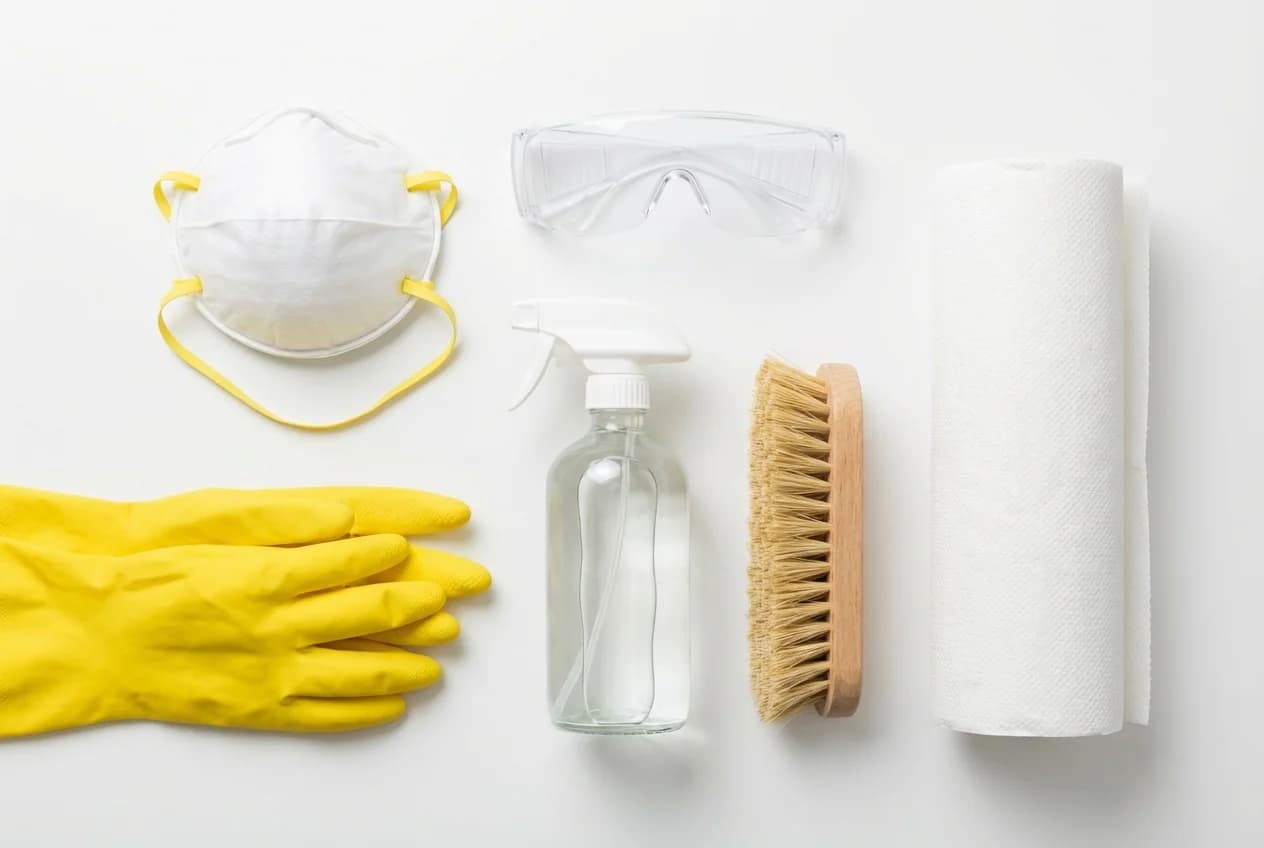
This is the EPA-supported homeowner scope. Anything bigger, anything porous past surface depth, anything Stachybotrys, and anything in your HVAC is a professional job that requires containment and HEPA filtration the homeowner doesn't have.
Walls and drywall
Wall mold on hard, non-porous paint is a homeowner job. Wall mold on bare drywall or behind wallpaper is usually a professional job because the porous substrate retains spores below the visible surface. Reading the growth pattern first, the scrub-or-cut decision on drywall, and the wall-specific cleanup steps all live in the full mold on walls guide.
How to get rid of mold in the shower
Shower mold on tile, grout, glass, and caulk is the most common DIY job in this guide. The protocol differs by surface.
Tile and glass: spray with 3% hydrogen peroxide; let sit 10 minutes; scrub with a tile brush; rinse; air dry. Run the bathroom exhaust fan for 30 minutes.
Grout (porous): the chlorine in bleach evaporates before penetrating the grout matrix; the mold roots survive at depth. Use a 1-to-1 hydrogen peroxide solution; scrub with a stiff toothbrush along grout lines; rinse; let dry. For stubborn grout mold, a paste of baking soda and 3% hydrogen peroxide left for 30 minutes lifts the staining and the spore mat together.
Caulk: if the caulk is more than 50% colonized, it won't clean back to white. Cut it out, clean the substrate with peroxide, let dry, and re-caulk with mildew-resistant silicone. Trying to "save" failed caulk wastes hours.
Most important: confirm the bathroom exhaust fan is venting through the roof, not into the attic. Attic-vented fans pump humid air into the insulation, where it condenses on cold roof sheathing and grows the next mold colony directly above your bedroom ceiling.
How to get rid of mold in the bathroom
Bathroom mold beyond the shower is usually a humidity problem, not a cleaning problem. The fix is structural, not chemical.
The diagnostic: does your bathroom exhaust fan run during showers? Does it run for 20 minutes after? Does the fan actually move air, or is the motor spinning without pulling? Tape a tissue to the cover while it runs; if the tissue doesn't stick, the fan is dead and humidity is staying in the room every shower.
The cleaning protocol is the same as the shower: 3% hydrogen peroxide on tile, glass, and caulk; specific protocols above for grout and failed caulk.
The structural fix: replace dead exhaust fans (a $30 to $80 part, an afternoon's work). Add a humidistat-controlled fan if anyone in the household takes long hot showers; the humidistat runs the fan automatically when RH crosses 60%. Confirm the fan vents through the roof.
Bathroom mold prevention and cleaning goes deeper on the bathroom-specific moisture audit.
How to remove black mold
The protocol for suspected Stachybotrys differs from the protocols above because mycotoxin disturbance produces airborne particles that PPE has to actually defend against.
The disturbance threshold: if you see dark, slimy mold paired with chronic water damage in an area larger than 10 square feet, OR you see it inside drywall, ceiling tile, or HVAC, stop. Call a professional. Don't spray, don't scrub, don't wipe; disturbance aerosolizes spores and mycotoxins into the breathing zone.
For suspected Stachybotrys under 10 square feet on a hard, non-porous surface:
Stop and verify the surface before continuing. Most Stachybotrys grows on porous water-damaged drywall, ceiling tile, or paper-faced insulation; if your surface is any of those, the protocol below does not apply and disturbance is actively dangerous. The 6-step procedure is only for the rare case where Stachybotrys appears on tile, glass, sealed concrete, or another hard non-porous surface that won't aerosolize spores when disturbed. If you're not sure which surface you have, stop and follow our how to get rid of black mold guide instead. Per CDC guidance, mycotoxin-bearing mold disturbance is a medical-PPE situation, not a household-cleaner situation.
- Full-face P100 respirator (not N95; N95 doesn't filter mycotoxin-bearing fragments)
- Tyvek protective suit and nitrile gloves
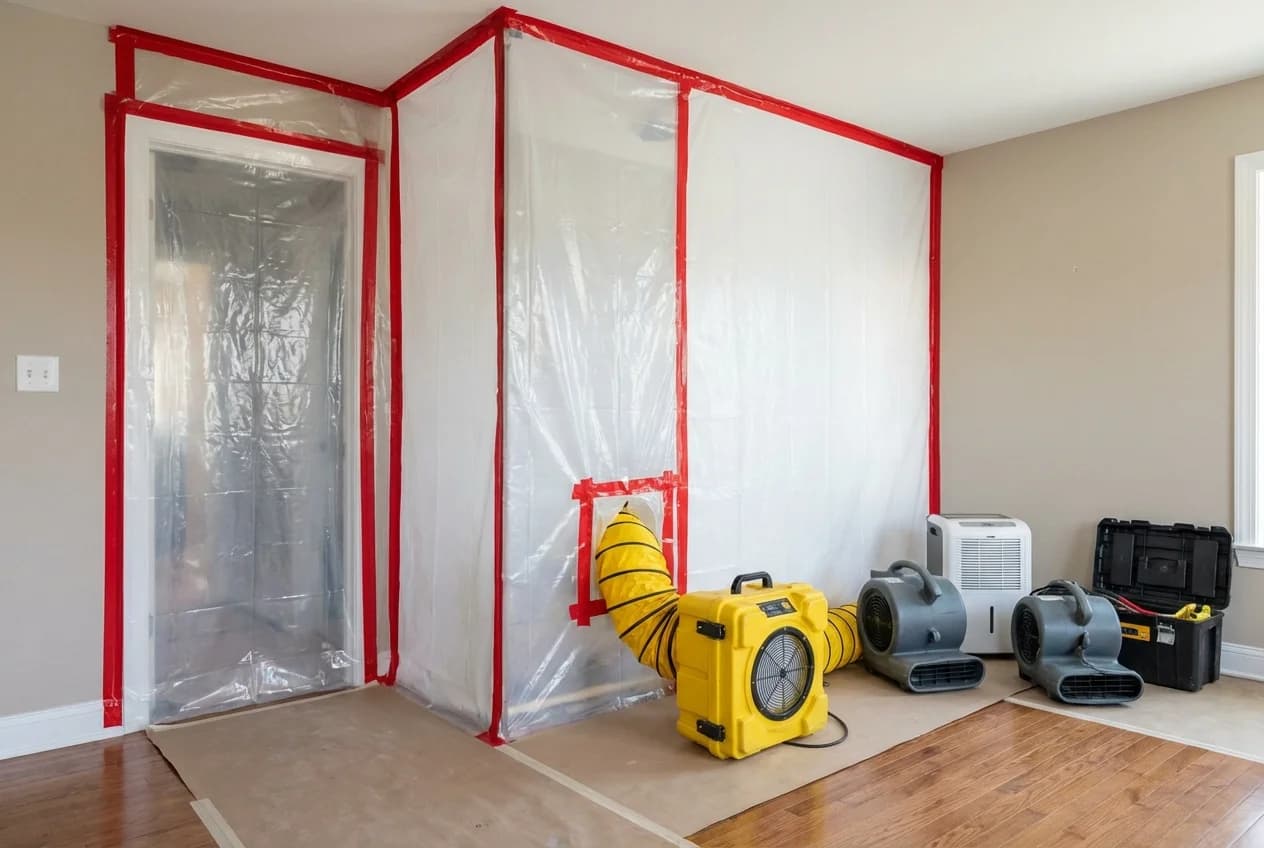
- Tape 6-mil polyethylene with red builder's tape across the doorway and HVAC return
- Wet the surface with the peroxide solution before any scrubbing (wet disturbance reduces aerosolization)
- Bag waste in 6-mil contractor bags; double-bag; tape sealed
- After cleaning, run a HEPA air scrubber for 24 hours
If any of those steps sound beyond what you want to do alone, that's the signal to switch to our how to get rid of black mold guide, or stop and call a certified remediator instead of doing this yourself.
What to use: hydrogen peroxide vs vinegar vs bleach
The bleach myth is everywhere on the internet. The IICRC S520 standard explicitly says bleach doesn't penetrate porous materials. Per CDC guidance, "the use of biocides such as chlorine bleach is not generally recommended as a routine practice during mold cleanup." Here's the surface-by-surface map:
| Surface | What works | Notes |
|---|---|---|
| Tile, glass, sealed concrete (non-porous) | Bleach OR 3% hydrogen peroxide OR vinegar | Bleach is fine here; the surface doesn't absorb |
| Painted drywall (sealed) | 3% hydrogen peroxide (1:1 with water) | Don't bleach; the chlorine doesn't kill mold under the paint film |
| Bare drywall, wood, grout, caulk (porous) | Hydrogen peroxide; replace if heavily colonized | Bleach evaporates; only the water penetrates; feeds the roots |
| Fabric, paper, insulation | Don't try; remove and replace | Porous; spores survive at depth |
Vinegar vs bleach for porous surfaces goes deeper on white-distilled vinegar specifically; 5% acetic acid kills approximately 82% of mold species per published research, effective on grout but ineffective on heavily colonized drywall.
PPE and ventilation
Per NIOSH guidance for mold cleanup, the PPE floor is N95 minimum for routine cleaning, P100 for active disturbance of suspected Stachybotrys. Goggles (sealed, not safety glasses); nitrile gloves; long sleeves and pants. Run a window fan exhausting outward to depressurize the work area while you clean; close the HVAC supply to the room you're working in.
After cleaning, let the area air-dry for 24 hours before re-occupying. Wash work clothes separately from household laundry.
Step 5: When to call a professional
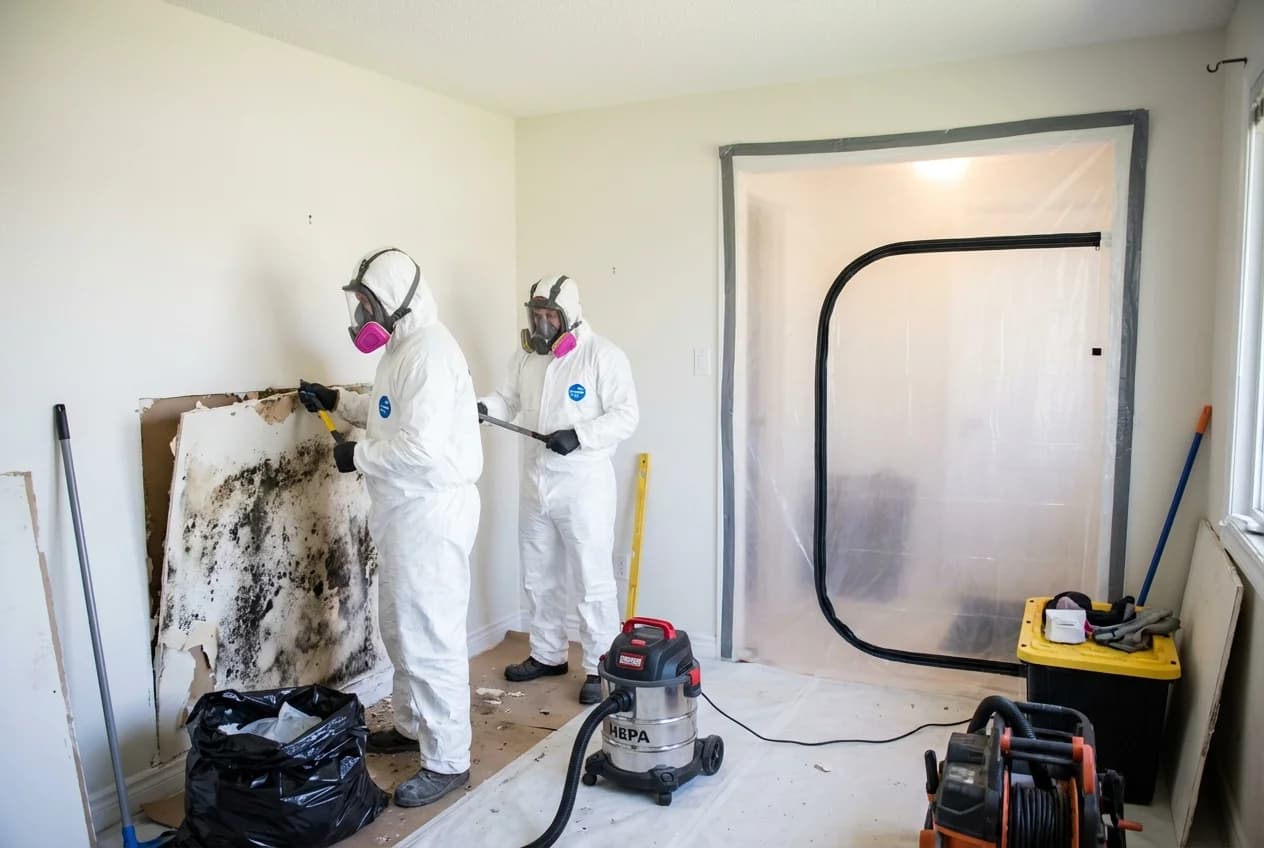
The EPA's 10-square-foot threshold is the published threshold. There are also five other triggers that flip the answer to "call a pro" regardless of size.
HVAC mold. Mold inside ducts, on the air handler, or in the condensate pan spreads spores throughout the entire home every cycle. This is professional-territory per CDC guidance; ducts require specialized cleaning that homeowners can't replicate.
Sewage or contaminated water. Per IICRC S500 standard, Category 3 water (sewage, flood, groundwater intrusion) carries pathogens beyond mold. Always professional.
Recurrence. If you've cleaned a spot more than once and it keeps coming back, the moisture source isn't fixed. Call a licensed mold assessor before you clean again; they'll find the leak. The inspector and the remediator should be different companies; the assessor who finds the mold shouldn't be the same firm that profits from removing it.
Health symptoms. If anyone in the household has unexplained respiratory symptoms that improve when away from home, the air-quality risk during disturbance is real. Professional containment with HEPA filtration protects the whole household; DIY disturbance doesn't.
Structural damage. Mold paired with rotted wood, soft drywall, or warped flooring is past cleaning territory. Materials need replacement; that requires demolition and licensed remediation.
Professional remediation pricing covers the ranges by project size and state. Most professional remediation runs $1,500 to $5,000 for a medium project; whole-house can hit $10,000 to $30,000.
Step 6: Prevent return
The single most useful thing you can do to keep mold from coming back is keep ambient humidity at 30 to 50% RH year-round per the EPA's recommended target. Everything else is downstream of humidity.
Humidity monitoring. A $15 hygrometer in the most-affected room. Check it weekly. If RH drifts above 60% for more than a few hours, find out why before you re-clean anything.
Dehumidifier sizing. A 50-pint dehumidifier handles up to 1,500 square feet of moderately damp space. Florida and Gulf Coast homeowners often need 70-pint or 90-pint units running 22 hours a day in summer; that's the tropical-load baseline.
Bathroom exhaust. Run the fan during every shower and 20 minutes after. Replace the fan if it's not actually moving air. Vent through the roof, never into the attic.
HVAC service. Annual service includes condensate-pan cleaning and coil inspection. The half-inch of standing water in the pan most homeowners have never opened up to see is a year-round Cladosporium colony.
Foundation and roof. Annual gutter cleaning; storm-damage roof inspection; foundation crack monitoring. Water intrusion at the building envelope is the source of most basement and attic mold.
Humidity control to prevent return has the full prevention checklist by season and climate.
Where mold hides, room by room
Different rooms face different risks. The bathroom-vs-basement-vs-attic-vs-crawl-space breakdown matters because the moisture source and the cleaning protocol both differ.
Bathrooms
Daily humidity spikes plus organic material plus warm temperatures equals mold-friendly conditions. The cleaning protocol is in Step 4 above; the structural fix is the exhaust fan and venting. The full bathroom moisture audit covers bathroom-specific moisture sources room by room.
Basements
Below-grade walls condensate against humid summer air; foundation cracks weep groundwater; sump pumps fail intermittently. Basement mold often spreads behind paneling and inside finished walls before the homeowner sees a visible patch. Basement mold causes and solutions covers the full basement audit.
Attics
Roof leaks; ridge-vent failure; bathroom exhaust fans venting into the insulation; ice dam damage. Most homeowners visit their attic once a year, so attic mold runs unchecked for months. Attic mold detection and removal walks through the attic-specific signs.
Crawl Spaces
Ground-vapor migration; failing vapor barrier; HVAC duct condensation. The "stack effect" pulls crawl-space air up through the home, so crawl-space mold affects whole-home air quality even when it's invisible from upstairs. Crawl space mold encapsulation covers vapor-barrier and encapsulation work.
Health risks
Mold affects people differently. Most short-term exposure causes allergy-like symptoms (congestion, eye irritation, sneezing, cough) that improve once you're away from the source. People with asthma, mold allergies, immune compromise, or chronic lung conditions face more serious risks; black mold (Stachybotrys) produces mycotoxins that can cause more severe reactions per CDC guidance.
Certain individuals face more serious health risks from mold exposure:
- People with asthma or mold allergies
- Immunocompromised individuals
- Infants and young children
- Elderly adults
- People with chronic lung disease
If you or family members experience persistent respiratory symptoms that improve when away from home and return when you're back, consult a healthcare provider. What mold exposure does to your body covers the symptom-pattern test and when to see a doctor.
Cost ranges
Remediation cost varies by scope, location, and material involvement. The EPA-defined size brackets:
| Project Size | Typical Cost Range |
|---|---|
| Small (under 10 sq ft) | $500 to $1,500 |
| Medium (10 to 100 sq ft) | $1,500 to $5,000 |
| Large (100+ sq ft) | $5,000 to $15,000+ |
| Whole house | $10,000 to $30,000+ |
Costs run 30 to 60% above national average in tropical-load states (FL, HI, LA, coastal TX) and in NYC; they run lower in low-humidity regions (AZ, NM, eastern CO). What remediation typically costs breaks this down by state with assessment and remediation pricing separated.
Insurance. Most homeowners insurance does not cover mold from ongoing humidity or maintenance issues. Mold from a "covered peril" (sudden burst pipe, hurricane, fire) is often covered with caps. Check your specific policy before you assume.
Next Steps
If you've identified or suspect mold in your home:
- Find the moisture source first. Mold can't grow without water. The cleaning protocol below works only after the source is fixed.
- Document what you see. Take photos with a ruler in frame for size reference. Note the location and any moisture indicators (water stains, peeling paint, musty smell).
- Confirm the size. Is it under or over 10 square feet on a hard surface? That's the EPA-published DIY threshold.
- Don't disturb suspected black mold. Disturbance aerosolizes spores; call a professional.
- Pick the protocol. DIY for small areas on hard surfaces (Step 4 above); professional for everything else.
Find a Verified Mold Professional
Don't trust your home and health to just anyone. Find verified mold professionals in your state who have been vetted for proper licensing, insurance, and professional reputation.
This guide is for educational purposes only and is not a substitute for professional advice. Always consult certified professionals for specific mold situations in your home. If you experience health symptoms, please consult a healthcare provider.
Frequently Asked Questions
What kills mold permanently?
Can you stay in a house with mold?
How fast does mold grow after water damage?
Does bleach kill mold?
How do you know if mold is making you sick?
Is it safe to remove mold yourself?
When DIY isn't the right call, you can find a professional mold remediation company on Verified Remediation. Every contractor is identity-checked and tier-ranked, with licenses, insurance, and reviews verified where available.