Mold Remediation Scams: 7 Red Flags to Watch For
Bait-and-switch inspections, scare tactics, miracle sprays, cash-only demands. The most common mold scams and how to protect yourself before signing anything.
Mold is a real problem. And some companies have figured out that mold creates fear, fear they can turn into profit.
The good news: these scams follow recognizable patterns. Once you know what to look for, they're much easier to spot. This guide covers the most common mold remediation scams and gives you practical steps to protect yourself.
In This Guide
- The Most Common Mold Scams: Patterns to recognize
- The Free Inspection Bait-and-Switch: The most common setup
- Scare Tactics: How fear gets weaponized
- Unnecessary Air Testing: When testing is sold, not needed
- Talking You Out of an Independent Check: When the company's own check is the only one
- Scope Creep: The quote that keeps growing
- The Miracle Spray: Products that can't do what they claim
- How to Protect Yourself: Practical steps
- Four Things the Standard Says You Can Ask For: With section numbers
- How Verification Works: The tier system explained
- If You've Been Scammed: Next steps
The Most Common Mold Scams
These scams don't all look the same, but they share a common thread: they exploit your lack of information and your fear about mold to get you to spend more than you need to, or to pay for work that wasn't done correctly.
Understanding each one gives you the tools to push back.
The "Free Inspection" Bait-and-Switch
This is the most widespread scam in the industry.
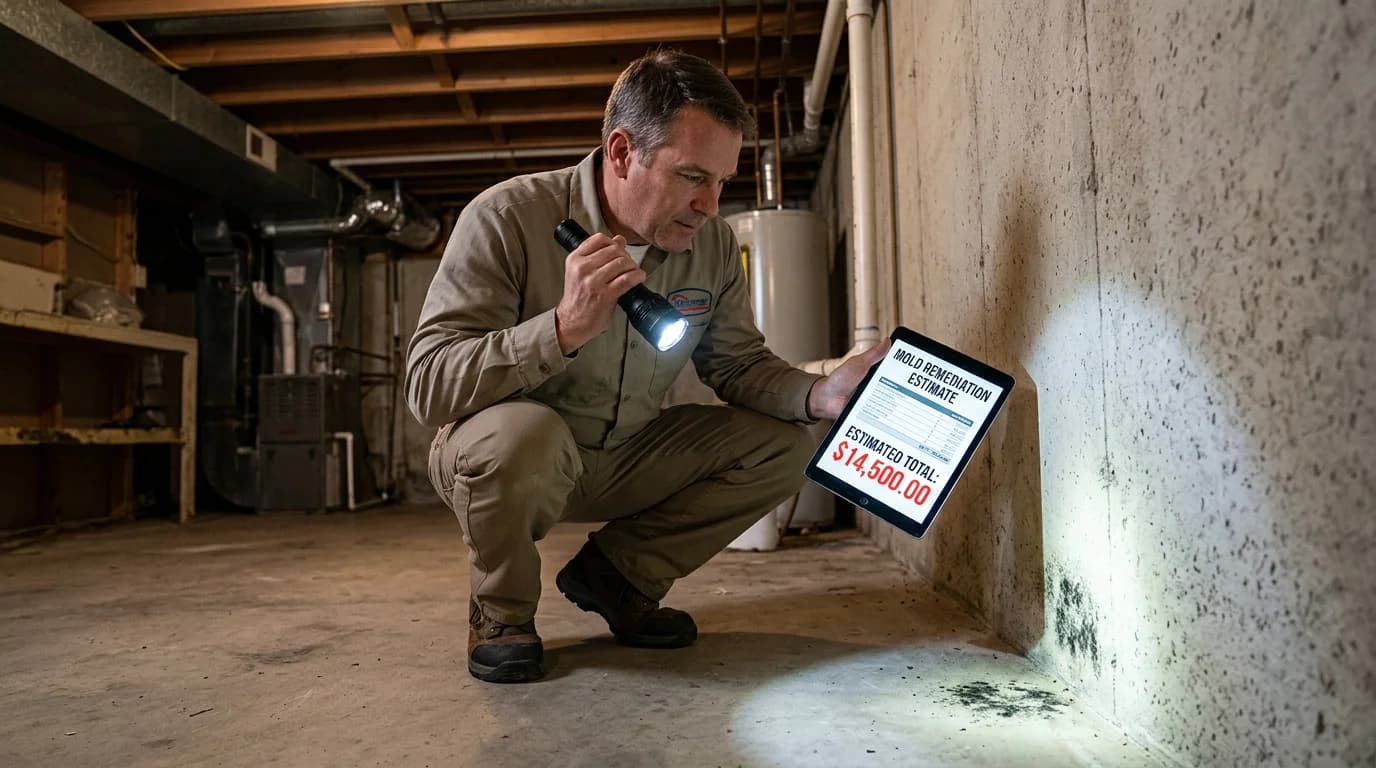
Here's how it works: a company offers a free mold inspection. You let them in. They find mold, often a lot more than you expected. They present a remediation quote for thousands of dollars, sometimes tens of thousands. They're ready to start immediately.
The problem isn't that they found mold. The problem is that the company diagnosing your problem also profits from fixing it. When your revenue depends on finding more mold, the incentive points toward finding more mold. That doesn't make every free inspection inflated; it means the company pricing the remediation also decided how big it is.
A hypothetical example: A homeowner smells something musty in her basement and calls a company offering free inspections. They report extensive mold growth throughout the space and quote a whole-basement job. Feeling uncertain, she pays for an assessment from a separate, independent assessor. That assessment finds mold, but confined to one area from an old leak that has already been repaired, and the scope it describes is a small fraction of the first quote.
The simplest protection: for any job beyond a small patch, our recommendation is to get your initial assessment from a company that does not offer remediation services. This is the core principle behind hiring separate assessors and remediators. An independent assessor is paid for the assessment whether or not it leads to remediation.
Warning: Any company that offers a "free inspection" and then immediately presents a remediation quote has a built-in financial conflict of interest. This doesn't mean every quote is dishonest, but an independent opinion gives you a way to check it.
The Scare Tactic
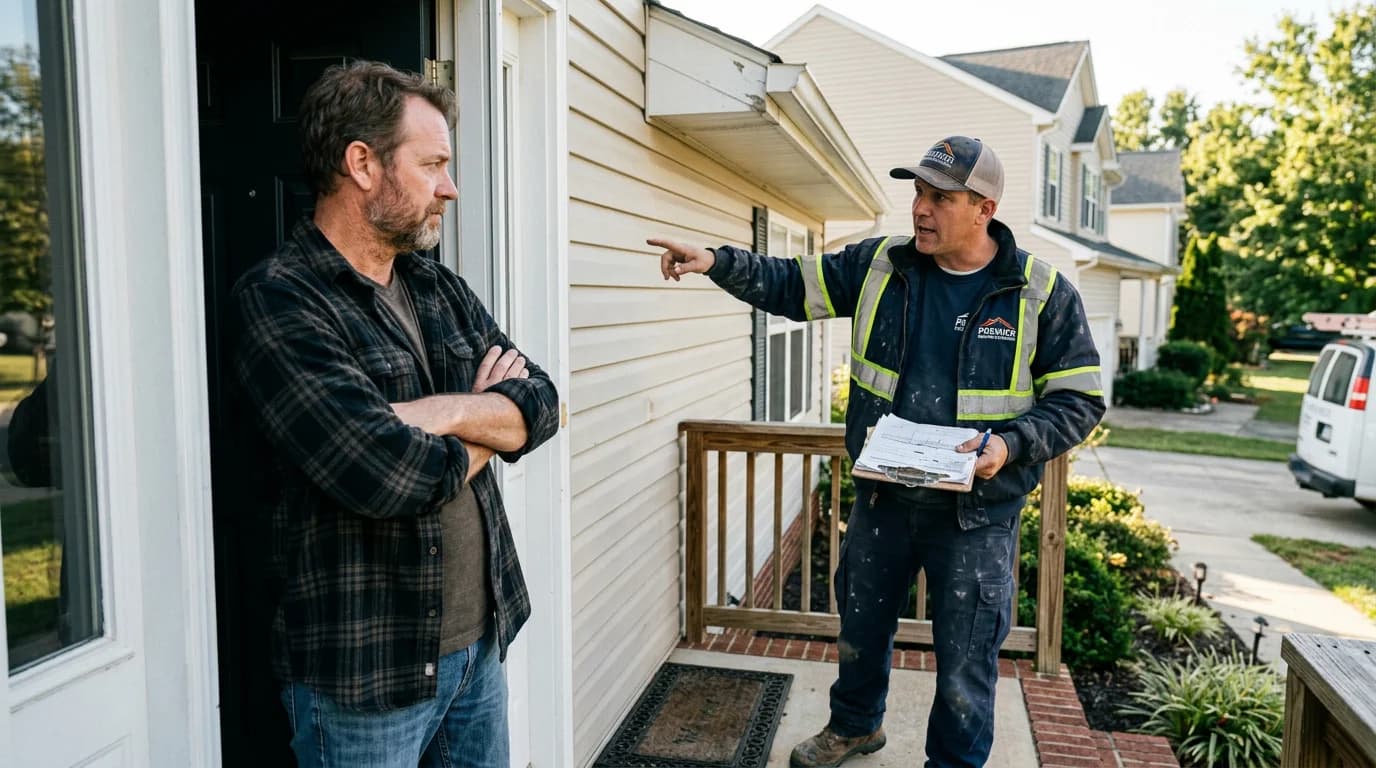
"This is toxic black mold. Your family is in danger. We need to start immediately."
Panic is a sales tool. When someone tells you your family is at risk, the natural response is to act fast and ask questions later. Some companies count on this.
The reality: most mold in homes is not Stachybotrys (the species typically called "black mold"). And while mold should be taken seriously, the appropriate response is a calm, methodical process, not a same-day emergency contract.
Legitimate professionals explain the situation clearly. They give you time to get a second opinion. They don't pressure you to sign today or lose your spot.
Watch for these phrases:
- "Your family's health is in immediate danger"
- "This is the worst case I've seen"
- "You need to sign today; we can start tomorrow"
- "Black mold is extremely toxic and spreading right now"
Any of these should slow you down, not speed you up. A company that uses fear to close a sale is not acting in your interest.
Unnecessary Air Testing
Air testing has legitimate uses. It's not always necessary, and some companies sell it when it adds no real value.
EPA's position is that in most cases, if visible mold growth is present, sampling is unnecessary. A lab result rarely changes the response either: the material, the extent of the growth and the moisture set the work, not the species name, and routine spore-trap or microscopy analysis generally identifies a genus or broad fungal group rather than a species.
Sampling is genuinely useful in specific situations, where it answers a defined question the inspection can't:
- Mold is suspected but not visible, such as a persistent musty smell with no visible source, or past water damage
- A specific question about a wall cavity or HVAC system, with the assessor designing the sampling around it and reading the results in context
- A post-remediation verification whose agreed completion criteria include sampling, which is one possible method rather than a requirement
If a company recommends air testing when you already have visible mold growth and no dispute about scope, ask why. If they can't give you a clear answer, that's a signal.
Talking You Out of an Independent Check
Every remediation should end with the remediator's own post-remediation evaluation: a documented check that the visible growth, dirt, dust and debris are gone, the area is free of musty odor, and the remaining materials are dry. ANSI/IICRC S520-2024 says that at that point a return to normal conditions is probable (§9.3.12), which is a careful word, not a guarantee. A post-remediation verification, what most people call clearance testing, is a separate, independent check on top of it: an independent professional inspects the work against completion criteria confirmed, as far as possible, before or early in the job, and takes samples where sampling was requested or required (§12). It isn't required on every job, but it is yours to request, and it is worth having on a large or complex job or where someone in the home has health concerns.
The scam version is a company that talks you out of it when you ask. Or one that offers to do the "independent" check itself without telling you in writing that this departs from the standard; §12 says a remediator in that position should disclose it in writing.
Why this matters: Without an independent check, the remediator's own evaluation is the only check on the work. That is the baseline rather than a failing, but it means you're taking the company's word for it, and they've already been paid.
A reputable remediator will welcome an independent check when you ask for one. It protects them too: it gives both of you an independent record that the work was checked against the criteria you agreed.
If a company discourages an independent check you've asked for, walk away.
The Scope Creep
You get a quote. The work starts. A few days in, the crew leader calls: "We found more mold behind the wall. Going to need more to address it."
Then another call. And another.
Scope creep isn't always fraudulent; sometimes mold does extend further than initially visible. But scope changes should be documented in writing, explained clearly, and tied to what was actually found. If costs keep escalating without written documentation of what was discovered and why the additional work is needed, that's a problem.
Protect yourself:
- Get the initial scope in writing before work begins
- Require written change orders for any additions, signed by both parties
- Ask to see (or photograph) any newly discovered mold before authorizing additional work
- Have your independent assessor update the protocol if scope changes are significant
The Miracle Spray
"We use a proprietary formula that kills all mold permanently. Your mold problem will never come back."
No product does this. No spray, no fog, no chemical treatment permanently eliminates mold. Remediation doesn't rely on killing mold; it physically removes it. Porous materials with growth on them, such as drywall and insulation, generally come out. Semi-porous materials such as wood framing and subfloor are judged case by case; some can be cleaned and some can't. Remaining surfaces are cleaned, with an antimicrobial only where the job calls for one. And the moisture problem that fed the growth has to be fixed.
Any company claiming their product alone solves your mold problem doesn't understand mold remediation, or is hoping you don't.
The standard is unusually direct about this. ANSI/IICRC S520-2024 §1.4 calls physical removal the primary means of remediation, and its 2024 edition treats spray, fog, foam or gas used without physical removal as a deviation from the standard of care. EPA's homeowner guide makes the same point in plainer language: "it is not enough to simply kill the mold, it must also be removed." If a pitch is built on a product, that sentence is the one to put in front of it.
How to Protect Yourself
These steps give you a process that makes scams much harder to pull off.
1. Get an Independent Assessment First
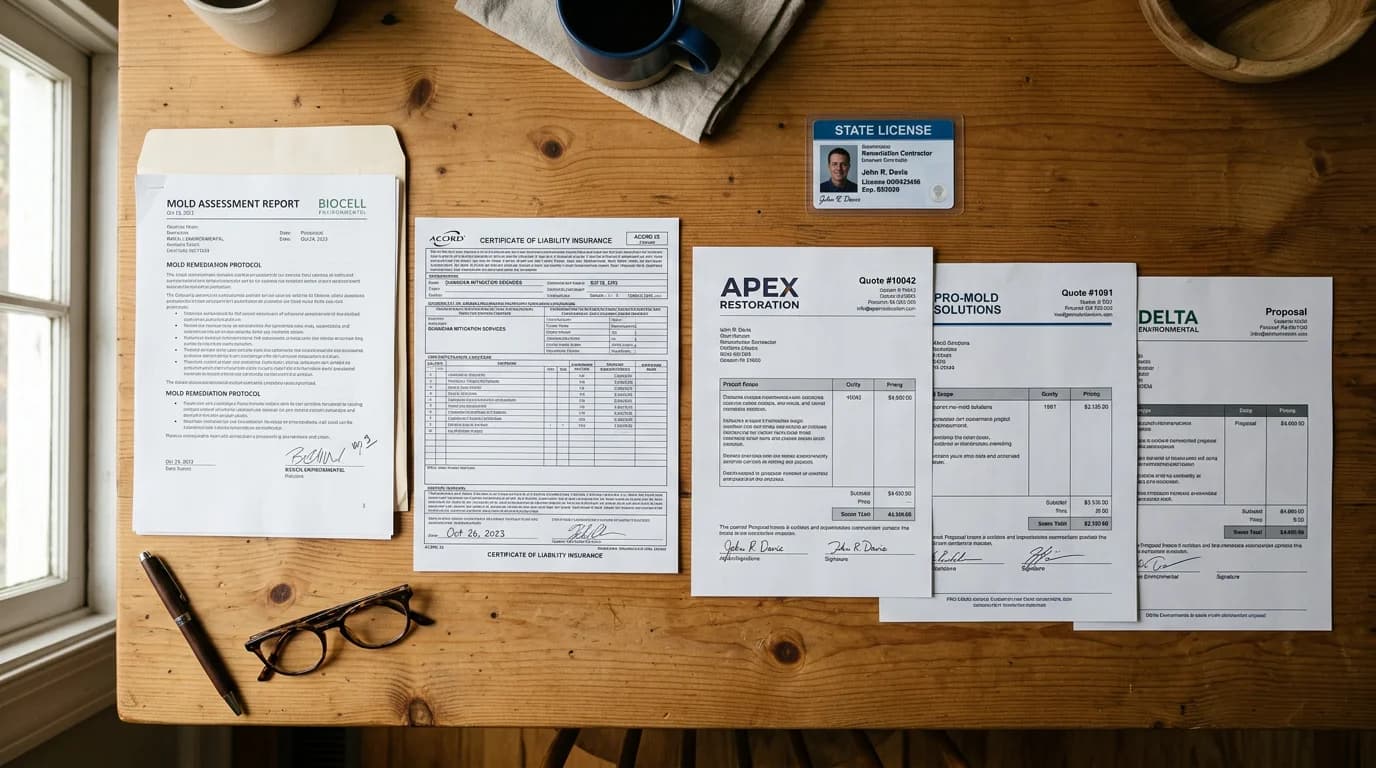
Before remediation work on anything beyond a small patch, our recommendation is to hire a mold assessor who does not offer remediation services. The industry standard doesn't require an independent assessment on every job, but having one takes the seller out of the diagnosis. The assessor will inspect, take moisture readings, sample only where a defined question needs it, document findings, and create a remediation protocol. This protocol becomes your blueprint for getting comparable bids from remediators.
See our full guide: Mold Assessor vs. Remediator
2. Verify State Licensing, and Know When There Is Nothing to Verify
This step carries a catch that most homeowner advice skips.
Five jurisdictions run dedicated mold licensing programs: Florida, New York, Texas, Louisiana, and Washington DC. Four more name mold remediation inside a different credential: Tennessee's contractor board has a Mold Remediation classification, Mississippi's includes mold remediation in a commercial classification, Connecticut's home improvement contractor registration covers mold remediation, and Virginia bars selling residential mold remediation without a certification from a nationally or internationally recognized certifying body. Illinois has a registration law that is not in effect yet, and in the other 41 states no state credential names mold remediation at all. Our mold remediation license requirements by state survey cites the statute or rule behind each of those answers. A contractor in Ohio or Arizona is not hiding something when they cannot produce a mold license. Their state does not issue one.
That cuts both ways. In a licensing state, an active license is a hard requirement and a missing one ends the conversation. Everywhere else, "licensed and insured" in an advertisement usually refers to a general business or contractor license or registration rather than a mold license, and the other checks in this list carry the weight instead.
In the five licensing jurisdictions, look the record up yourself:
- Florida: MyFloridaLicense.com
- Texas: TDLR License Search
- New York: NYS Department of Labor Mold Program
- Louisiana: LSLBC Contractor Search
- Washington DC: DOEE Licensed Mold Professionals
Ask for the number, then check it against the state's own record rather than a screenshot or PDF the company hands you. In DC the list shows names, not numbers, so ask who'll run the job and find that person on it. If you are weighing up services that promise to have done this for you, how to verify a mold remediation company walks through what each kind of service is actually confirming.
A license that exists is not the same as a license that is current. Verified Remediation tracks 7,107 mold practitioner license records across Florida, New York, Texas, and Louisiana, and 31.7% of them have lapsed. The rate runs highest in Louisiana (36.7%) and Florida (36.4%), followed by New York (27.1%) and Texas (23.2%). Washington DC licenses mold work too, but DOEE's public list publishes no expiration dates, so there's no lapse history for us to count there.
A lapsed record does not mean a company is breaking the law. Licenses are frequently held by an individual rather than the business, and people retire, move, or relicense under a new entity. What it does mean is that the number printed on the quote in your hand may not match what the state shows today. That is the entire reason to check it yourself rather than take the document at face value.
3. Verify Insurance
Request a certificate of insurance (COI) before any work begins. Legitimate professionals provide this without hesitation. At minimum, you want general liability insurance. Workers' compensation is required in most states for companies with employees.
If the COI is expired or they refuse to provide one, that's a disqualifying red flag.
4. Get Everything in Writing
Your contract should include:
- Detailed scope of work (exactly what will be done)
- Materials and methods to be used
- Timeline
- Payment schedule
- What happens if additional mold is discovered
- How completion will be checked and documented, and who does any independent verification
A one-page generic contract is not enough. Vague contracts protect the contractor, not you.
5. Ask How Completion Will Be Checked
Ask upfront how completion will be checked and documented, and whether an independent verification is part of the plan. The remediator documents its own post-remediation evaluation either way. When a verification is required or requested, the standard says an independent professional should do it, and if the remediator does it themselves, they should tell you in writing that they're deviating from the standard. Details and the section number are in the four asks below. A company that suggests an independent check is unnecessary when you've asked for one has answered a different question than the one you asked.
6. Get Multiple Quotes
Once you have an independent assessment with a remediation protocol, share that protocol with multiple remediators and ask each to quote against the same scope. That is what makes the quotes comparable.
If quotes vary significantly, ask why. The answer tells you a lot.
7. Ask the Right Questions
Some questions that separate legitimate professionals from bad actors:
- "Can I see your state license number?"
- "Will you provide a certificate of insurance before work starts?"
- "How will completion be checked and documented, and who does any independent verification?"
- "What happens if additional mold is found, and how are change orders handled?"
- "Do you offer both assessment and remediation, or just one?"
A professional with nothing to hide answers these without hesitation.
For a full list of what to ask, see our guide: Questions to Ask a Mold Company Before Hiring
Four things the standard says you can ask for
Most advice about avoiding mold scams comes down to instinct. Get three quotes, trust your gut, watch for pressure. That's fine as far as it goes, and it leaves you arguing about vibes with someone who does this for a living.
There's a better footing available. The mold industry works to a published standard, ANSI/IICRC S520, currently in its 2024 fourth edition. We bought a copy and read it. Four of the things it says are useful to you specifically, and each one converts a hunch into a question with a section number behind it.
"Show me how you're removing it, not just what you're spraying on."
This is Section 1.4 again, turned into a question you can ask out loud. Physically removing mold contamination is the primary means of remediation, and attempts to kill or encapsulate it instead are generally not adequate. So a proposal built around a treatment, with nothing in it for physically removing the contamination (cleaning it off, or taking out what can't be cleaned), isn't a cheaper version of remediation. It's a different thing wearing the name.
"What are the completion criteria, and can we agree them now?"
Per Section 12, when a post-remediation verification is required or requested, the remediator should confirm the completion criteria with the appropriate parties, you among them, to the extent possible, before remediation starts or as early in the process as possible. Note the trigger there: required, or requested. The independent check is not automatic, which means the request is yours to make. Ask in week one and the finish line gets drawn while it is still negotiable. Not afterwards, when the crew is packing the van and your only move is to argue. It is the single cheapest thing on this page, and almost nobody does it.
"Who is doing the clearance check, and if it's you, I want that in writing."
This is the one worth memorizing. When a post-remediation verification is required or requested, it should be performed by an independent third-party indoor environmental professional. If the person verifying the work is not independent of the company that did the work, Section 12 says the remediator should disclose to you in writing that they are deviating from the standard.
Read that again, because it changes the conversation. A company clearing its own job isn't automatically disqualified. However, they owe you a document saying so. A contractor who won't put it in writing is telling you something, and a contractor who doesn't know the requirement exists is telling you something else.
And one promise to refuse outright: a mold-free house.
Two definitions from the standard's Definitions section (Section B) are worth knowing here, because together they tell you what "gone" can honestly mean. Condition 1, the goal state, is a normal fungal ecology: the ordinary settled and airborne spores in any clean, dry indoor space. It is not a sterile room and not a zero-spore reading, so anyone promising to eliminate all mold from your house is promising something the standard doesn't ask for.
Condition 3 is actual mold growth, and the definition includes growth that is dead and non-viable. Killing a colony doesn't move a building out of Condition 3. Only physically removing it does. That's the whole reason the first question on this list is the first question.
How Verification Protects You
The core problem with mold scams is information asymmetry. The contractor knows a lot about mold; you probably don't. They can exploit that gap.
Verification closes it.
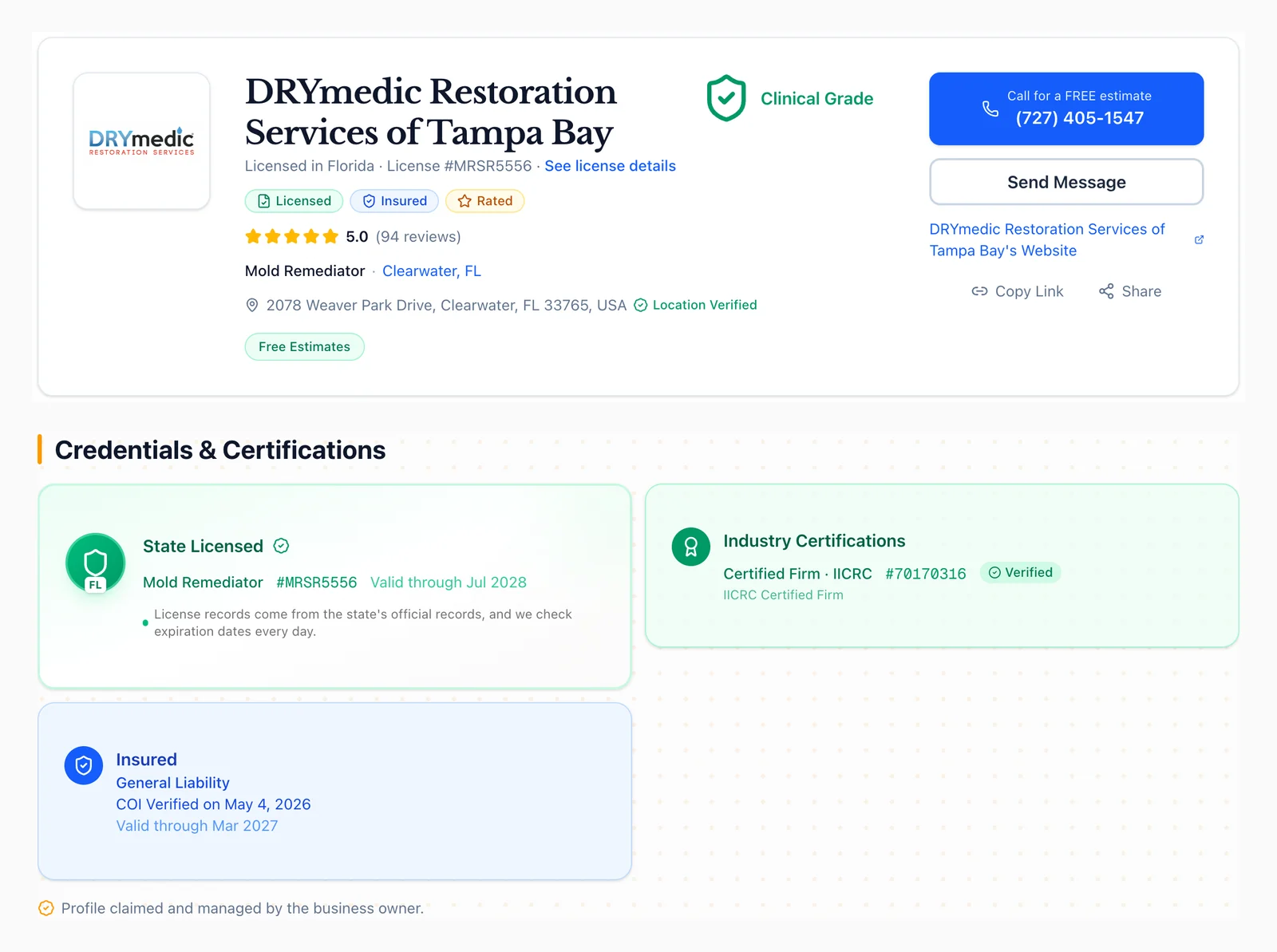
At Verified Remediation, every professional we list is assessed before appearing in results. What we can check depends on which state records we hold, so the tiers describe verification performed, not verification implied.
Tier A: Clinical Grade Insurance verified, and a 4.0+ star rating across at least 5 reviews. Where we hold the state's license records, an active state license is matched to those records as well. Our highest confidence tier.
Tier B: Advanced Verified Insurance verified, with an active state license confirmed where we hold the state's license records. Not yet at the 4.0+ rating from 5+ reviews that Tier A asks for, but the foundational checks are complete.
Tier C: Verified Pro Business identity and location verified. In Florida, Texas, New York and Louisiana, this also means an active state license matched to the state's license records. Insurance not yet verified.
In Florida, Texas, New York and Louisiana, a professional whose license we cannot confirm does not appear in results at all. Everywhere else, a listing's tier rests on the other checks we run. We would rather show you which of those two situations you are in than imply a check nobody ran.
There is no advertising and no paid placement. Ranking follows verifiable signals only.
This doesn't guarantee a perfect experience. What it does is show you, before you call, whether we could confirm a state license, whether insurance has been verified, and whether the company has a track record of ratings.
About this data. Figures on this page come from the Verified Remediation License Index, which holds state mold practitioner license records from Florida, New York, Texas, and Louisiana, and a December 2025 copy of Washington DC's public list of licensed mold professionals, alongside a wider catalog of 18,296 mold companies across all 50 states and Washington DC, in 4,100 cities, not all of which are publicly listed. The lapse rate reflects 7,107 records from the four jurisdictions where we hold both active and expired history: Florida, New York, Texas, and Louisiana. Washington DC also licenses mold work, but DOEE's public list publishes no expiration dates, so there's no lapse history to count there. Figures are current as of 29 July 2026. The license records are ones we collected from state sources, not a certified copy of any state register, so a state's own register can differ from our counts.
For more on how certifications add another layer of trust, see: Mold Certifications Explained
What to Do If You've Been Scammed
If you believe a mold company defrauded you, here's what to do.
1. Document everything. Pull together all contracts, invoices, before-and-after photos, text messages, emails, and any written communications. Write down a timeline of events while it's fresh.
2. Get an independent assessment. Hire a qualified mold assessor, licensed where your state requires it, to evaluate the work that was done. Their report can document the condition of the work area now and how it compares with the scope you were charged for. It can't prove what happened during the job, but it gives you an independent record to work from.
3. File a complaint with your state licensing board. If the contractor holds a state license, the licensing board can investigate and impose penalties, including license revocation. In Florida, that's the DBPR. In Texas, TDLR. Search "[your state] contractor licensing board complaint" to find the right agency.
4. Report the fraud to consumer-protection agencies. File a report with the FTC at reportfraud.ftc.gov, and file a complaint with your state attorney general's office (find yours through the NAAG directory). These agencies track patterns of contractor fraud and can act against repeat offenders even when a single case is too small for a private lawsuit.
5. Report to the Better Business Bureau. A BBB complaint creates a public record and sometimes prompts a response from the company.
6. Contact your credit card company. If you paid by credit card and the work was not performed as contracted, you may be able to dispute the charge. Act quickly; dispute windows are typically 60–120 days.
7. Consult an attorney. For significant fraud (thousands of dollars or more) a consultation with an attorney who handles contractor disputes is worth the time. Many offer free initial consultations.
The surest way around these tactics is to start with pros we have checked: browse verified mold remediation companies, where every listing is identity-checked, with state licenses verified where we hold the state's license records.
Frequently Asked Questions
How do mold companies scam homeowners?
Are free mold inspections a scam?
What does mold remediation fraud look like?
Is 'toxic black mold' a real threat or a scare tactic?
What should I do if a mold company won't provide clearance testing?
What can I do if I've already been scammed by a mold company?
This guide is for educational purposes only. Licensing requirements and regulations vary by state; always verify current requirements with your state licensing board. If you believe you've been defrauded, consult an attorney for advice specific to your situation.