Questions to Ask a Mold Remediation Company (2026)
20+ questions to ask before, during, and after mold remediation. Know what answers to expect, and which answers are red flags.
Mold is stressful. The last thing you need is to hire the wrong company and end up with an inflated bill, shoddy work, or a mold problem that comes back.
The right questions protect your wallet and your health. This guide gives you the exact questions to ask: before you sign anything, during the assessment, through the remediation itself, and after the job is done.

In This Guide
- Before You Hire: Screening Questions: 10 questions before signing
- During the Assessment: Questions for Your Inspector: What to ask the assessor
- During Remediation: Questions for Your Contractor: Keeping the job on track
- After Remediation: Follow-Up Questions: Verifying the work
- Red Flags in Their Answers: Warning signs to watch for
- Your Hiring Checklist: Quick reference summary
Before You Hire: Screening Questions
Ask these questions before you sign any contract or agree to any work. A good company will answer all of them clearly and without hesitation.
1. Are you licensed in this state? What is your license number?
Why it matters: Five jurisdictions run dedicated mold licensing programs (Florida, New York, Texas, Louisiana and Washington DC), and a few other states regulate mold work another way; our 50-state mold licensing survey shows the rule, if any, in each state. Where a license is required, an unlicensed contractor isn't just a legal risk to you; it signals they may lack the training to do the job right.
What a good answer sounds like: They give you the number on the spot and encourage you to look it up yourself. You can verify Florida licenses at MyFloridaLicense.com and Texas licenses at tdlr.texas.gov. New York, Louisiana, and Washington DC publish their records too, and our verification guide lists all five along with what to ask for in states that issue no mold license.
2. Do you carry liability insurance and workers' compensation? Can I see your certificate of insurance?
Why it matters: If a worker is injured in your home, or if something gets damaged during remediation, you need to know you're protected. A contractor without workers' comp means you could be liable for on-site injuries.
What a good answer sounds like: They send you a current certificate of insurance (COI) before work starts. The policy should be active, not expired.
3. Do you perform both mold assessment and mold remediation?
Why it matters: This is a critical question. A company that both diagnoses your mold problem and profits from fixing it has a built-in incentive to overstate the scope of work, whether or not they act on it. Seven jurisdictions put a rule on this dual role, from a ban on doing both on the same job in Texas, New York, Louisiana and Oklahoma to a 12-month restriction in Florida and a written disclosure in Maine and Washington DC. Elsewhere, state law allows it.
What a good answer sounds like: For your initial assessment, our recommendation is a company that does assessment only, no remediation, and then a separate company for the remediation, working from that assessor's protocol. Learn more about why we recommend separating assessment and remediation.
4. What certifications does your team hold?
Why it matters: Industry certifications document formal training, separate from any state license. They're not a guarantee of quality, but they do signal investment in professional development.
What a good answer sounds like: They name specific credentials, who issued them, and who on your job holds them: for example the IICRC's AMRT (Applied Microbial Remediation Technician) or MRS (Mold Remediation Specialist) for remediators, or ACAC's CMI (Council-certified Microbial Investigator) for assessors. The issuing body is part of the answer, because both ACAC and NORMI issue a credential abbreviated CMR. Generic claims like "our team is certified" without specifics are not enough. For a full breakdown of what each certification means, see our guide to mold certifications.
5. How long have you been doing mold work specifically?
Why it matters: General construction experience is not the same as mold remediation experience. Mold work follows its own industry standard, covering containment matched to the job, HEPA filtration, physical removal of contamination, and drying. You want someone who has done this many times before.
What a good answer sounds like: Several years of mold-specific experience, not just "we do water damage and mold." Ask for examples of similar projects.
6. Can you provide references from recent mold jobs?
Why it matters: References give you direct access to homeowners who went through what you're about to go through. Past clients can tell you whether the company communicated well, stuck to the timeline, and delivered on their promises.
What a good answer sounds like: They offer 2-3 references without being asked. Be skeptical of companies that only point to online reviews; talk to an actual person.
7. Will you provide a written scope of work before starting?
Why it matters: A verbal agreement isn't worth much if the job goes sideways. The written scope protects you both; it defines exactly what work will be done, what materials will be removed, and what the timeline looks like.
What a good answer sounds like: Yes, before you sign anything. The scope should be detailed enough that another company could bid on it. If the remediator is working from an independent assessor's protocol, the scope should match that document.
8. What is your timeline for this project?
Why it matters: Mold remediation takes time. Containment setup, physical removal, drying, and verification don't happen overnight. An unusually fast timeline can be a sign that corners will be cut.
What a good answer sounds like: A realistic estimate based on your specific scope, with the active remediation and the drying given separately. Drying ends when moisture readings say the materials are dry, not on a set date.
9. Who checks the work at the end, and will anyone independent be involved?
Why it matters: There are two different checks and it is worth knowing which one you are being offered. The IICRC S520 standard calls the remediator's own final check a post-remediation evaluation, and Section 1.4 says the job should be considered complete when the remediator confirms through it that the visible growth, dirt, dust and debris are gone. So a company checking its own work is not the scandal it sounds like. It is the baseline.
The second check is a post-remediation verification by an independent professional, which the standard describes as further assurance rather than a universal requirement. It is worth asking for when the job was large, when someone in the house has health concerns, or when you simply want a second set of eyes that has not been paid to say yes. One rule does hold firmly: Section 12 says that if the person performing that verification is not independent of the remediator, the remediator should tell you in writing that they are departing from the standard.
What a good answer sounds like: They can describe their own final check and what it covers, and they are comfortable with you bringing in your original assessor on top of it. A company that resists any independent look, or that offers to do the independent verification itself without mentioning that this departs from the standard, has told you something.
10. What are the completion criteria, and when will they be agreed in writing?
Why it matters: There is no national number a lab result has to come in under, so "it passed the test" is not what finished means. Under S520 Section 12, when a post-remediation verification is required or requested, the remediator should confirm the completion criteria with the appropriate parties, to the extent possible, before the work begins or as early in the process as possible. At a minimum those criteria cover a return to normal fungal ecology (what the standard calls Condition 1: the ordinary background of spores in any clean, dry building, not a number), remaining materials being dry, and the area being free of visible dirt, dust, debris, mold growth, and musty odor. If nobody writes those down beforehand, there is nothing to hold the finished work against.
What a good answer sounds like: They can describe what done looks like before they start, and they will put it in the contract. Ask what happens if the verification does not go well the first time: if the work was not done properly, the remediator should come back and finish it at no extra charge, and that belongs in writing too.
During the Assessment: Questions for Your Inspector
Once you've hired an independent mold assessor, these questions help you get the most out of the inspection.
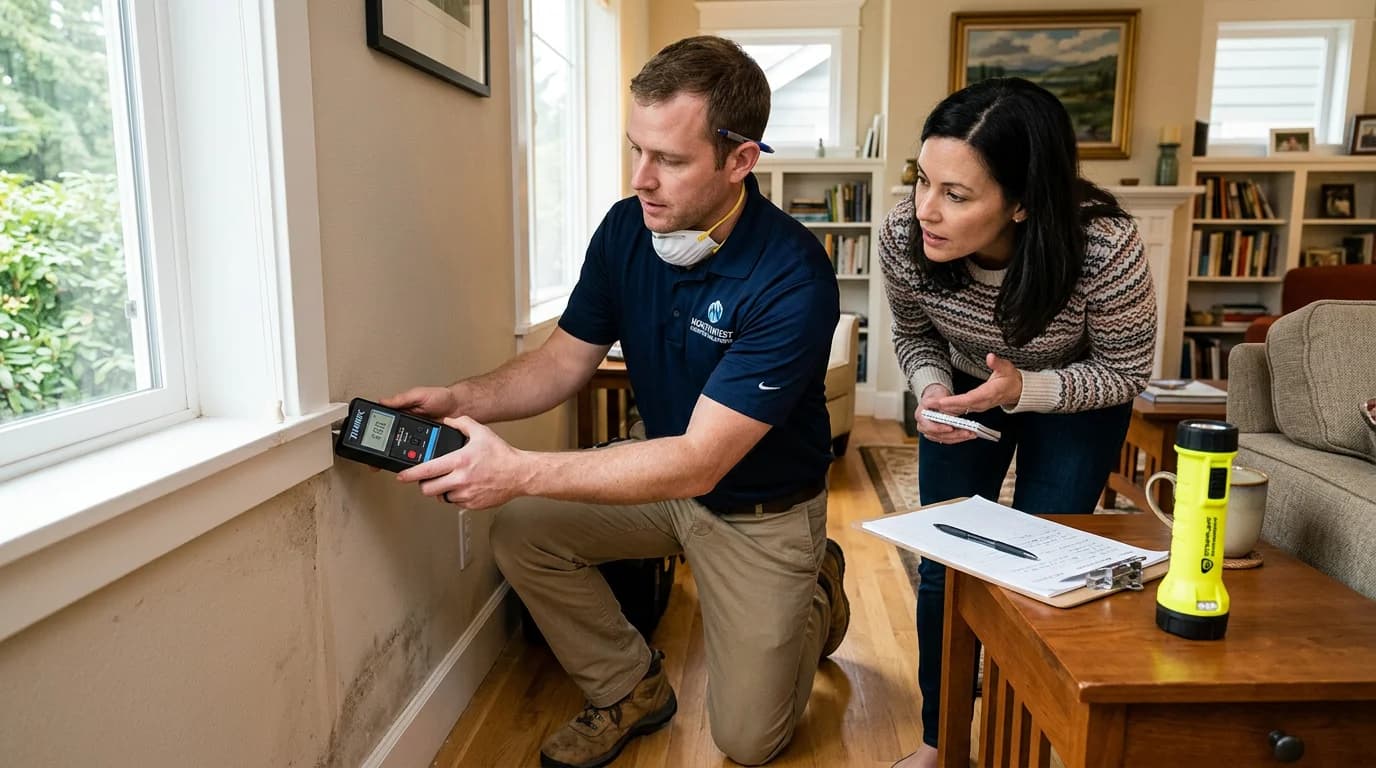
1. Where could the moisture be coming from?
Mold needs moisture to grow. As EPA puts it, if you clean up the mold but don't fix the water problem, the mold problem will most likely come back. Ask your assessor to investigate and document known or suspected moisture sources and the conditions contributing to them, such as a leaking pipe, roof intrusion, condensation, or inadequate ventilation, and to point you to the right trade to confirm and fix them.
2. How extensive is the contamination?
Ask the assessor to quantify what they're seeing. Is this a small, isolated patch, or is there evidence of spread behind walls, into framing, or through the HVAC system? The scope of contamination directly determines the scope (and cost) of remediation.
3. Will you collect air or surface samples?
Not every assessment requires lab sampling. Ask whether samples are necessary for your situation, what they would show, and how much they add to the cost. A good assessor explains when sampling adds value and when a thorough visual inspection is sufficient. For background on inspection costs, see our mold inspection cost guide.
4. What will the remediation protocol include?
The assessor's protocol is the document that remediators will bid from. Ask them to walk you through it: what materials need to come out, what surfaces need cleaning, and what the drying requirements are. Understanding the protocol helps you evaluate whether remediation bids are reasonable.
5. How long should remediation take for this scope?
Your assessor has seen many jobs. Ask them for a realistic timeline so you know what to expect when you talk to remediators. A remediator promising a much shorter timeline than the assessor suggests is a warning sign.
6. What is the estimated cost range for this remediation?
Assessors don't give you a remediation quote; that's not their job. But an experienced assessor can give you a ballpark range for what a job like yours typically costs. This helps you evaluate whether the bids you receive are reasonable or inflated. Our mold remediation cost guide also gives you national benchmarks.
During Remediation: Questions for Your Contractor
Once you've hired a remediator, stay engaged throughout the project.
1. How will you contain the work area?
Containment is there to keep contamination from spreading into clean parts of your home during removal; done properly, it limits how far spores travel. Ask specifically about plastic sheeting barriers, negative air pressure systems, and HEPA air scrubbers. If they plan to skip containment on a job of meaningful size, that's a serious problem.
2. What materials will be removed versus cleaned?
Absorbent materials with growth below the surface, like drywall and insulation, generally need to come out. Wood is judged case by case, and hard, non-porous surfaces are generally cleanable in place. Ask the remediator to explain their decision-making for each material.
3. How will you protect the rest of my home from spores?
Beyond containment, ask about air filtration during the work, protective measures at doorways and HVAC vents, and how workers will handle moving between the work area and the rest of your home. Sloppy cross-contamination practices can spread the problem.
4. How long will the drying process take?
After mold-affected materials are removed, the underlying structure needs to dry completely before any reconstruction. Skipping or rushing this step can leave the conditions for regrowth in place. Drying ends when moisture readings show the materials are dry, compared against the same material where it is known to be dry, rather than after a set number of days.
5. Who verifies completion, and against what criteria?
Confirm before work starts what the remediator's own final check covers, whether an independent verification is also happening, and what criteria both are measured against. If your assessor is doing an independent verification, schedule it with them before the remediation wraps up.
6. What warranty do you offer on the work?
Ask specifically: what is covered, for how long, and what voids the warranty. A reasonable warranty covers the remediation work itself: if mold returns in the same treated area due to improper work, the company addresses it. No legitimate warranty can promise mold won't return if new moisture problems develop.
After Remediation: Follow-Up Questions
The job isn't done when the crew leaves. These questions ensure the work was completed properly and help you protect your home going forward.
1. Can I see the verification report?
Ask for whatever documents the checks produced: the remediator's own evaluation record, and the independent verification report if one was done. Either should show how the work was measured against the agreed criteria, with visual inspection notes, moisture readings, and any sampling. If samples were taken, ask for the lab results rather than a summary, so you have the documentation if problems come up later.
2. What should I monitor going forward?
Ask your assessor what signs of moisture or mold recurrence to watch for, especially in the affected area. They may recommend a specific humidity range to maintain, or periodic checks at a problem area.
3. How can I prevent mold from coming back?
The underlying moisture source should already be identified and addressed. But ask for specific prevention advice based on your home's situation: ventilation improvements, drainage corrections, or humidity control. If the moisture source was never fixed, mold can come back however good the remediation was.
4. Is there anything I should do before reconstruction begins?
Before drywall goes back up and finishes are restored, confirm that the completion check, and any independent verification, is done and the area is fully dry. Ask your assessor whether they recommend any additional moisture barriers or treatments before reconstruction.
5. Do you offer any follow-up inspections?
Some assessors offer follow-up inspections after remediation for higher-risk situations. This isn't always necessary, but it's worth asking, especially if you had an ongoing moisture problem that required structural repairs.
Red Flags in Their Answers
Some answers should make you stop and reconsider. Here's what to watch for.
They won't provide a license number where your state requires one. A licensed professional has nothing to hide. Refusing or evading this question means they may not be licensed at all. Walk away.
They pressure you to sign today. Legitimate companies don't manufacture urgency. Mold is a real problem, but a legitimate company won't object to you taking time to verify credentials and get a second opinion. High-pressure sales tactics are a sign of a predatory business.
They can't explain their process clearly. If a contractor can't walk you through their containment setup, materials removal process, and drying protocol in plain terms, they either don't have a solid process or don't understand it themselves. Neither is good.
They guarantee to "eliminate all mold." Mold spores exist everywhere: in the air outside, in every home. No remediation company can eliminate all mold. This claim reveals either ignorance or dishonesty. The goal of remediation is a return to normal fungal ecology, the ordinary background of spores in any clean, dry building, not zero.
They offer a free inspection and then quote remediation. This is the conflict of interest problem in action. A company that assesses your home for free and then quotes you for remediation has a financial incentive to find more mold. Our recommendation is an independent assessment from a company that does not perform remediation. For more on this dynamic, see our guide on mold remediation scams.
They're vague about how completion gets documented. If a remediator is unclear about who verifies the work, or about what the criteria are, that tells you they may not expect it to hold up to independent scrutiny. Being dismissive about an independent check is the version of this worth walking away from.
Your Hiring Checklist
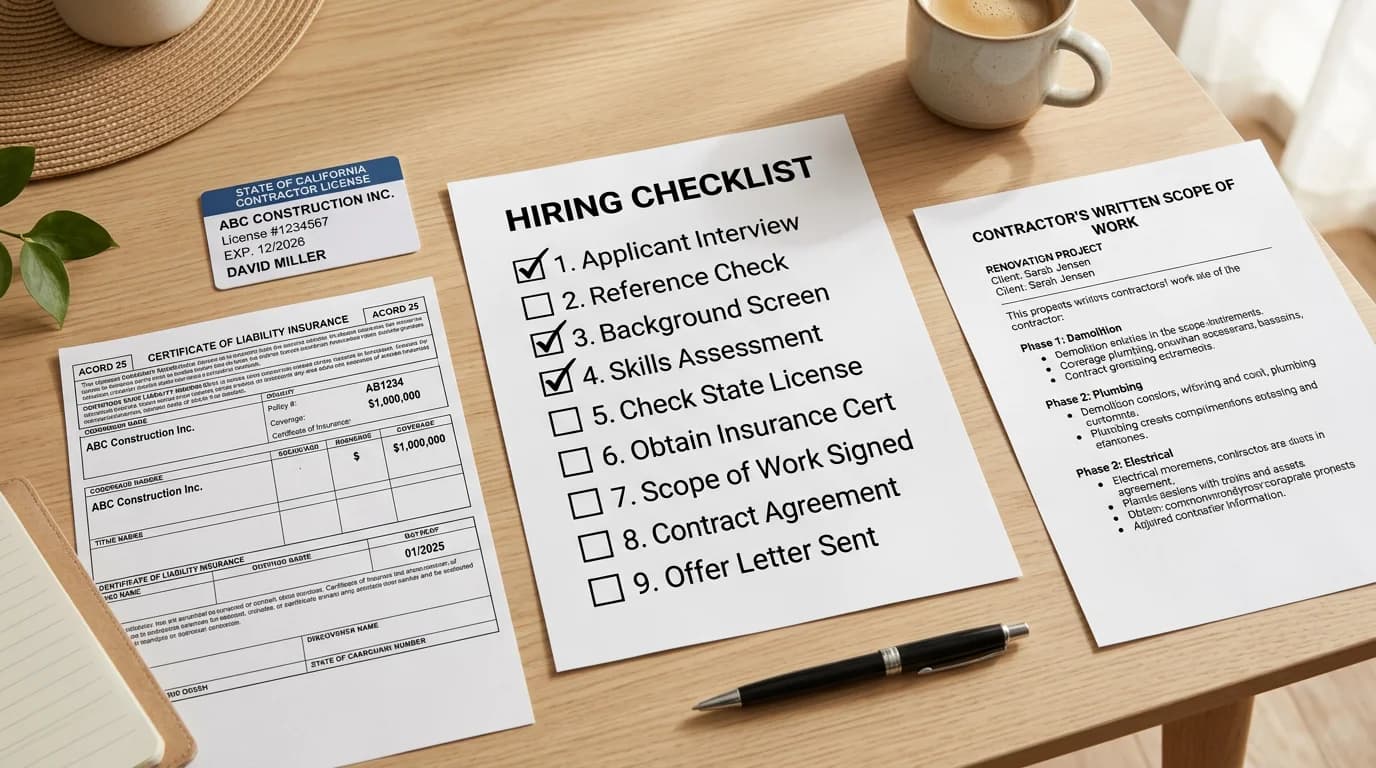
Before any work begins, confirm you have:
- License number verified in the state database (where your state requires one)
- Current certificate of insurance (COI) received and reviewed
- Assessment and remediation with separate companies, as we recommend
- Written scope of work in hand, matching the independent protocol where there is one
- Timeline agreed upon in writing
- Clear agreement on who checks completion, whether an independent verification is included, and on the criteria
- Warranty terms documented
- References contacted and checked
For the full guide on finding the right professional, see our guide to hiring a mold professional.
Frequently Asked Questions
What is the first question to ask a mold remediation company?
Should the mold inspector and mold remediator be the same company?
What does a written scope of work include for mold remediation?
Who should check that mold remediation is complete?
What should a mold remediation warranty cover?
What are the biggest red flags when hiring a mold company?
Have your questions ready and a shortlist of pros? You can find a verified mold removal company; every contractor on Verified Remediation is identity-checked and tier-ranked, with licenses, insurance, and reviews verified where available.
This guide is for educational purposes. Licensing requirements vary by state and change over time; always verify current requirements with your state licensing board.