Identification
Mold in Air Ducts and Vents: What to Check and What to Do
Spots on a vent can be dust, condensation or mold. What to check, when it's inside the system, why to leave the system off, and how to judge a duct quote.

Spots on a vent cover are easy to worry about. They aren't automatically mold: they could also be dust or condensation, and the cover can come off and be washed. Growth inside the duct itself, or a musty smell coming from the system, is a different story. Those are the signs EPA says to look for, and if you know or suspect your system has mold in it, EPA says not to run it.
So checking before you call anyone is the right instinct, whether you're standing under a vent with a flashlight or holding a quote to have your ducts cleaned. What happens next comes down to three things: what you've found, where it is, and what your ducts are made of.
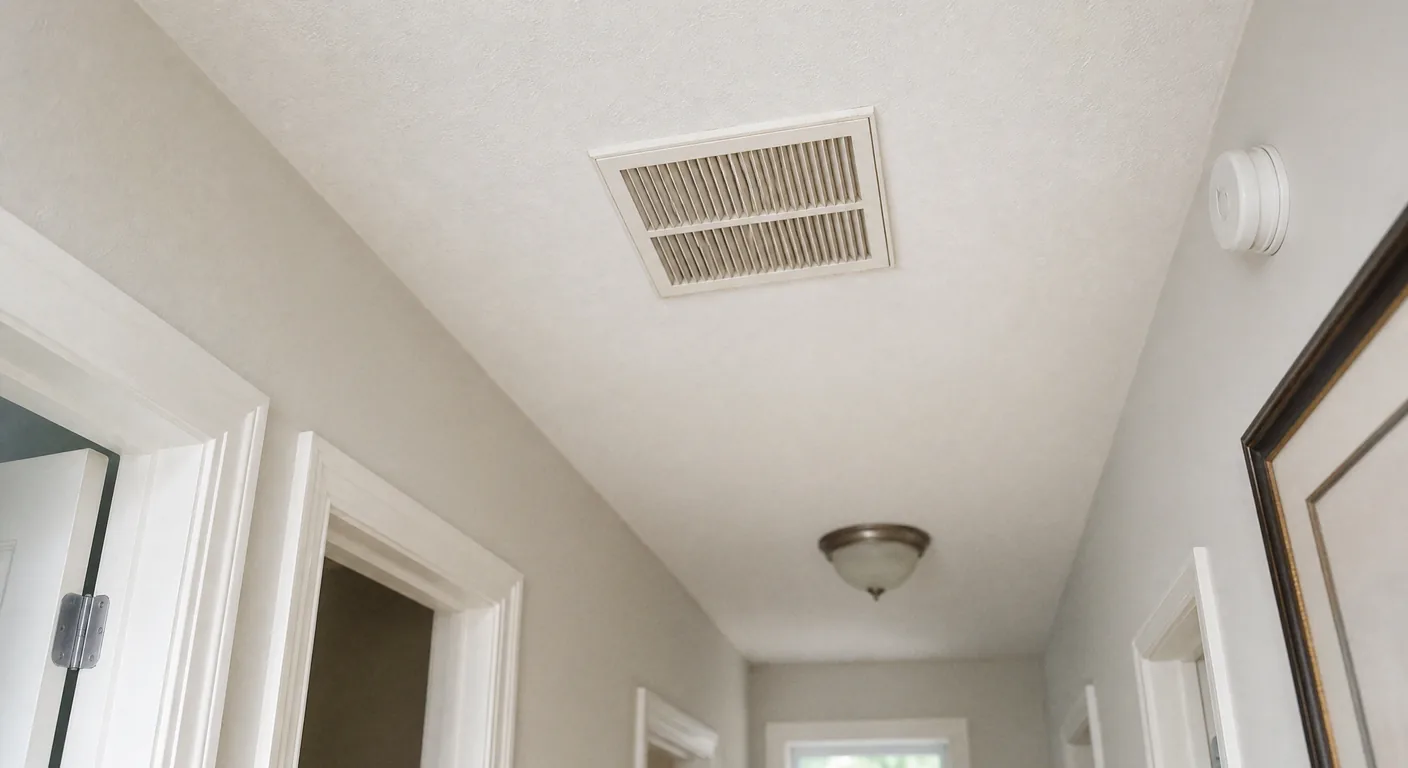
Three checks at the vent
Do them in order. Each one narrows down what you're looking at and who should deal with it.
What's on the cover?
Take it down and look in good light.
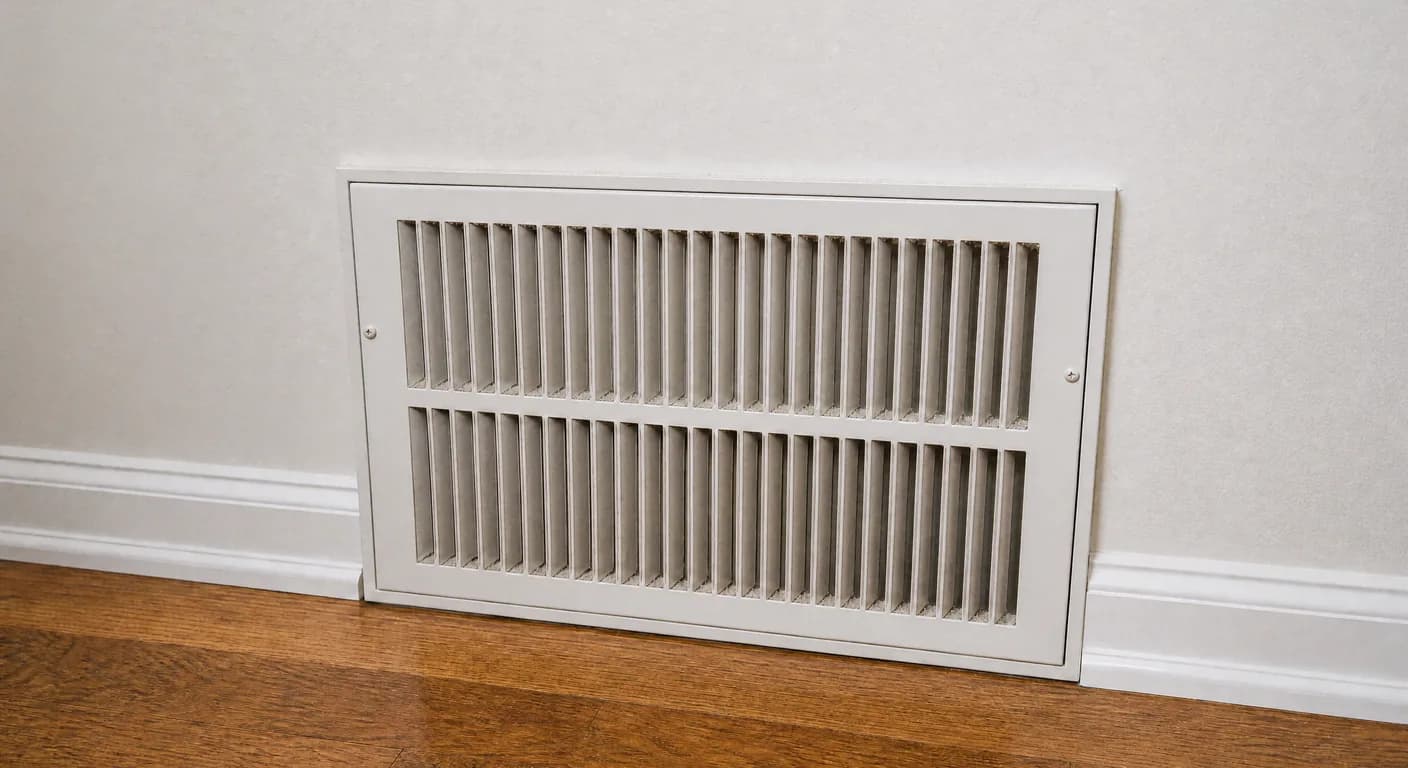
Dust on a return
Normal on the grille that pulls air back in, EPA says. Vacuum it, or take the cover off and wash it.
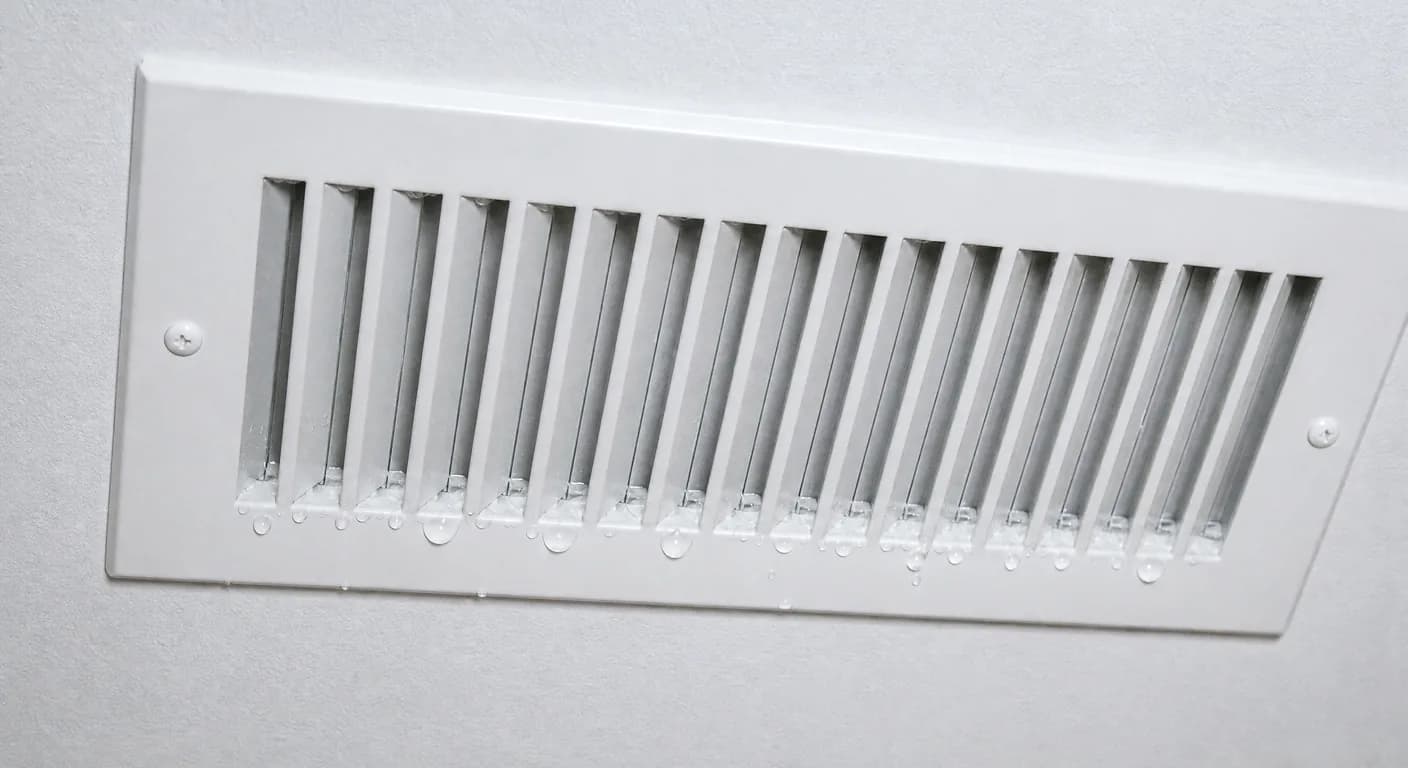
Water beads
Can be a sign of high humidity or a cold surface. Keep humidity below 60 percent, ideally 30 to 50; if it keeps happening, have the register, boot, insulation and air leaks checked.
What looks like growth
Only an expert can confirm it's mold, sometimes with a lab. Then check 2.
On this page: telling dust, condensation and mold apart
Does it stop at the grille?
With the cover off, shine a flashlight into the duct.
Only on the cover
A cleaning job. Scrub the cover with detergent and water and let it dry completely.
Past the grille, or a musty smell from the system
Treat it as a system problem. EPA says not to run a system you know or suspect is contaminated with mold. Then check 3.
On this page: cover or system, and whether to keep running it
What are the ducts made of?
It changes what happens to a moldy section, and one system can mix types.
Bare sheet metal
May be cleanable where its condition and access allow.
Fiberglass-lined duct or duct board
If wet or moldy, should be removed and replaced rather than cleaned. EPA says it can't be cleaned effectively.
Flex duct
May be cleanable when its condition, access and the cleaning method allow; sections that can't be successfully remediated are removed and replaced (S520 §10, p. 52).
On this page: what your ducts are made of
Spots on a cover are clues, not a diagnosis. Our recommendation: anything past the removable cover is work for a professional.
Source: EPA, Should You Have the Air Ducts in Your Home Cleaned?; EPA, A Brief Guide to Mold, Moisture and Your Home; ANSI/IICRC S520-2024 §10, p. 52, paraphrased.
Standard available from iicrc.org.
Is it mold, dust or condensation on your vent?
Dust, condensation and mold can all show up on a vent cover, and where it sits and what happens after you wash the cover are your first clues. They're clues, not a diagnosis. Only an expert can positively identify something as mold growth, according to EPA, and a lab may be needed to confirm it (EPA, Should You Have the Air Ducts in Your Home Cleaned?).
Dust
A dusty return register is normal. Dust-laden air is pulled through the grate, and EPA's duct guide says that doesn't mean the ducts behind it hold heavy deposits of dust or debris. The register is the grille you can unscrew from the wall, floor or ceiling; a return pulls air back toward the system. You can vacuum it or take it off and clean it.
Condensation
Water beads form when a surface is colder than the dew point of the air around it, EPA's duct guide explains. A supply register carrying cold air into a humid room can be that surface. EPA's homeowner guide treats condensation as a possible sign of high humidity and recommends keeping indoor humidity below 60 percent, ideally between 30 and 50 (EPA, A Brief Guide to Mold, Moisture and Your Home). A grille that stays wet can grow mold. Surfaces can be too cold, moisture too high, or both, EPA's indoor air quality guide for schools notes. Check and control excessive indoor humidity, but if the grille keeps getting wet, have the register, the duct boot (the box the register screws into), insulation and air leakage evaluated as well. Cleaning the grille alone won't correct the cause.
Signs it may be growth
Visible mold growth and a musty odor are among the signs EPA's duct guide tells you to look for. Color won't settle it either way. "Black mold" describes a color, not a species or a level of risk (what people mean by black mold). Our rule of thumb: if spots come back after you've washed the cover and brought the humidity down, look further, starting behind the grille.
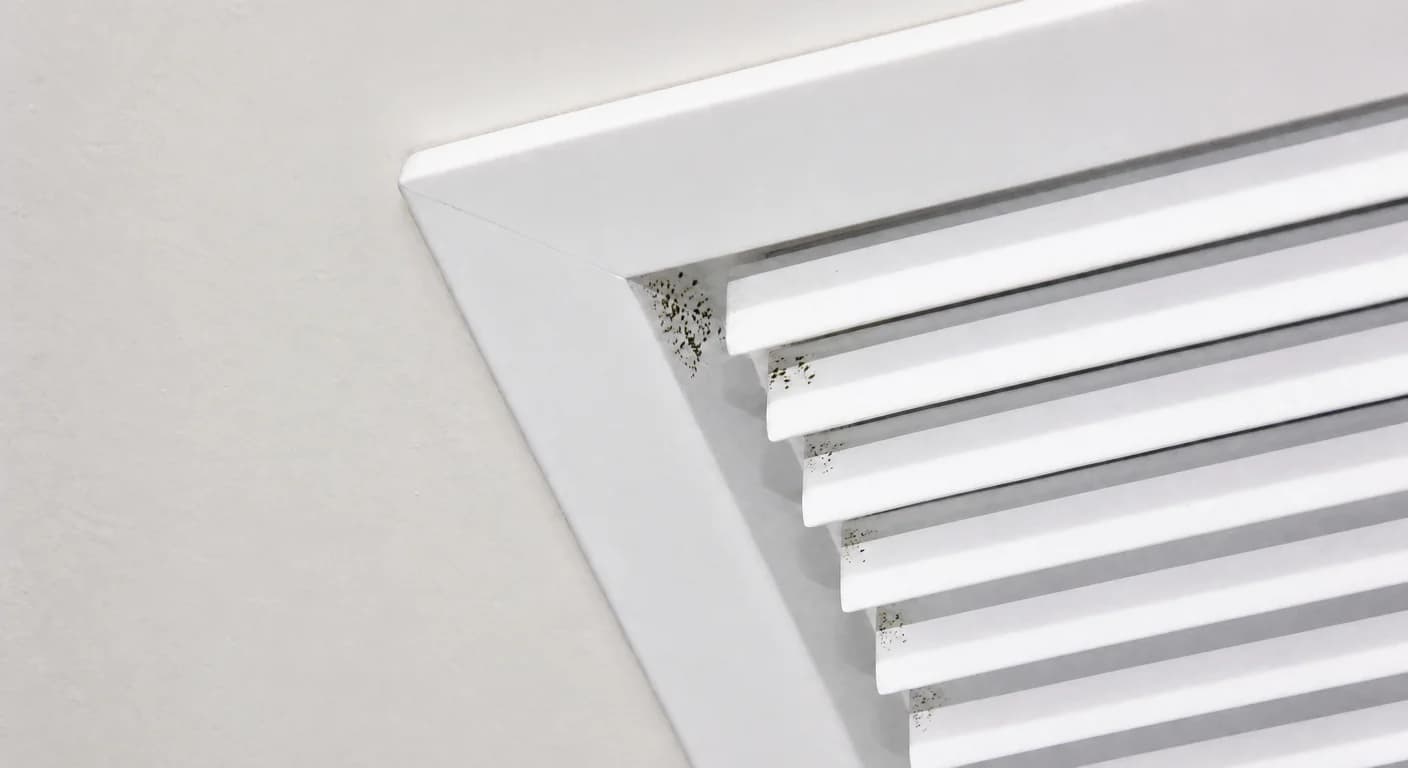
Is the mold only on the vent cover, or inside the system?
Take the cover off and look into the duct with a flashlight: growth that stops at the grille is a cleaning job, and growth on the duct, its insulation or the equipment is a system problem. Two possible hidden-mold spots EPA lists are inside the system. One is the condensate drain pan inside the air handler, the cabinet that holds the blower and the cooling coil. The other is porous insulation lining the inside of some ducts (EPA, Mold Remediation in Schools and Commercial Buildings, Chapter 3). A persistent musty odor with no visible source warrants investigation for hidden moisture or microbial growth.
One caution before you reach in. EPA tells duct cleaners to check for asbestos in insulation and register boots (the box the register screws into) before they clean, because only specially trained and equipped contractors should disturb it. Look without scraping or pulling at the boot or the insulation.
What your ducts are made of
EPA says to find out whether your ducts are sheet metal, flex duct, duct board or lined with fiberglass, because the cleaning methods vary by type, and a system can have more than one.
| Duct type | If it has mold |
|---|---|
| Bare sheet metal | May be cleanable where its condition and access allow |
| Lined duct or duct board (fiberglass) | Wet or moldy fiberglass duct liner or duct board should be removed and replaced rather than cleaned |
| Flexible (flex) duct | May be cleanable when its condition, access and the cleaning method allow; contaminated sections that can't be successfully remediated are removed and replaced |
The fiberglass row is EPA's: wet or moldy duct insulation can't be cleaned effectively, and there are no antimicrobial products or biocides approved by EPA for use on lined ductwork (EPA Mold Course, Chapter 2). ANSI/IICRC S520-2024, the industry standard for professional mold remediation, is more conditional. It says lined duct, duct board and flex duct that can't be successfully remediated should be removed and replaced (§10, p. 52). EPA's duct guide adds that soft brushes can clean flex duct, though replacing it where it's easy to reach can cost less.
Should you keep running your HVAC if you think there's mold?
No. EPA says not to run an HVAC system if you know or suspect that it is contaminated with mold (EPA, Chapter 3). A contaminated HVAC system can distribute mold spores or fragments beyond the source area. S520 says a system found contaminated should stay off until it's been cleaned, repaired, and any contaminated porous material replaced (§10.2.2, p. 53).
Extreme heat or cold is the hard case. EPA's Mold Course allows a professional to run all or part of a system only where there's "no risk of increasing occupant or worker exposure" (EPA Mold Course, Chapter 5). If someone in your home can't safely go without heating or cooling, say so when you call the HVAC professional. Our advice is to ask about temporary heating or cooling instead of running the system. If the home can't be kept at a safe temperature, go somewhere heated or cooled, such as a community cooling or warming center (call 2-1-1 to find one), and ask for an urgent HVAC visit. Don't restart the system on your own.
What can you safely do yourself?
You can wash a removable vent cover and work on the humidity; work inside the ducts or the equipment is for professionals experienced with HVAC systems, per EPA's Mold Course.
- Turn the system off before you start.
- Take the cover off, scrub it with detergent and water, and let it dry completely before it goes back (EPA, A Brief Guide). CDC's advice is to wear at least an N-95 respirator, goggles without vents, gloves, and long sleeves and pants.
- Don't spray, fog or pour anything into the duct. Steam cleaning and other moisture methods shouldn't be used on any kind of ductwork, according to EPA's duct guide.
- Bring the moisture down. Keep indoor humidity below 60 percent, keep air conditioning drip pans clean and the drain lines unobstructed and flowing properly, and use the highest efficiency filter your system's manufacturer recommends, changed regularly (keeping humidity down).
EPA's homeowner guide says mold covering less than about 10 square feet can, in most cases, be handled yourself. A suspected HVAC problem is one of its exceptions; there, EPA says to consult its duct guide before taking further action and not to run the system. Our recommendation: treat anything beyond the removable cover as professional work, whatever its size.
What does a professional do about mold in ductwork?
A sound job finds the moisture source, keeps the system off and isolated, removes what can't be cleaned, cleans the rest, and checks the result before anything is coated or switched back on. Each step below is cited, mostly to S520's HVAC section (§10).
EPA's Mold Course says HVAC remediation should be done only by professionals experienced with HVAC systems. In S520, the remediator should have HVAC training and experience, and repairs to the system go to a qualified HVAC professional (§10, p. 52). The cause of the growth should be found and fixed, with a written work plan before the work starts (§10, p. 52; §10.2.2, p. 53).
During the work, affected sections should be isolated and contained where possible, and the whole system powered off and contained where that isn't (§10.2.2 and §10.2.3, pp. 53-54). Lined duct, duct board or flex duct that can't be successfully remediated is replaced (§10, p. 52). For cleanable parts, S520 points to NADCA's ACR standard, ACCA Standard 6 and IICRC S590 for inspection, says their cleaning methods may be enough to remove the mold, and keeps the mold work's documentation and verification under S520 (§10.1, p. 52).
The remediator does its own post-remediation evaluation; an independent third-party verification can add assurance (§1.4, p. 24; Section B, p. 20). Any fungicidal or mold-resistant coating comes only after that check shows the system is back to Condition 1, S520's term for the normal condition of a clean, dry building (Section B, p. 14; §2.2, p. 27; §10.2.4, p. 54). The system may then go back into normal use once a qualified professional has inspected it and there's documented assurance it's back to Condition 1, and an HVAC professional should confirm it runs as intended (§10.2.2 and §10.2.3, p. 54).
S520 also sets rules for the products themselves (§10.2.4, p. 54). An antimicrobial used in HVAC equipment must be registered by EPA or another applicable regulator for that HVAC use and applied according to its label. Coatings or sealants claiming antimicrobial performance have corresponding HVAC-specific registration and application requirements. If the directions can't be followed completely, the product isn't used, and it shouldn't go where the surface can't be directly observed.
The standard also says when to bring someone else in. If the remediator can't tell how contaminated the system is, it should engage an indoor environmental professional or recommend that you do. When health issues are reported and suspected to be related to the mold, it should recommend one, plus a qualified health care professional (§10.2.2, p. 53). Our view: pick an assessor who isn't also doing the remediation (an independent assessment).
Floodwater in ductwork is a water-damage job under a different standard, and outside this page.
How do you judge a duct-cleaning or mold-fogging quote?
EPA's advice is to talk to at least three companies, get written estimates, and ask each one to show you the contamination before you agree to anything.
EPA suggests a few checks before you sign:
- Did they show you growth in your system? EPA calls petri-dish (settling-plate) demonstrations inappropriate, because some microorganisms are always present in the air.
- Are they making sweeping health claims, or selling cleaning as routine maintenance? EPA, in fact, recommends cleaning only as needed, and says duct cleaning has never been shown to actually prevent health problems.
- A claim of EPA certification is a reason to be wary. EPA doesn't certify, endorse or approve duct cleaning companies.
- Do they want to apply a biocide or a chemical treatment? Don't allow it until you fully understand the pros and cons. EPA notes that little research has tested whether most biocides or ozone work inside ducts, and that spraying into an operating system can carry it into other parts of the home. EPA, NADCA, NAIMA and SMACNA don't recommend routine use of sealants, and in EPA's guidance a sealant never goes over wet duct liner, active growth or debris, and comes only after cleaning.
- Can they give references and a clean record with consumer affairs or the Better Business Bureau? Ask about experience with systems like yours, NADCA's standards (NAIMA's for fiberglass) and state licenses, and get the total cost and scope in writing before work begins.
S520 adds its own tests. Fogging, spraying or gassing in place of physically removing mold is, in its words, "a deviation from this standard of care," and that covers a building's systems too (§1.4, p. 24). Fog instead of removal is the problem, not every fog (what fogging can and can't do). Inside an HVAC system, antimicrobials should never substitute for removal, and neither antimicrobials nor coatings should go where the surface can't be directly observed (§10.2.4, p. 54). S520 says coatings shouldn't be used in place of removal, and come only after the check (§2.2, p. 27; what professionals use on mold).
For prices, see what HVAC mold work costs.
What about mold in a window or portable air conditioner?
A window or portable unit collects water from the air, and when that water doesn't drain, mold can grow inside it. In 2025, about 1.7 million window units were recalled because pooled water could fail to drain quickly, and mold could grow in it (CPSC recall notice). Check the notice for your model.
If "the AC" in your house means the central system's indoor coil and drain pan, everything above applies. For a window or portable unit, follow the manual for what you can reach and keep its drain clear. If growth is inside the unit beyond what the manual lets you clean, or keeps coming back, our advice is to stop using it and contact the manufacturer, or replace it.
Can mold in your air ducts make you sick?
For some people, mold can cause a stuffy nose, sore throat, coughing or wheezing, burning eyes, or skin rash, and people with asthma or who are allergic to mold may have severe reactions (CDC). Those symptoms are common to many conditions, and they won't point to a vent, a room or a part of the system. If someone in your home has symptoms, talk to a healthcare provider; EPA's duct guide says the same. More on common symptoms of mold exposure.