What Does Black Mold Look Like? Photos and Look-Alikes
What does black mold look like? Dark green to black, slimy or powdery, on damp drywall and wood. See photos by surface, the look-alikes, and when to test.
Black mold is usually dark green to black, looks slimy and shiny when it is actively growing, and turns powdery as it dries. It spreads in irregular patches on damp, cellulose-rich materials like drywall, wood, and ceiling tiles.
If you are looking at a dark patch and trying to decide how worried to be, here is the part most pages skip: color and texture can tell you that you are looking at mold, and that it is worth taking seriously. They cannot tell you it is the toxic kind. Only a lab can do that. This guide shows what black mold actually looks like, surface by surface, how to tell it apart from the things people mistake for it, and what to do once you are fairly sure.
In This Guide
- What black mold looks like: color, texture, and pattern
- On different surfaces: drywall, wood, ceilings, showers
- Is it black mold, or something else?: the look-alikes
- You can't confirm it by sight: why a lab matters
- What to do if it looks like black mold: the next step
- Black mold appearance FAQ: quick answers
What black mold looks like
Black mold has four signals you can read at a glance: its color, its texture, the way it spreads, and where it grows. None of them confirms the species, but together they tell you whether you are looking at mold at all.
What black mold actually looks like
Four signals that tell you it is mold. None of them tells you the species.
Dark green to black.“Black” is misleading; many molds look dark.
Slimy and shiny when active; powdery and sooty when dry.
Irregular patches spreading from a moisture source, not straight lines or even dots.
On damp cellulose: drywall, wood, ceiling tiles, cardboard, wet for days.
Color
Black mold is usually dark green to greenish-black, not the true jet black the name suggests. In good light it can read as charcoal gray or very dark brown, and it often looks darker when it is wet. The color narrows down what you are dealing with, but it will not confirm a species, because mold changes color as it ages and several different molds fall into the same dark range.
Texture
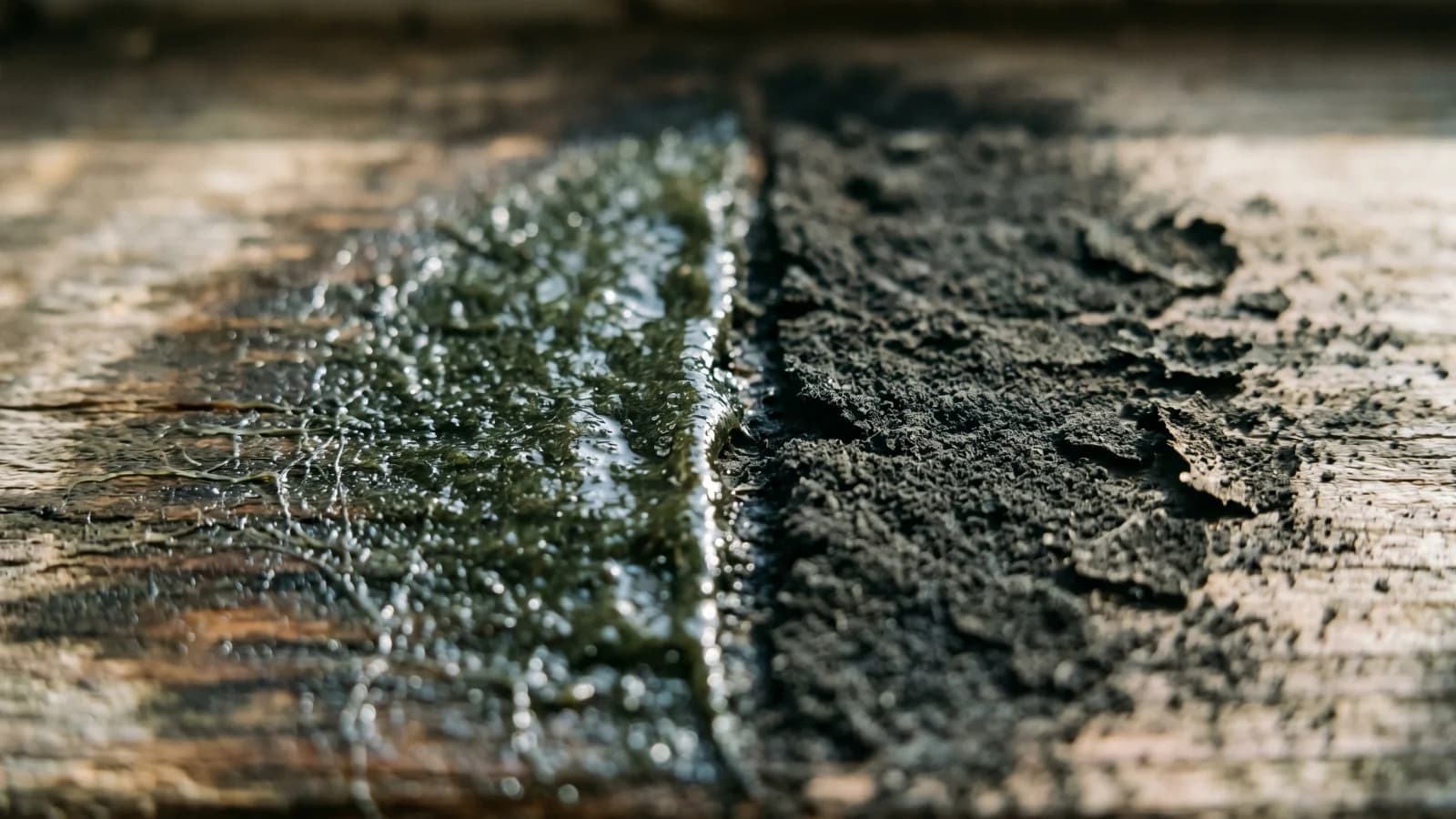
The texture of black mold changes with how wet it is, and that tells you more than the color does. Active, growing black mold looks slimy, gelatinous, and faintly shiny, almost wet. As the same colony dries out it turns matte, powdery, and sooty, and flakes lift easily. The dry state matters for a practical reason: disturbing dried growth sends spores into the air, which is why you do not want to wipe, brush, or fan a patch before you know what it is.
Growth pattern
Black mold grows in irregular, organic patches that spread outward from a moisture source, not in straight lines or evenly spaced dots. It needs cellulose to feed on (drywall paper, wood, ceiling tiles, or cardboard), and that material has to stay wet for days before the colony takes hold, longer than the day or two that common molds need. That is why black mold tends to show up around chronic leaks, condensation, and old water damage rather than in spots that get damp once and dry out. Small dark specks clustered near a damp corner are often the early stage, before the patch fills in.
Are tiny black dots mold? Often, and not automatically. A cluster of small black or dark green specks near a damp corner, a leak, or a window that sweats is the usual early stage, and it spreads outward and starts to smell musty if the moisture stays. Dots that are perfectly uniform, hard to the touch, or sitting on a surface with no moisture history are more likely soot or dust, and a damp cloth settles it: soot smears, dust lifts, and mold neither wipes clean nor stays gone.
What black mold looks like on different surfaces
Black mold reads differently depending on what it is growing on, because the surface decides whether it sits on top or works into the material. Here is what it tends to look like in the places it shows up most.
On drywall and walls
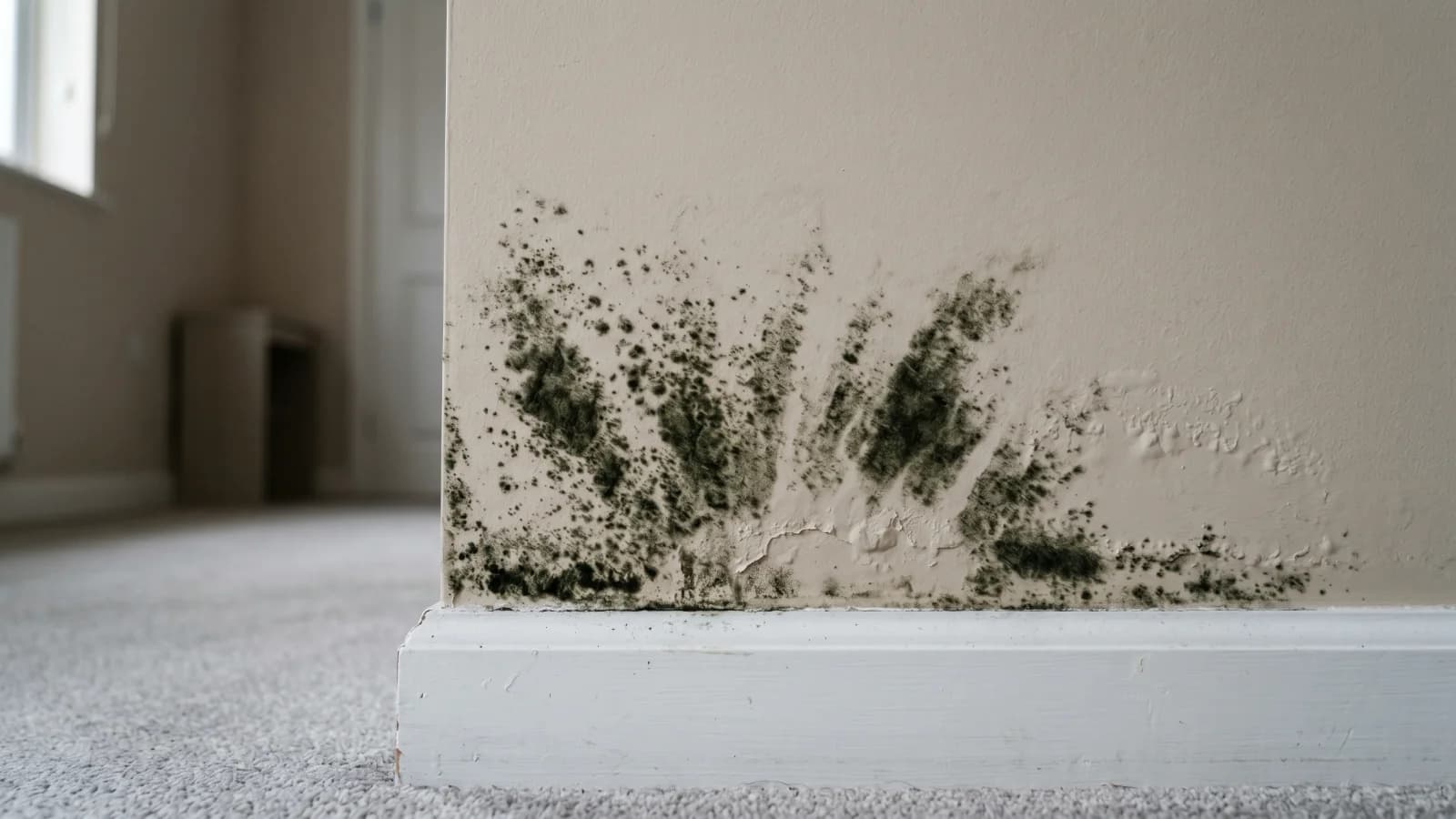
On painted drywall, black mold often appears as a raised, fuzzy patch that returns after you clean it. The paint film is non-porous, but the drywall behind it is porous and holds moisture, so growth that looks like a surface stain can extend into the board. A common pattern is dark growth climbing from behind a baseboard or spreading around a window, with the paint faintly bubbled above it where moisture rose through the wall. Bubbled or peeling paint over a dark patch is a sign the water source is inside the wall. The cause-and-fix breakdown, pattern by pattern, is in why mold grows on walls and how to fix it.
On wood and framing
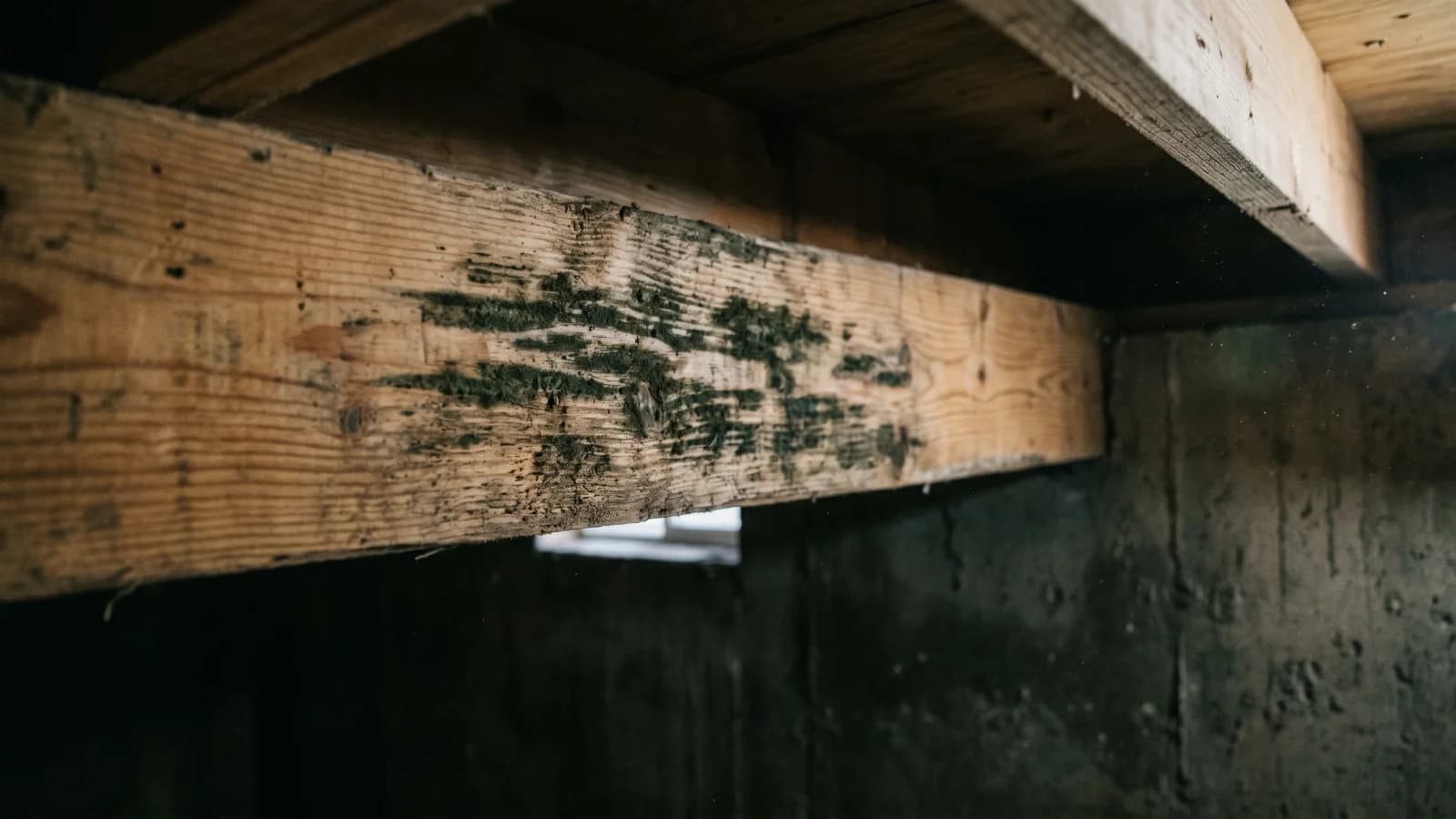
On bare wood, black mold follows the grain in dark green-black streaks and grows into the surface. You see it on floor joists, studs, and subfloor in basements and crawl spaces, and on the backs of trim and cabinets. Wood is porous, so growth below the surface here usually needs more than a wipe-down; the wood beneath often darkens and softens, and badly affected framing gets cut out and replaced. If the growth is in a basement or crawl space, see black mold in the basement, and for roof-line framing, black mold in the attic.
On ceilings
On ceilings, black mold usually shows up as a dark, spreading patch directly below a moisture source, most often a roof leak, a plumbing leak from the floor above, or condensation. It can look like a fuzzy stain that grows over weeks, sometimes ringed by a brown water mark. Ceiling growth is worth treating as a signal that water is coming from above, so the fix starts there. For attic and roof-line growth, see black mold in the attic.
In showers, tile, and grout
In a shower, the black growth along grout lines and caulk is usually a surface species, not Stachybotrys. It feeds on soap film and stays wet between showers, sitting on top of non-porous tile, so it tends to be a cleaning problem rather than one below the surface. The exception is when growth spreads from the tile onto painted drywall or the ceiling, or keeps returning in the same corner, which points to moisture behind the surface. For the full surface-by-surface playbook, see black mold in the shower.
On carpet, behind wallpaper, and window frames
On soft and hidden surfaces, black mold often looks like dark staining rather than a raised patch, which makes it easy to miss. On carpet and padding it appears as dark blotches, usually from a spill or a slow leak underneath. Behind wallpaper it grows where paste and trapped moisture feed it, so a bubbling or discolored seam can hide a colony. On window frames and sills it follows the line where condensation pools. In all three, a musty smell often arrives before the growth is obvious.
Is it black mold, or something else?
Plenty of dark marks are not mold at all, and plenty of mold is not the toxic kind. Before you assume the worst, check what you are seeing against the common look-alikes. The fastest tells are whether it is raised or flat, whether it wipes away cleanly, and whether it keeps coming back.
What gets mistaken for black mold, most often: soot and dust from candles, vents, and heaters; a dried water stain; efflorescence, the white crystalline powder on concrete and brick; surface mildew; and paint that has bubbled or darkened over a damp wall, which is a sign of water in the wall rather than mold itself. The other half of the confusion is real mold that isn't Stachybotrys: Cladosporium, Aspergillus niger, and Alternaria all grow black or dark green and look the same on a wall. The first group wipes away or dissolves. The second needs a lab.
If it is raised, fuzzy, spreads, or returns after cleaning, treat it as mold and connect with a verified professional for testing.
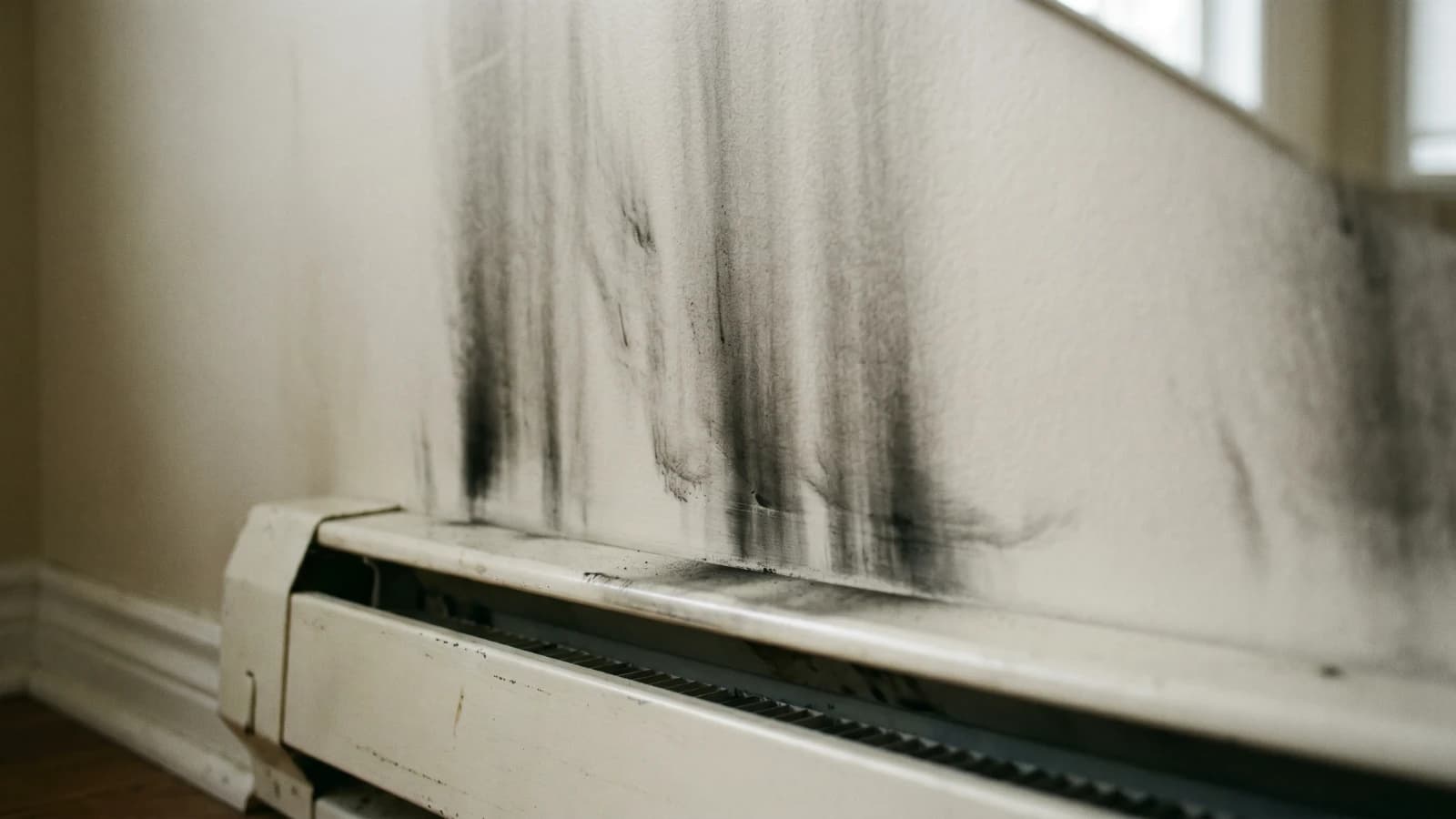
The two that fool people most are soot and efflorescence. Soot and dust from candles, vents, or heaters collect in flat, gritty, feathered streaks that follow airflow and wipe away with a cloth, where mold stands off the surface and smears. Efflorescence is the white, crystalline powder that shows up on basement concrete and brick; it dissolves in water, and mold does not, which is the quickest way to settle it. If you want the full color-by-color rundown of every household mold, see the full mold identification chart and photos.
You can't confirm toxic black mold by sight
Color and texture can tell you that you are looking at mold. They cannot tell you the species, and they cannot confirm so-called toxic black mold. The CDC states that the color of mold does not necessarily indicate whether it is more or less dangerous, and several ordinary molds look just like the one people fear. Cladosporium, Aspergillus niger, and Alternaria all appear black or dark green, and on a wall they can be indistinguishable from Stachybotrys chartarum.
Here is the part that saves people a lot of worry: you do not need the species name to act. The CDC advises treating all mold the same for health and cleanup, so confirming whether a patch is Stachybotrys does not change what you should do next, which is to find the moisture and remove the growth. A lab name matters mostly for an insurance claim or your own documentation, and that takes a sample, not a closer look.
"People send me a photo and ask if it is the toxic kind. I can tell them it is mold, and I can tell them it is worth taking seriously. What I cannot tell them, and what no one can tell from a picture, is the species. Two patches that look identical on a wall can be a harmless mold and Stachybotrys. The only thing that settles it is a sample in a lab."
Reviewed by Drew Fuller, IICRC-certified mold remediator, Principal at Restoration 365 (IICRC Certified Firm), Willow Grove, PA.
When you do want certainty, for a claim, a home sale, or symptoms you cannot explain, the right move is to get a professional mold assessment rather than guess from a photo. A certified assessor takes air and surface samples and a lab confirms what is there.
What to do if it looks like black mold
If you are fairly sure you are looking at black mold, the first rule is do not disturb it. Wiping, brushing, or running a fan near it sends spores through the rest of the house, and that is exactly what you want to avoid before the growth is contained. Take photos for your records, then size up the job.
The EPA's rule of thumb is the clearest line to start with: if the moldy area is smaller than about 10 square feet, which is roughly a 3 foot by 3 foot patch, in most cases a homeowner can handle it. Larger than that, on porous materials like drywall or wood, in the HVAC system, or after contaminated water, the EPA points people to professional remediation, because those jobs need containment and equipment a homeowner does not have. Black mold on a hard, non-porous surface under that threshold is the one case where careful do-it-yourself cleanup is reasonable.
The full step-by-step, including the safe way to handle a small patch, is in the guide on how to get rid of black mold. For anything bigger, or anything you are not sure about, an assessment is cheaper than guessing wrong.
Black mold appearance FAQ
The questions that come up most often, with the short answer first.
Frequently Asked Questions
What does toxic black mold look like?
What does harmless black mold look like?
What color is black mold?
What does early-stage black mold look like?
Is all black-colored mold black mold?
What does black mold look like on wood?
Are tiny black dots mold?
What is commonly mistaken for black mold?
What to do next
What black mold looks like tells you it is mold and that it is worth taking seriously. It does not tell you the species, and per the CDC it does not need to, because the response is the same either way: find the water, do not disturb the growth, and deal with it based on size and surface. The growth comes back until the moisture does not, so the lasting fix is always the water source.
This guide is for educational purposes only and is not a substitute for professional advice. Health information is summarized from CDC and EPA mold guidance; verify any specific health concern with a healthcare provider. Always consult certified professionals for mold situations in your home.