Mold on Walls: Causes, Fixes, and Danger (2026)
Where mold sits on a wall is a clue to what is feeding it. How to read the pattern, when scrubbing is safe, when drywall comes out, and when to call a pro.
The couch has been hiding it for a while: a dark patch, low on the paint. Mold on a wall is a moisture symptom, and where it sits is a clue to the source; the pattern, checked against the moisture, decides whether you scrub the wall or open it.
Most wall mold gets cleaned on sight and diagnosed never. Reverse that order. What kept the spot wet decides the tools, the budget, and whether the drywall stays.
In This Guide
- What mold on walls looks like: what each patch shape points to
- Black mold on walls: the halo matters more than the color
- Is the mold inside the wall?: the five signs and how pros check
- How to get mold off walls: whether wet drywall always molds, and the scrub-or-cut gate
- Can you paint over it?: why that fails, and when paint helps
- The fix that sticks: stopping the moisture
- Wall mold when you rent: document first, then report
- When it's a professional's job: the triggers and the cost question
- Mold on walls FAQ: quick answers
What mold on walls looks like (and what it means)
The spray bottle can wait; it'll still be there in five minutes. Walls repeat the same handful of mold patterns, and each one points toward a likely water source, so the patch you're staring at is your first clue to what kind of job this is. Treat the pattern as a clue, not a verdict: patterns can overlap, so confirm the source before you choose the fix.
Five patterns, five likely problems
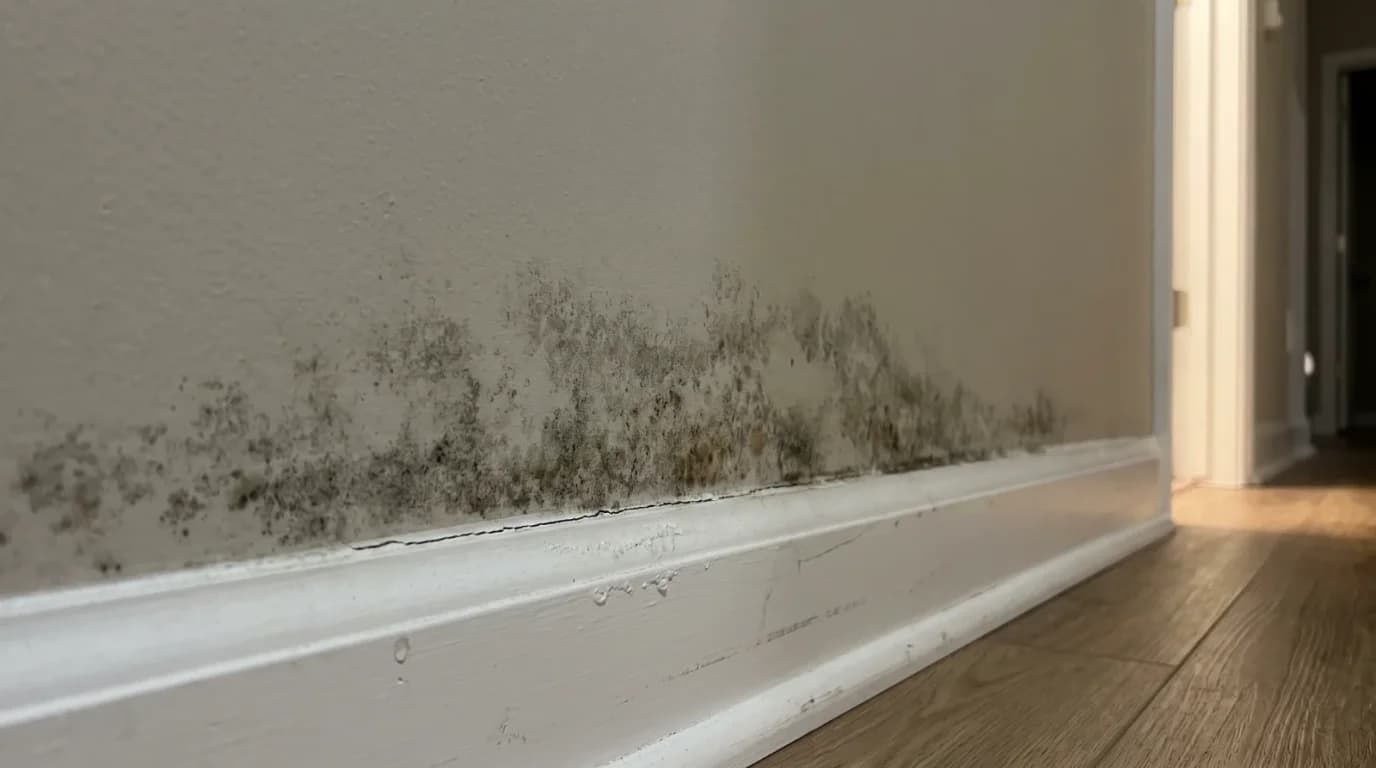
Usually water wicking up from below: a flood line, slab moisture, or a leak at the wall's base.
Find the water firstUsually condensation on the coldest spot in the room. Common behind poor insulation.
Usually DIY: airflow + humidityStud ghosting: cooler lines where framing sits, spaced 16 or 24 inches apart.
Usually humidity; check for a leak if it persistsUsually trapped air against a cool wall. The couch was the lid.
Pull furniture out a few inchesUsually water reaching the wall from inside. Treat it as an active leak until checked.
Stop scrubbing, call a proHugging the baseboard: usually water from below
A band of growth along the bottom of a wall, densest right at the trim line, usually means liquid water is wicking up from below: a past flood line, slab moisture, or a leak at the wall's base. This is the pattern that shows up in hallways and finished basements months after everyone thought the water event was over. Scrubbing it treats the top inch of a problem that starts at the floor. Find where the water came in first, and if the wall in question is concrete or block below grade, mold on basement walls and concrete is its own subject with different fixes.
Corners, stripes, and the patch behind the couch: usually condensation
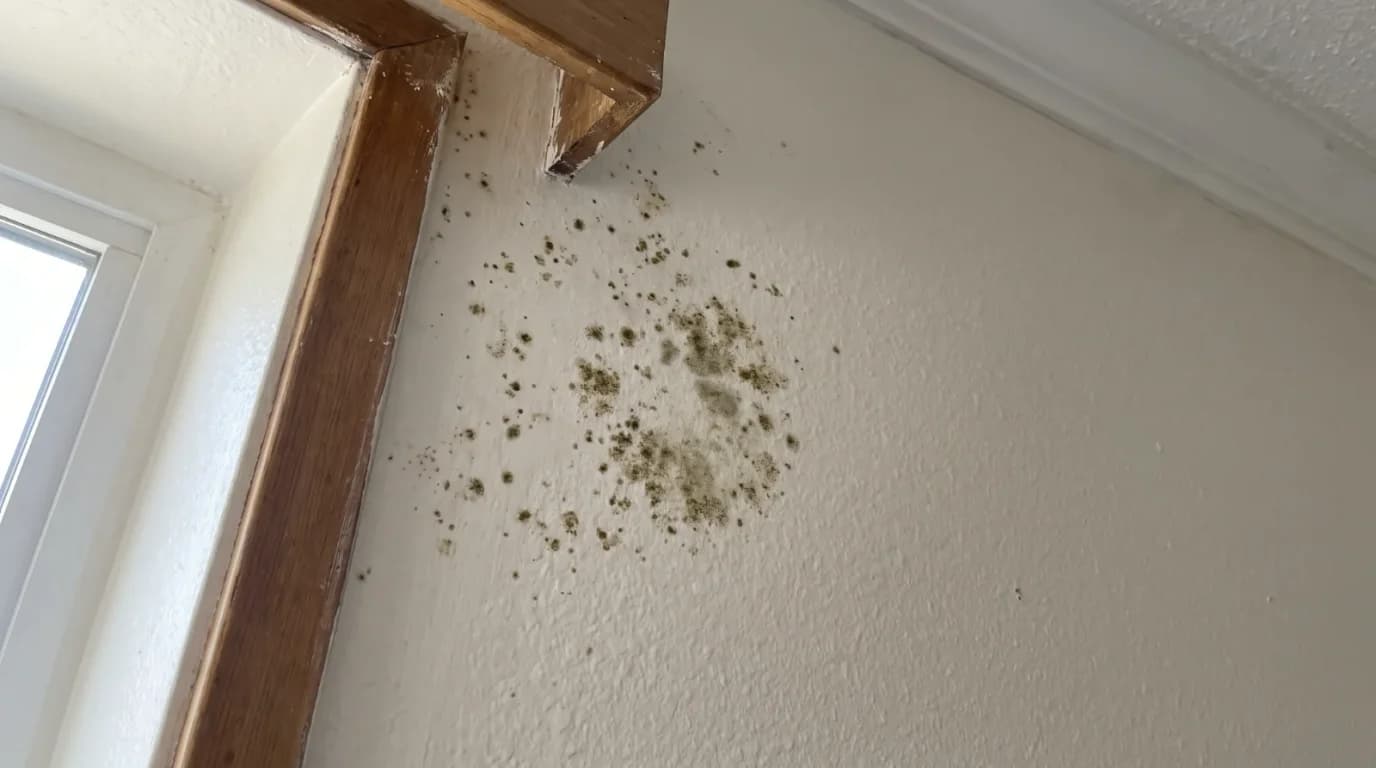
Speckled growth in the upper corner of an outside wall usually points to condensation: that corner is the coldest paint in the room, and moist indoor air keeps wetting it. The same physics writes two stranger patterns. Even vertical stripes, spaced 16 or 24 inches apart, follow the framing behind the drywall; the studs make cooler lines where condensation and fine dust collect, which is why the stripes are often ghosting rather than growth, and sometimes both. A patch behind furniture is trapped air against a cool wall; the couch was the lid. All three usually come back to the same thing, a humidity-and-airflow problem, though none of these patterns on its own rules out a leak, and it's the version you can usually fix yourself. One room is the exception; mold on bathroom walls has its own steam sources and its own guide.
A ring or halo around a stain: usually water from inside
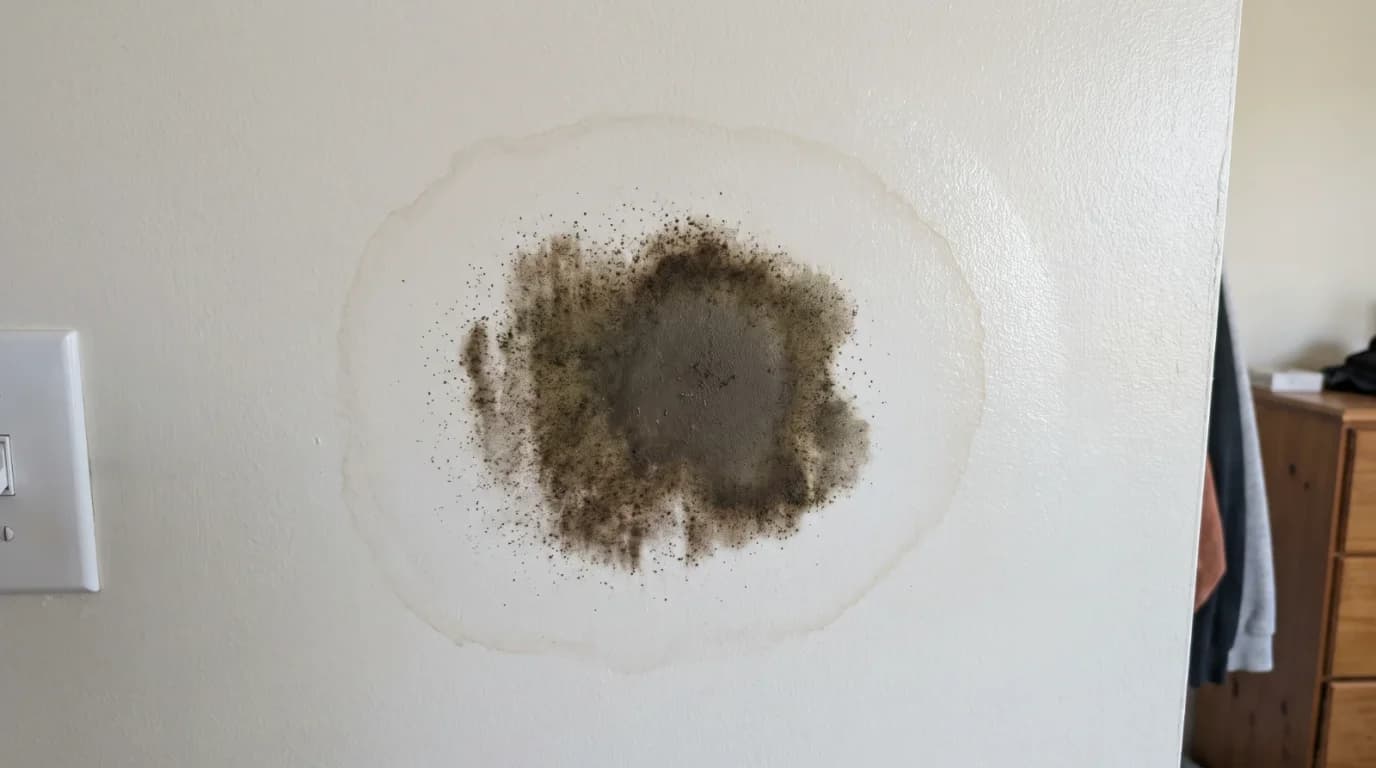
A patch surrounded by a tan ring or halo usually means water reached the wall from inside, and until it has been checked, you should treat that water as still active. Blistered paint nearby tells the same story from a different direction: water in the board, pushing outward. Put the sponge down. A halo patch cleaned from the room side stays wet on the cavity side, and if the leak is live, it is likely to regrow.
Is it even mold? The early-stage check
Mold caught small often reads as scattered pinpoint specks with a matte dullness that breaks the paint's sheen; rake a flashlight across the wall and the affected area goes flat while clean paint still reflects. Flat gray marks that never spread are usually ghosting or an old stain, and a flat white or gray film low on a damp wall may be what people call mildew, which is still mold, and the look can't tell you how far it goes into the board; mold or mildew? how to tell the difference covers what the two words mean and what to do. Color alone won't settle much: green, olive, brown, and black growth all get the same response on drywall, and the full mold identification chart and photos shows what different growth can look like, though no photo can name the species.
Black mold on walls: read the halo, not the color
Start with what surrounds the patch, not the patch itself. A tan ring or halo around dark growth usually means water reached the wall from inside; treat it as active until it has been checked, and that finding matters whatever the shade of what's growing. The color settles less than the internet suggests, and the CDC skips the species question for a reason: removal is the answer whatever a lab would have said, so identification doesn't change the job.
None of that makes mold harmless. It can irritate eyes and skin, stuff up a nose, and set off coughing or wheezing, and EPA notes it can cause asthma attacks in people with asthma who are allergic to mold; the people most at risk, anyone with a weakened immune system, asthma, or a mold allergy, are exactly the people who shouldn't be doing the scrubbing. If the stuffy nose clears every weekend you spend away, that pattern is worth a read through the full breakdown of mold exposure symptoms and a mention to your doctor. Size is a more useful signal than color, whatever the growth looks like: EPA puts homeowner cleanup at roughly 10 square feet, though it presents that as a benchmark rather than the point where a professional becomes necessary. And when heavy black growth does qualify for cleanup, the step-by-step black mold guide carries the full protocol.
Is the mold inside the wall?
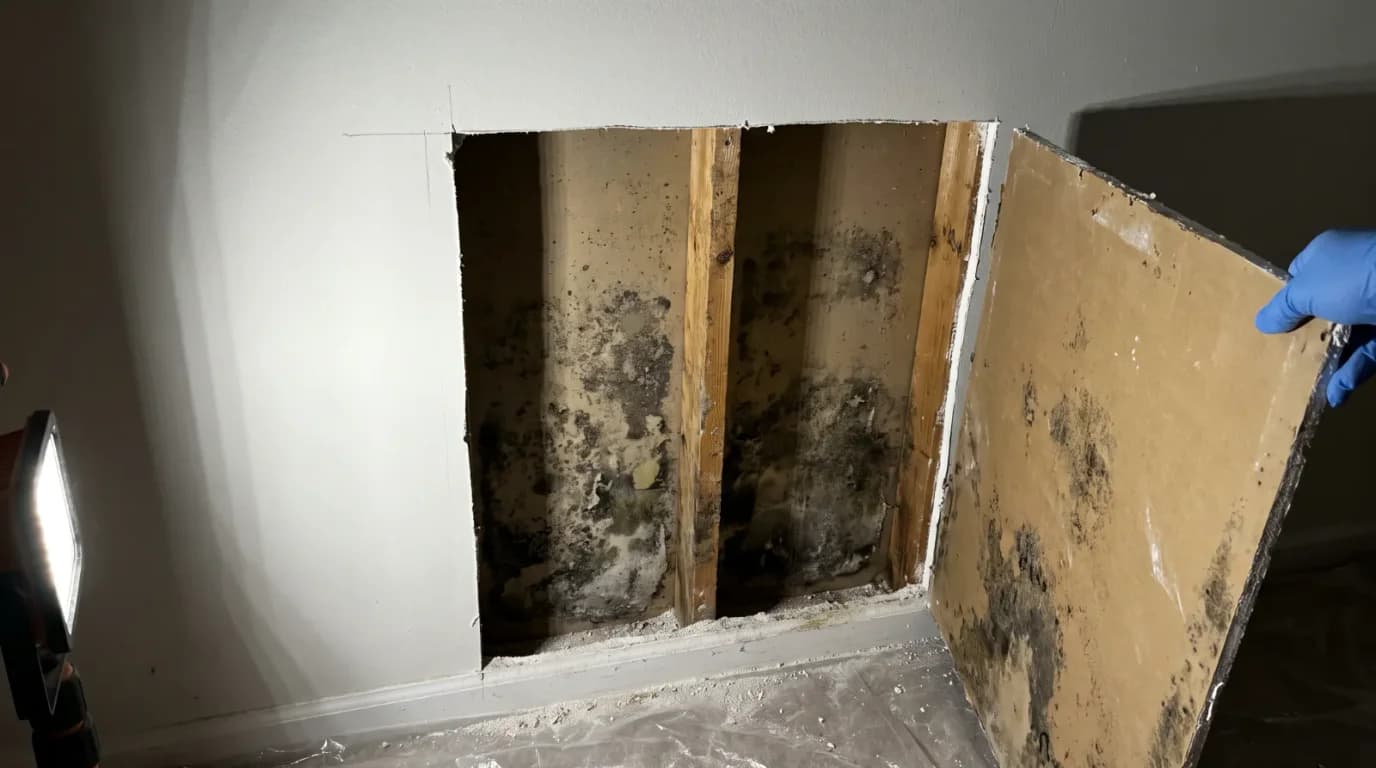
Good news: wall mold often lives on the wall, not in it. Bad news: the exceptions are expensive to guess wrong, in both directions. Opening a healthy wall wastes drywall and a weekend; wiping down the exit point of a cavity problem lets the real colony keep growing behind fresh paint.
The wall tells you before the meter does
The wall gives you five signs, and none of them require a single cut. A musty smell where nothing is visible. Paint that bubbles or flakes on its own. Drywall that gives under a firm fingertip press when the board around it feels solid. Growth that keeps coming back on the same stretch after a proper cleaning. And a leak you already know about, even a fixed one, behind that section of wall. One sign is a reason to check; two or more mean the checking should happen before anybody scrubs anything.
How pros check inside a wall
A professional assessor starts with a moisture meter, not a saw: meters that don't damage the wall map where the drywall is wet, readings are compared with the same material somewhere known to be dry, and pin probes, used where that's warranted and you agree, check the reading where it matters. Elevated readings map the water. Dry readings on a stained wall suggest the event may be over, though one dry reading doesn't prove an on-and-off leak is fixed, and a stain on its own doesn't show that mold remains. In fact that distinction is the whole value of checking first: it helps separate the walls that open from the walls that don't, before the saw comes out. If your wall is showing the signs above, get a professional mold assessment; it costs a fraction of exploratory demolition, and the report gives whoever does the repair a much better idea of where to work.
How to get mold off walls (and when not to try)
Mold on intact painted drywall is often a job you can do yourself, and the gate for it is short. The EPA's benchmark is about 10 square feet, roughly a 3-foot by 3-foot patch; under that, with the paint intact and the board firm, you can handle it in most cases. Ordinary detergent in warm water, or a peroxide cleaner if you have one, is all the chemistry the job needs. Skip the bleach on this surface: the EPA doesn't recommend bleach as a routine practice during mold cleanup, and on drywall it mainly changes the color, so a lighter spot doesn't show the growth is gone. Wear at least an N95 respirator, goggles without vent holes, and gloves, per EPA and CDC cleanup guidance, and never mix bleach with ammonia or any other cleaner; the CDC warns the combination produces a poisonous gas.
Will wet drywall always grow mold?
Drywall can get mold, and more easily than most surfaces: it's a gypsum core wrapped in paper, and paper is on EPA's list of the organic materials mold uses as food, so the paper face is what grows first whichever way the water arrived. But wet doesn't mean moldy. EPA's guidance is that materials dried within 24 to 48 hours of getting wet will, in most cases, not grow mold. A board that's splashed and dried the same day is fine. The one that stays damp past two days, or got soaked from behind where nobody could dry it, is the one at risk, and it can look clean on the painted side while growth starts. The five signs are how you find out, and a board that's gone soft comes out whatever the paint looks like.
The 10-square-foot question, and the two after it
Smaller than about 10 square feet? (EPA's homeowner benchmark)
Paint intact: no bubbling, flaking, or soft spots under a fingernail press?
Nothing stained through the paper face from behind?
Detergent or a peroxide-based cleaner; at least an N95, goggles without vent holes, and gloves. Never mix bleach and ammonia. If it comes back, have the moisture and the extent checked.
Board that has gone soft, or that mold has grown into, generally can't be cleaned back to normal. In an older wall, or one of unknown age, resolve asbestos and lead concerns first. Cut past the visible edge and fix the moisture before the new board goes in.
Drywall changes the math: scrub or cut
Drywall is a porous material, and the EPA's guidance for porous materials is that they may have to be thrown away once mold gets into them. The fingernail press is your first instrument. Solid under the nail is a good sign the board itself is sound; any give at all means the gypsum is wet through, and no cleaner fixes a board that's gone soft. Staining that has come through the paper face from behind is a different signal: water reached the board from the cavity side, so the cavity gets checked before anyone scrubs. The stain on its own doesn't show that mold has grown into the board; if it has, that section comes out too, because you can't scrub the inside of a board. Before cutting, sanding, or opening an older wall, or one of unknown age, resolve applicable asbestos and lead concerns: the CPSC lists patching and joint compounds for walls and ceilings among products that might have contained asbestos, and if the house went up before 1978, the paint may contain lead, and the EPA's lead-safety guidance is to treat disturbed painted surfaces carefully or have them checked first. Cut past the visible edge, fix the water, and let the cavity dry before the new piece goes in. For everything beyond the wall itself, the full room-by-room remediation walkthrough is the deeper reference.
Can you paint over mold on a wall?
No, and this one comes straight from the EPA: don't paint or caulk moldy surfaces, and its warning is that paint applied over growth is likely to peel. The mechanism is worth understanding so the shortcut stops being tempting. Mold feeds on the paper and dust in and on the drywall, so a new coat doesn't starve it. Paint is a lid on an active colony, and the colony wins that arrangement; the film blisters or the spots bleed back through.
The instinct behind the shortcut is sound, though; you want the wall to look finished, and paint feels like progress. The order is what matters. Cleaning comes first, the moisture repair second, a full drying third, and paint last of all. At that final step, a mold-resistant paint or primer is a legitimate upgrade on a wall with a condensation history. Used as step one instead of step four, the same can of paint is a delay purchased at full price.
The fix that sticks: stop the moisture
Mold grows on walls because something keeps them wet, and the cleaning only holds if that something stops. Condensation walls want drier air and moving air. Aim for indoor humidity under 60 percent (the EPA's ideal band is 30 to 50), and steal the free fix first: pull furniture a few inches off exterior walls so the paint behind it isn't sealed in still, moist air. Dry air is the whole trick. Leak-fed walls want the leak found and fixed before anything else, and speed matters more than people expect; the EPA's advice is to dry wet materials within 24 to 48 hours to prevent mold growth. A wall that's had its water source fixed and its surface cleaned doesn't need special treatment after that. It needs to stay dry, which is a habit more than a project.
Wall mold when you rent: document first, then report
Take the photos before you touch anything. Date them, get the whole wall plus a close-up, and keep copies somewhere other than your phone. Then put it in an email with a date on it, not a doorway chat. The repair itself is usually the landlord's to make, though where that duty sits exactly is a lease-and-local-law question, and hidden in-wall mold especially deserves a professional assessment on record, because an assessor's written report is the kind of document a property manager acts on. If the growth comes back after a repair, photograph it again next to the old picture. That pair is strong evidence the fix didn't hold. And keep the humidity habits going in the meantime; they buy time while the landlord clock runs. For notices, deadlines, and who pays, see the full renter's guide to mold in an apartment.
When the wall is a professional's job
The distinction that matters is water-finder versus stain-remover. Anyone can wipe a wall. The professional you actually need can trace where the moisture enters, dry the cavity, and document both with meter readings before new paint goes on; that's the service to insist on when growth covers more than about 10 square feet, when any inside-the-wall sign shows up, or when a properly cleaned patch returns anyway.
On cost, the patch you can see is rarely the expensive part. If drywall is coming out, the source repair, the drying, and the rebuild set the budget; for real numbers by job size, see what mold remediation actually costs. Credentials are the other half of the decision. On Verified Remediation, licenses and insurance are verified where available; it's still worth asking who will actually do the work and what credentials that person holds.
Mold on walls FAQ
The questions homeowners ask most, with the short answer first.
Frequently Asked Questions
What causes mold on walls?
What does mold look like on walls?
Is mold on walls dangerous?
Can I paint over mold on a wall?
How do I know if mold is inside my walls?
When should moldy drywall be replaced instead of cleaned?
Can drywall get mold?
Will drywall always mold if it gets wet?
The short version
Pattern first, press test second, sponge or phone third. Bands and halos usually point to water; speckle and stripes usually point to humidity; soft board means stop. And a wall that regrows mold after every cleaning is telling you the moisture and the extent need another look, starting with where the water is coming from.
This guide is for educational purposes only and is not a substitute for professional advice. Health information is summarized from CDC and EPA guidance, lead-paint information from EPA guidance, and asbestos information from CPSC guidance; verify any specific health or safety concern with a qualified professional. Always consult certified professionals for mold situations in your home.