Mold on the Ceiling: Causes, Danger, and Fixes (2026)
Mold on the ceiling usually means water from above. Find the cause by location, match it to the right fix, and know when to call a verified pro.
Mold on a ceiling almost always means water came from above: a roof leak, a pipe in the floor overhead, or condensation. The spot you can see is usually the smallest part of the problem, because the water that fed it sat in the space above the drywall first.
If you are standing under a dark patch trying to work out whether this is a thirty dollar problem or a three thousand dollar one, the location and pattern of the growth will tell you which. This guide walks you through finding the cause, matching it to the right fix, and knowing when the ceiling is hiding more than it shows.
In This Guide
- First, find the cause: four water sources, read by location
- Why a ceiling is different: the hidden-damage truth
- Is it even mold?: stains, ghosting, and efflorescence
- Is mold on the ceiling dangerous?: the honest risk picture
- Match the fix to the cause: why one cleaning method fails
- Popcorn and textured ceilings: the asbestos warning
- Can you clean it yourself?: the DIY line
- Ceiling mold FAQ: quick answers
First, find the cause: where it is tells you what it is
What causes mold on a ceiling is almost always one of four water sources, and where the growth sits tells you which one. This is the step every quick cleaning guide skips, and it is the one that decides whether your fix holds or fails in three weeks. Read the location and pattern before you reach for a spray bottle.
The four causes of ceiling mold
Where A top-floor or top-story ceiling.
The tell A defined brown or yellow ring with mold at its edge.
The fix Fix the roof, dry the cavity, replace the wet drywall, then clean.
Where Directly under an upstairs bathroom, laundry, or kitchen.
The tell Growth under a wet room, often soft drywall.
The fix Shut off the water, open the cavity, dry or replace inside, then clean.
Where The perimeter and corners of a top-floor room.
The tell Spread along the cold edges, not one spot.
The fix Add insulation and ventilation so it stops recurring, then clean.
Where A whole bathroom or laundry ceiling.
The tell An even haze across the surface.
The fix Run an exhaust fan, then clean. Often a genuine do-it-yourself job.
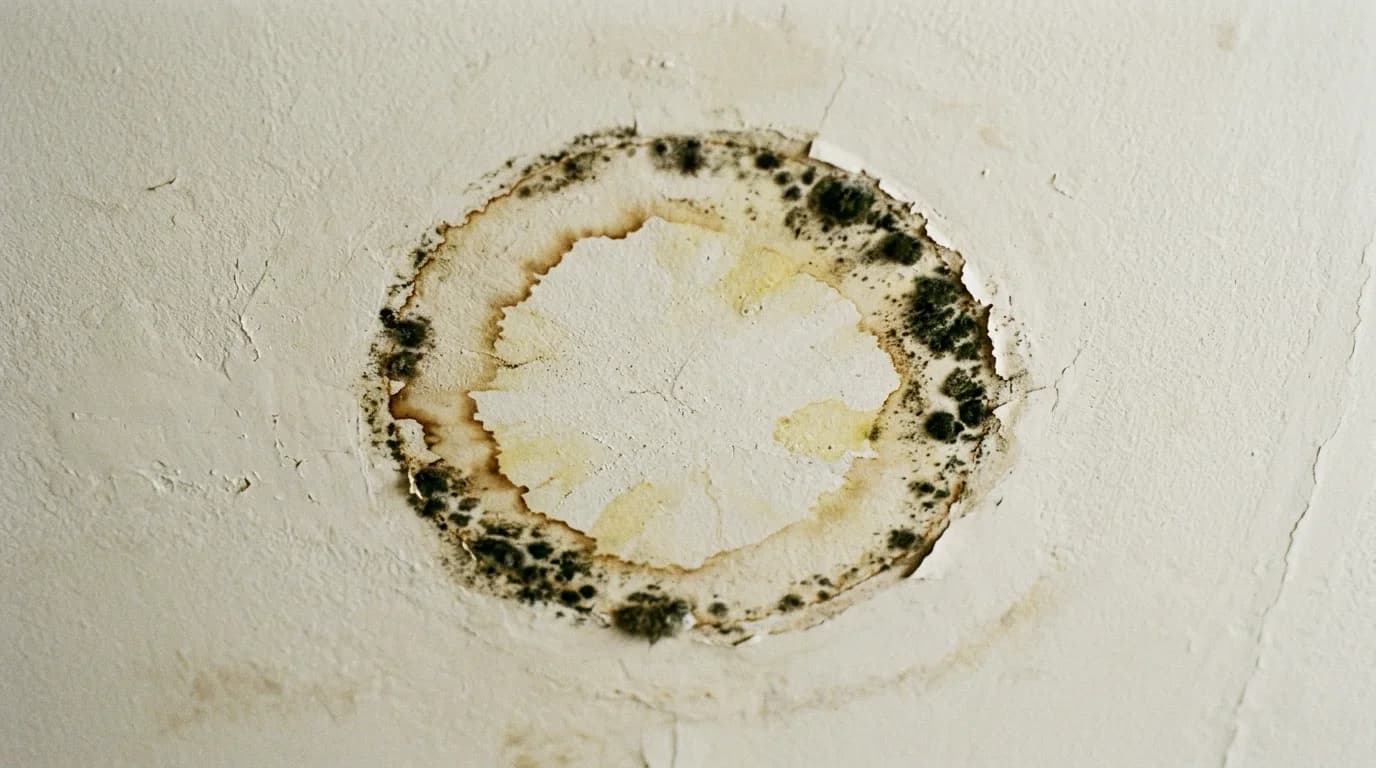
A defined brown or yellow ring means a roof leak
A circular brown or yellow stain with mold growing at its edge is the signature of a roof leak. Water tracks down from a failure in the roof or flashing, spreads as it hits the ceiling, and dries into a ring with a darker center. The growth follows the damp edge. A roof-leak ceiling needs the roof fixed and, more often than not, the wet drywall cut out and replaced before any cleaning, because the material has usually been soaked from above.
Growth at the perimeter of a top-floor room means condensation
Mold spread across the edges and corners of a top-floor ceiling, rather than in one defined spot, usually points to condensation rather than a leak. Warm indoor air meets a cold ceiling under an under-insulated or under-ventilated attic, and moisture forms on the coldest surfaces, which are the perimeter and the corners. Scrubbing it does nothing lasting, because the attic conditions rebuild the moisture every cold night. This is an insulation and ventilation problem, and the attic mold and condensation guide covers the fix that actually stops it.
Growth under an upstairs wet room means a plumbing leak
Mold directly beneath an upstairs bathroom, laundry, or kitchen usually means a plumbing leak, and the important part is that the growth is inside the ceiling cavity, not on it. The spot on the drywall is the exit point; the colony is in the wet space above. Wiping the surface accomplishes nothing here. The fix is to shut off the water, open the ceiling, and dry or replace what the leak soaked. If the drywall is sagging or bulging, that comes first: it's holding water and it's heavy. Keep people out from under it, and follow the Red Cross's guidance on draining a bulge: poke holes starting at its outer edge so the water comes out slowly, and never strike the center, which can bring the whole ceiling down.
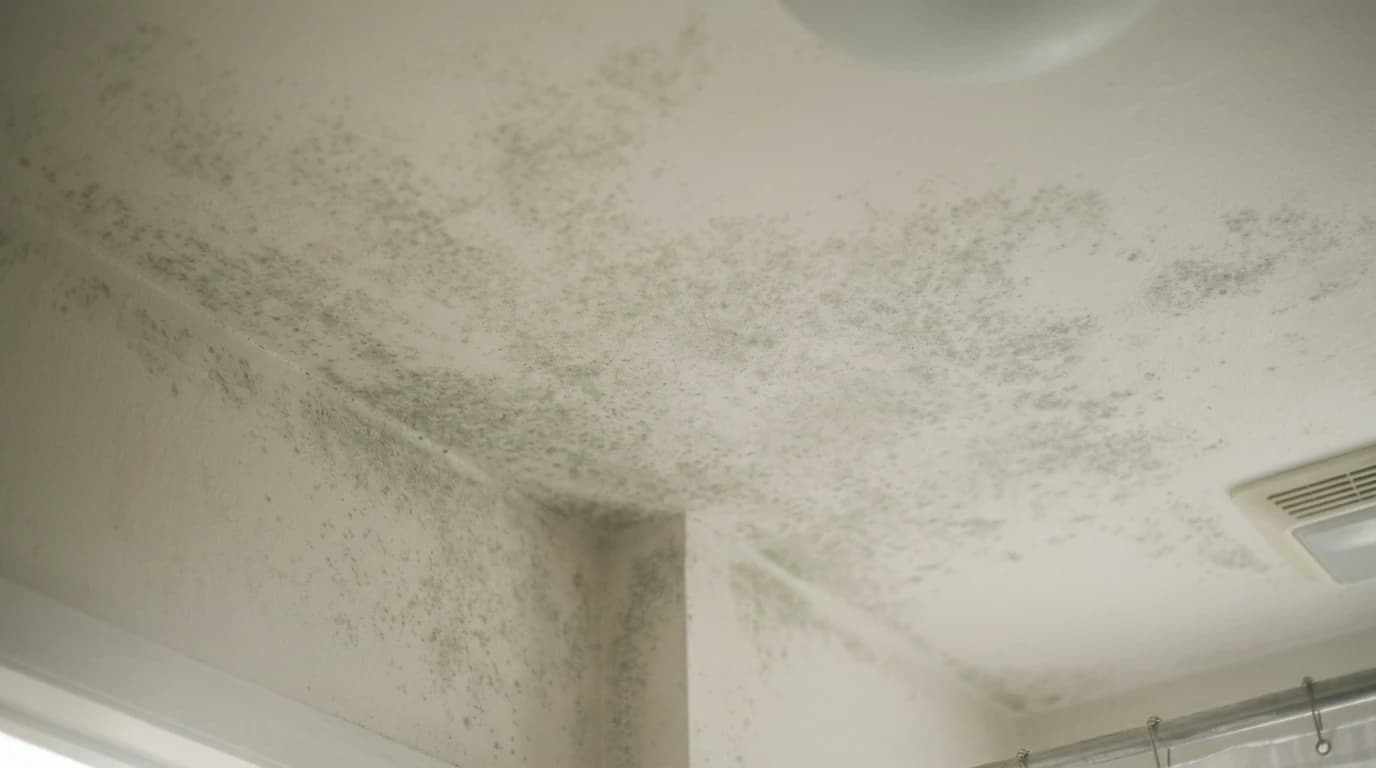
A whole-ceiling haze in a humid room means humidity
A light, even haze across a whole ceiling in a humid room is the most do-it-yourself-friendly cause, because it is surface growth fed by room moisture rather than a hidden leak. The usual culprit is a bathroom or laundry that stays damp. The fix is ventilation: an exhaust fan that actually moves air, run during and after the moisture. If the haze sits on the ceiling above the shower specifically, that is bathroom humidity; the dedicated guide to mold on the ceiling above the shower covers reading that pattern and the fan fix, and the full bathroom mold guide covers the rest of the room.
Why a ceiling is different
Because gravity pulls water down, a mold spot on a ceiling almost always means the drywall cavity, insulation, and framing above it are already wet. This is the single thing that makes a ceiling different from a wall or a shower stall, and it is why the visible mold is the symptom rather than the disease. The water reached the underside of the ceiling last, after sitting in the space above it.
That changes how you read the size of the problem. On a wall, the patch you see is roughly the patch you have; mold on walls is its own diagnosis and its own guide. On a ceiling, the patch you see can be a fraction of a wet cavity that spans several joist bays. Drywall that feels soft, sags, or shows a stain far wider than the mold itself is telling you the materials behind it need to come out, not just a wipe-down. When the cavity is the question and you cannot see inside it, get a professional mold assessment; a moisture meter reads what is behind the ceiling without opening it and turns a guess into a number.
Is it even mold? Stains, ghosting, and efflorescence
Before you treat anything, rule out the look-alikes, because not every dark patch on a ceiling is mold and some of them need a completely different response. Actual mold is raised and fuzzy, often grows back after you wipe it, and tends to follow a damp pattern. Three things get mistaken for it. A dried water stain is flat, usually a brown or yellow ring, and does not lift off. Soot or dust ghosting forms straight gray lines that trace the framing on a poorly insulated ceiling, because dust clings to the cold stripes over the joists; it is dirt, not growth. Efflorescence is a white crystalline deposit that dissolves in water, common on masonry, and it is mineral, not mold.
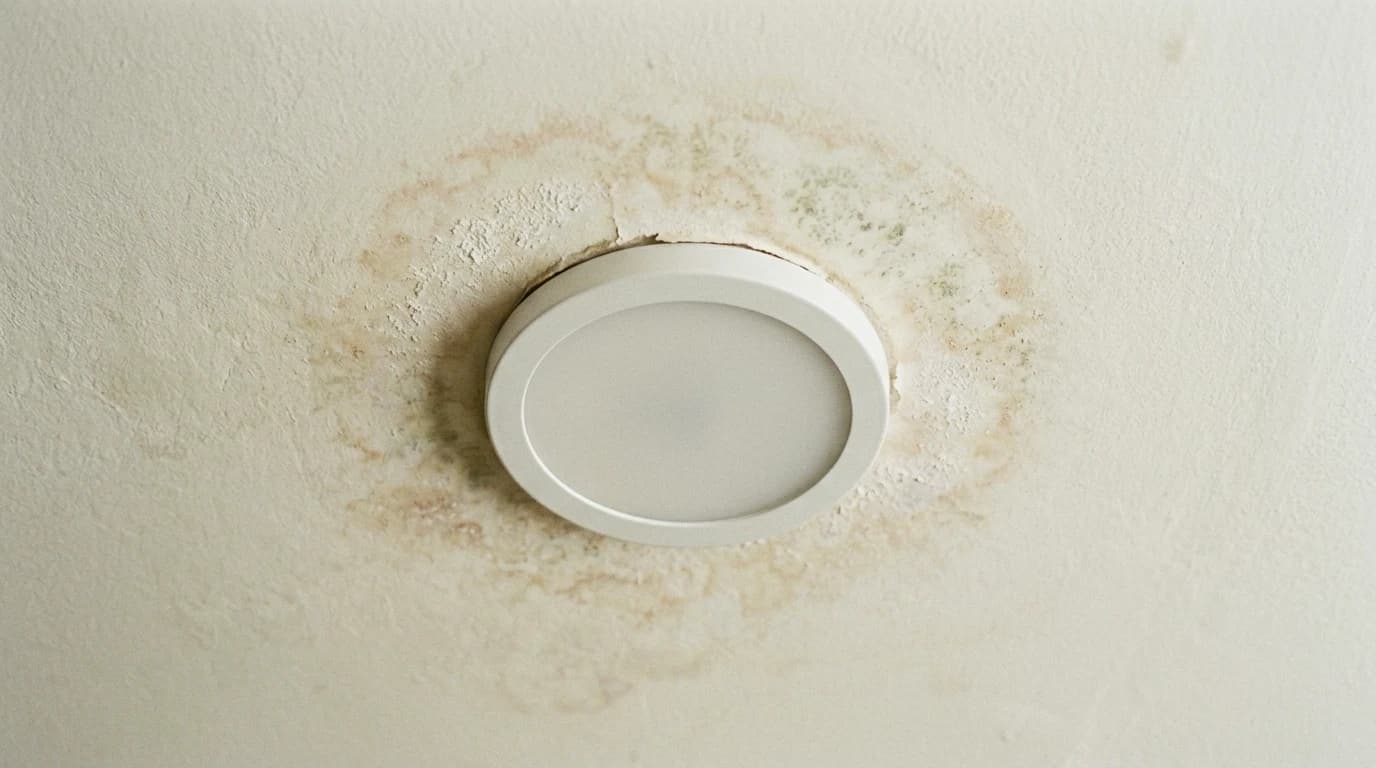
If the patch is flat and you are genuinely unsure, compare it against the full mold identification chart and photos before you spend a dollar treating it. White crystalline deposits on a basement or garage ceiling point to basement mold and efflorescence on concrete rather than a remediation job.
Is it even mold?
Raised and fuzzy, often grows back.
Flat ring, dry to the touch.
Straight gray lines that follow the framing.
White crystals that dissolve in water.
Mold versus mildew on a ceiling
Mildew is a surface mold that wipes off, while what people loosely call mold grows into porous material and comes back. On a ceiling, a thin film that lifts cleanly with a cloth is usually mildew and the mildest case you can have. Growth that returns in the same spot after cleaning has worked into the material, or the water feeding it is still there.
What the colors mean
The color of ceiling growth, whether black, yellow, white, or brown, does not tell you how dangerous it is or even confirm that it is mold. The CDC states that the color of mold does not necessarily indicate how dangerous it is, and that a species can only be confirmed by lab testing, which you do not need before acting. Yellow and white growth on a ceiling is as worth removing as black; treat the moisture, not the shade.
Is mold on the ceiling dangerous?
Black mold on a ceiling is not automatically the toxic kind, because color does not tell you how dangerous a mold is. The CDC is clear that it is not necessary to identify the species and that all molds should be treated the same way for removal. Even the often-feared black mold, Stachybotrys, has not been proven to cause the severe illnesses it is commonly blamed for, according to the CDC.
That said, mold on a ceiling is not harmless. The CDC reports that mold can cause a stuffy nose, sore throat, coughing or wheezing, burning eyes, or a skin rash, and that it can trigger asthma attacks in people who are allergic to it. Most healthy adults tolerate a small amount of ceiling mold, but people with asthma, mold allergies, weakened immune systems, infants, and the elderly carry the higher risk and should not be the ones removing it. Any growth that covers more than about 10 square feet, keeps returning, or comes with symptoms that ease when you leave the house deserves more than a household response. If anyone at home has symptoms like that, read the full breakdown of mold exposure symptoms and raise it with a doctor.
How worried should you be?
A small, dry patch, for most healthy adults.
Growth that is recurring or spreading.
Over about 10 square feet, or anyone with asthma, allergies, a weakened immune system, plus infants and the elderly.
Match the fix to the cause
The right fix for mold on a ceiling depends entirely on what caused it, because cleaning the surface does nothing if the water source is still feeding it. This is where the four causes pay off. The spray bottle is the last step, not the first, and for two of the four causes it is barely involved at all.
| Cause | The fix, in order |
|---|---|
| Roof leak | Fix the roof, dry the cavity, replace the wet drywall, then treat the surface |
| Plumbing leak above | Shut off the water, open the ceiling, dry or replace inside the cavity, then treat |
| Attic condensation | Add insulation and ventilation so it stops recurring, then treat the surface |
| Room humidity | Run an exhaust fan and clean the surface, often a genuine do-it-yourself job |
The EPA puts the principle plainly: if you clean up the mold but do not fix the water problem, the mold comes back. A roof-leak or plumbing-leak ceiling is a repair job with cleaning at the end; a humidity ceiling is a cleaning job with a ventilation habit attached. For the step-by-step removal once the water is handled, see how to get rid of mold the right way.
"On a ceiling, the spot you can see is almost never the whole job. Water runs downhill, so by the time it shows on the drywall below, the cavity above has usually been wet for a while. I've opened up 'small' ceiling spots and found a foot of soaked insulation and framing that needed to come out. Find where the water is coming from and stop it first. Cleaning a ceiling that's still getting wet just buys you a few weeks before it comes back."
Reviewed by Drew Fuller, IICRC-certified mold remediator, Principal at Restoration 365 (IICRC Certified Firm), Willow Grove, PA.
Popcorn and textured ceilings: the asbestos warning
Popcorn and textured ceiling coatings installed before the early 1980s can contain asbestos, and scraping or scrubbing them to remove mold is the real hazard. Asbestos was used in textured paint and in the patching compounds used on ceilings until it was banned in 1977, so a textured ceiling in an older home is the one surface where the cleaning is more dangerous than the mold.
The CPSC advises leaving asbestos material that is in good condition alone, and warns that doing minor repairs yourself is not recommended, because disturbing the material is what releases the fibers. Do not scrape, sand, or aggressively scrub a popcorn or textured ceiling of that age. Have it tested by a licensed asbestos professional before any removal, and if it does contain asbestos, both the testing and the removal belong to a trained, licensed pro. Textured surfaces also trap spores in their ridges, so even where asbestos is not a concern, surface cleaning alone tends to fail on them.
Can you clean it yourself, or do you need a pro?
The EPA's rule of thumb is that a moldy area smaller than about 10 square feet, roughly a 3 foot by 3 foot patch, is generally a job you can handle yourself. On a ceiling, treat that number as a floor rather than a limit, because the wet cavity above the visible patch can be several times larger than what you see.
A few situations take a ceiling out of do-it-yourself range no matter how small the patch looks. Soft or sagging drywall, or a stain much wider than the growth, means the cavity is wet and the materials need to come out. A suspected leak inside the ceiling, or growth tied to an upstairs bathroom, is a moisture problem behind a surface you cannot see. A pre-1980s popcorn or textured ceiling is an asbestos question first. And growth fed by contaminated water, such as a sewage backup, is a professional job regardless of size. In any of those cases, the cleaning is the easy part; finding and stopping the water is the job.
Mold on the ceiling FAQ
The questions homeowners ask most, with the short answer first.
Frequently Asked Questions
What causes mold on a ceiling?
Is black mold on the ceiling dangerous?
Is mold on a popcorn ceiling dangerous to remove?
How do I tell mold from a water stain on the ceiling?
Why does mold keep coming back on my ceiling?
When should I call a professional about ceiling mold?
When should I worry about a sagging ceiling?
What to do next
Read the ceiling before you clean it. The location and pattern tell you whether you are looking at a roof leak, a pipe, condensation, or simple humidity, and that answer decides everything that follows. Stop the water first, check whether the cavity above is wet, and save the surface cleaning for last. The one spot that keeps coming back is the spot trying to tell you where the water is.
This guide is for educational purposes only and is not a substitute for professional advice. Health information is summarized from CDC and EPA guidance, and asbestos information from CPSC and EPA guidance; verify any specific health or safety concern with a qualified professional. Always consult certified professionals for mold and asbestos situations in your home.