What Kills Mold? Products Professional Remediators Use
What kills mold, and why remediators remove it instead: the EPA-registered products, equipment, and IICRC-standard process they use on real jobs.
You searched for what kills mold. The results are mostly bleach. Or vinegar. Or a generic "call a professional" page with no information about what the professional is actually going to use on the wall.
There is no single product that makes a mold remediation job complete simply by ‘killing’ mold. The goal is to physically remove the contamination and correct the moisture condition that allowed it to grow. EPA notes that in most cases it is not possible or desirable to sterilize an area. ANSI/IICRC S520-2024 §1.4 makes physical removal of contamination the primary means of remediation, and EPA notes that dead mold may still cause allergic reactions in some people, so killing it without removing it leaves the job undone. Depending on the material, removal can mean cleaning, HEPA vacuuming, sanding, or taking out the affected component. An antimicrobial is used only where appropriate for the material and project, permitted by the label, and included in the work plan or protocol where applicable; for thoroughly cleaned non-porous materials, S520 §2.1.1 says antimicrobials are generally not needed.
Where chemistry is used on a remediation job, it comes from three categories of products: EPA-registered antimicrobials, encapsulant coatings, and post-remediation stain cleaners. Six specific products show up on most remediation trucks in the U.S.; the table below gives each one's EPA registration status, dilution, labeled dwell or dry-down time, and the job it's good for. Only one uses bleach chemistry, and it is a stain remover rather than an antimicrobial. The chemistry is also the smaller half of the answer; on a real job the work is physical removal under the IICRC S520 process, with HEPA air filtration capturing airborne particulate and 6-mil polyethylene containment used to control the spread of contamination. This guide names the products, the equipment, the process, and the surface-by-surface protocol pros use.
If you're cleaning a small patch yourself, our homeowner protocol covers small-patch work, roughly 10 square feet or less on a hard surface. This guide is for the next layer: what a competent remediator should be doing on the jobs that need one.
In This Guide
- The short answer: what kills mold (and what doesn't)
- Professional mold removal products: the 6 in a remediation truck (with EPA reg #s and dwell times)
- The controls and equipment that make remediation effective (HEPA, containment, PPE)
- How professionals actually remediate mold: the IICRC S520 process
- Surface-by-surface: what to use where
- What about black mold (Stachybotrys) specifically?
- What pros don't use (and why)
- When DIY ends and a professional starts
The short answer: what kills mold (and what doesn't)
The substrate decides whether chemistry is the answer
Tile, glass, metal, sealed concrete
Cleaned in place. Where an antimicrobial is used, it follows the contact time its own label specifies.
Concrete, unsealed wood
Judged on whether the material can be returned to Condition 1.
Drywall, insulation, ceiling tile, paper-faced
No product changes this. §1.4 calls physical removal the primary means of remediation.
Source: ANSI/IICRC S520-2024 §1.4 and Section B. Standard available from iicrc.org.
FIG. 01 / SUBSTRATE / 3 CASESverifiedremediation.comThree things come up on a remediation job. Physical removal is part of every job; the other two are chemistry, and they are supplemental.
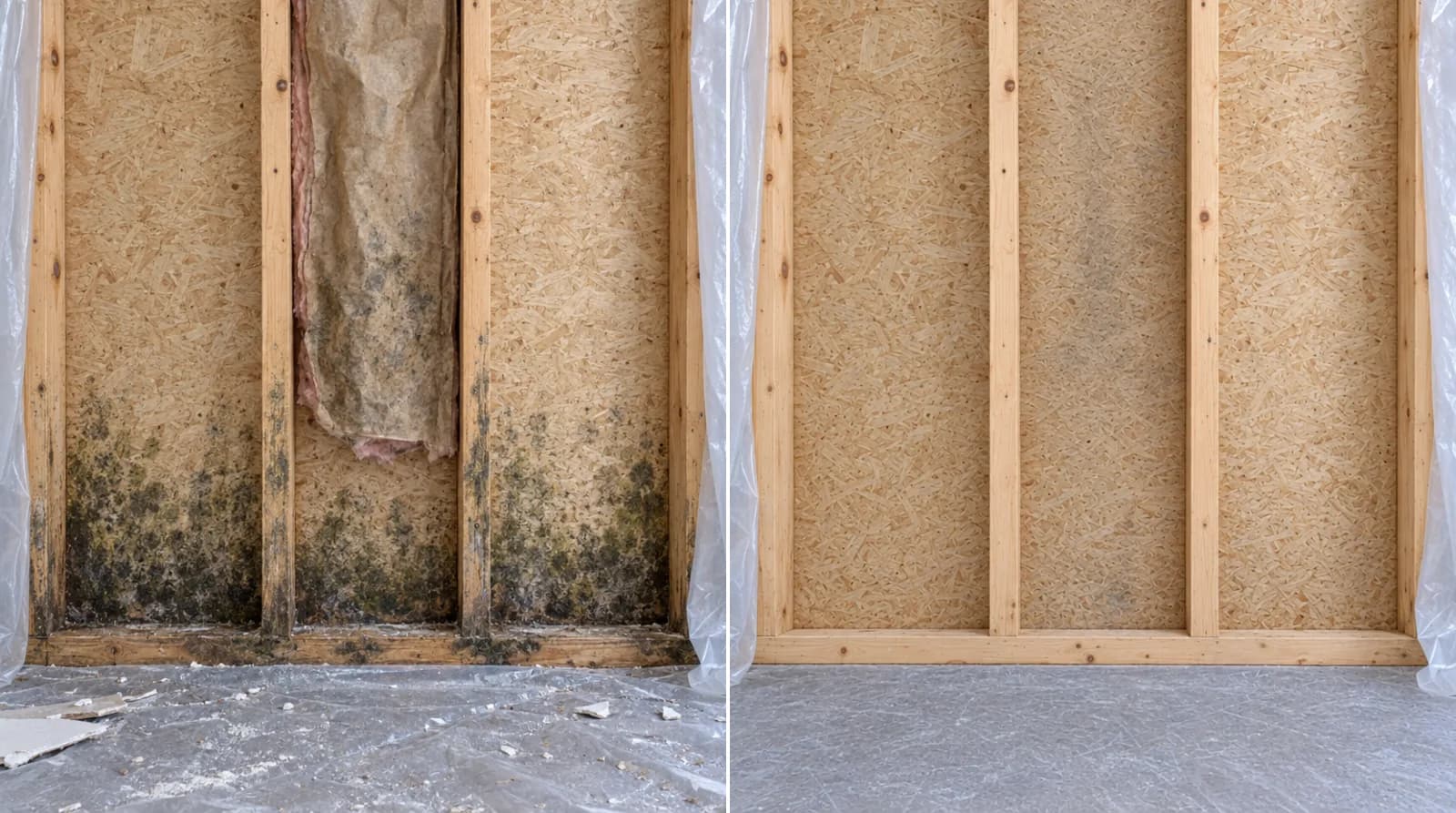
Physical removal plus HEPA filtration. Physically removing the contamination is the primary means of remediation (ANSI/IICRC S520-2024 §1.4). Affected framing gets sanded or media-blasted back to clean wood. Nonstructural porous materials such as drywall, carpet, insulation and ceiling tile are generally not cleanable once they are Condition 3, so they are commonly removed rather than cleaned. Semi-porous materials are evaluated case by case, and non-porous surfaces are generally cleanable. The test is whether the material can be returned to Condition 1. HEPA air scrubbing at a minimum of 4 air changes per hour (ANSI/IICRC S520-2024 §9.3.5) captures the spores that get airborne during removal.
EPA-registered antimicrobials. A supplemental surface treatment on some of the materials you're keeping, used only where appropriate for the material and project, permitted by the label, and included in the work plan or protocol where applicable. These are the products that do an actual chemical kill, with a labeled contact time and a registration number you can verify. Quat-based, phenolic and thymol-botanical formulations cover most of what's on a competent truck.
Encapsulants. A film-forming coating a project may call for on structural framing once it has been cleaned, dried and evaluated, to help protect it from future growth. Concrobium Mold Control and Foster 40-20 Fungicidal Protective Coating are two common examples. A coating is a supplemental step, never a substitute for removal.
What doesn't work, on the jobs that need a pro: relying on bleach instead of removing the porous material. ANSI/IICRC S520-2024 §1.4 calls physical removal of mold contamination the primary means of remediation, treating attempts to kill or encapsulate mold instead of removing it as generally not adequate. Vinegar has real but narrow antifungal activity; it's fine for surface mildew on bathroom tile, inadequate for active growth on drywall. Tea tree oil works in a petri dish; it doesn't scale to a 200-square-foot containment.
On a remediation job, mold is physically removed rather than killed in place. Chemicals, where they are used at all, are for surfaces being kept.
Professional mold removal products: the 6 in a remediation truck
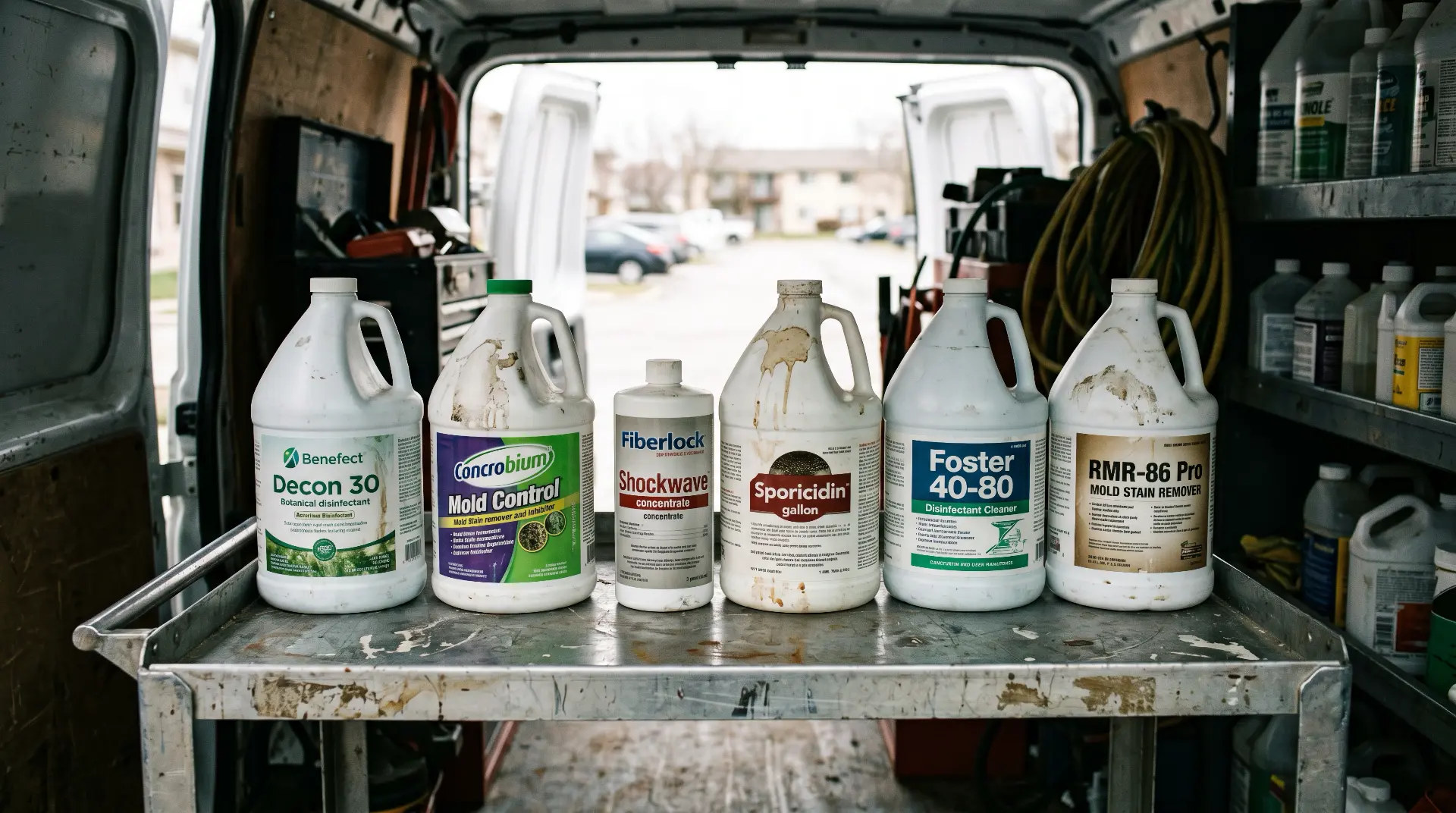
These six products show up on most U.S. remediation trucks. Five are EPA-registered antimicrobials with labeled contact or dry-down times; the sixth (RMR-86 Pro) is a sodium-hypochlorite stain remover applied only after cleaning, and any antimicrobial step, is complete. Each has a job it's good for; the spec sheet below maps each product to where its label allows it.
| Product | Active ingredient | EPA reg # | Surface | Dilution | Dwell | Best for |
|---|---|---|---|---|---|---|
| Benefect Decon 30 | Thymol (botanical) | 84683-3-74771 | Hard non-porous + sealed porous | Ready-to-use | 30 seconds | Botanical active; used on occupied-space jobs |
| Concrobium Mold Control | Sodium carbonate | 82552-1 | Structural framing post-removal | Ready-to-use | 24 hr dry-down | Encapsulant-style finish on remaining studs and sheathing |
| Foster First Defense 40-80 | Quaternary ammonium | 6836-152-63836 | Hard surfaces, HVAC sheet metal | Ready-to-use | 10 minutes | Broad-spectrum disinfection on water-damage and restoration jobs |
| Sporicidin Disinfectant Solution | Phenolic (phenol + sodium phenate) | 8383-3 | Hard surfaces, sewage backup | Ready-to-use | 10 minutes | Phenolic disinfection on hard surfaces and sewage backup |
| Fiberlock Shockwave (Concentrate) | Quaternary ammonium | 61178-1-73884 | Broad-spectrum hard surfaces | 2-4 oz/gal per label (about 1:64 to 1:32) | 10 minutes | Broad-spectrum use on hard surfaces per label |
| RMR-86 Pro / Rapid Mold Remover | Sodium hypochlorite | Not registered (stain remover only) | Cosmetic stain removal after cleaning | Ready-to-use | 15 seconds visible | Stain bleaching after cleaning is complete; not an antimicrobial |
A few non-obvious notes. Required wet contact time varies by product and labeled use, so follow the current EPA-approved label rather than a rule of thumb. Concrobium isn't a "kill" product in the disinfectant sense; it's an encapsulant-style product used, where a project calls for one, after the porous materials are out and the framing has been cleaned, dried and evaluated. Foster is a common source of confusion here, because the brand sells both: First Defense 40-80 in the table above is a quat disinfectant, while the encapsulant is the separate Foster 40-20 Fungicidal Protective Coating (EPA Reg. No. 63836-1). Fiberlock Shockwave also ships in a ready-to-use formulation (EPA Reg. No. 61178-2-73884) for jobs that don't justify the concentrate-and-dilute workflow.
RMR-86 Pro is the product TikTok shows in before-and-after videos, and it's the one that confuses homeowners the most. It isn't EPA-registered as an antimicrobial because it isn't one; it's classified as a stain remover. The dramatic visible result is sodium hypochlorite bleaching the stain pigment, not killing live mold. RMR Solutions (the same brand) sells RMR-141 RTU Disinfectant as their EPA-registered antimicrobial counterpart, for jobs where an antimicrobial is used. Pros use RMR-86 Pro only after cleaning is complete, for cosmetic stain cleanup on surfaces being kept.
EPA registration numbers above were sourced from manufacturer label PDFs and EPA records. Verify against the EPA Pesticide Product and Label System (PPLS) before relying on them for compliance purposes; manufacturers update registrations periodically.
The controls and equipment that make remediation effective
Inside a containment
The removal and cleaning happen inside this envelope, which helps minimize cross-contamination into the rest of the house.
- 16-mil fire-retardant polyethylene walls, taped at every seam
- 2Zipper door: the single entry and exit in this setup
- 3HEPA air scrubber: captures particulate and exhausts outside the work zone
- 4Supply vent sealed with poly
- 5Return vent sealed with poly
- 6Affected drywall cut out and bagged inside the containment
- 7Technician: respirator, coverall, sealed goggles, gloves
- 8HEPA vacuum on the surfaces being kept, during and after cleaning
Negative pressure: air leaks in rather than out, which helps control the spread of contamination.
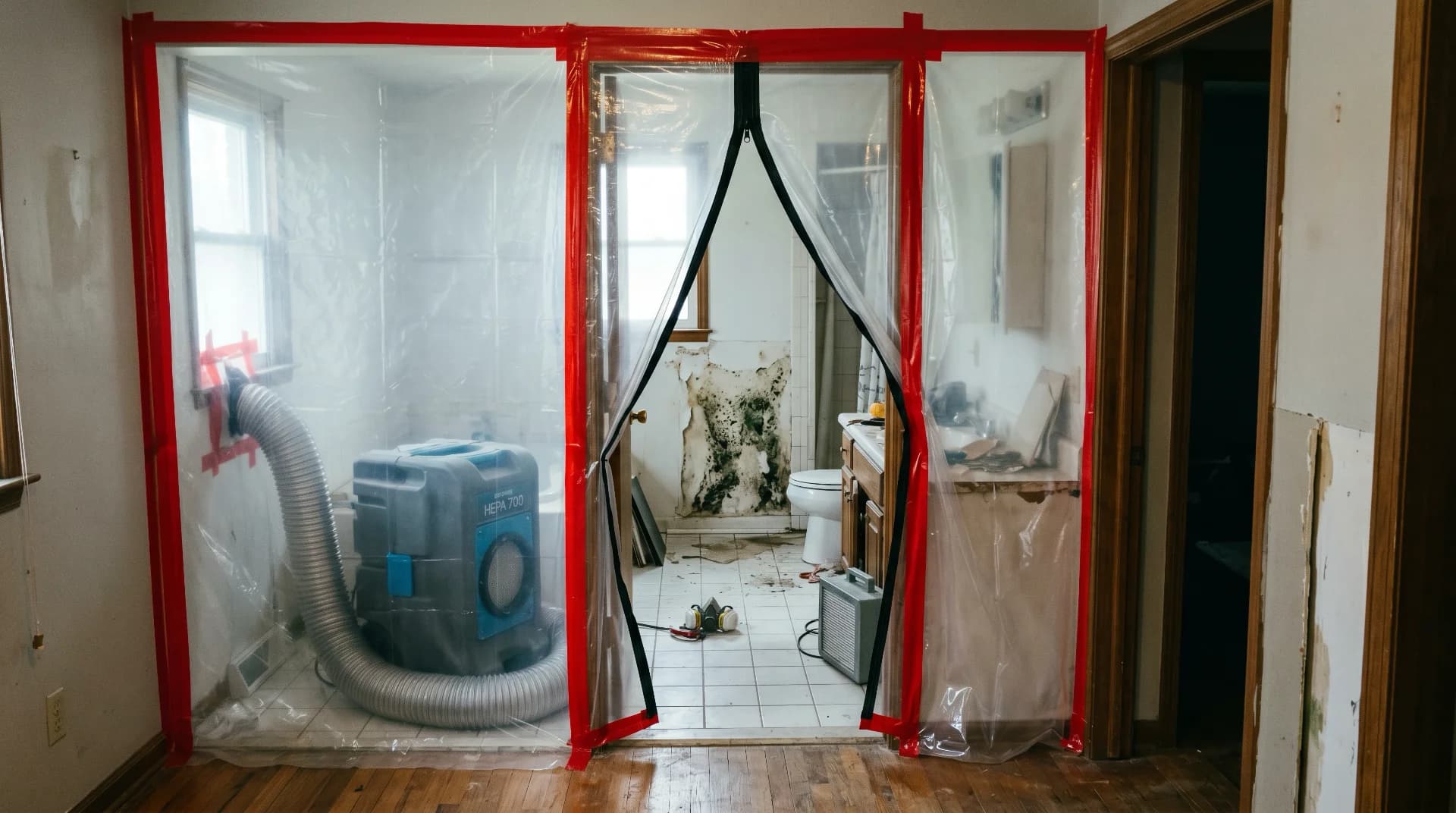
The controls and equipment are what make physical removal effective: HEPA filtration captures airborne particulate, containment and negative pressure help control cross-contamination, and PPE protects the people doing the work.
Chemicals are only a supporting tool rather than the core of a mold remediation job. The success of a job relies primarily on physical removal, containment, and HEPA filtration. Chemistry can complement these controls, but it can never substitute for them.
HEPA air scrubbers and AFDs. HEPA filtration is rated to remove at least 99.97% of particles at 0.3 micrometers under the HEPA performance criterion, and is used during remediation to capture mold spores, fragments and other airborne particulate. Note that 0.3 micrometers is the filter's test point, not the size of a mold spore. ANSI/IICRC S520-2024 §9.3.5 says containment should hold a minimum of 4 air changes per hour, with air drawn from the entry across the work area and exhausted outside where possible. A 500 to 700 CFM unit is a common field example for smaller residential containments, roughly up to about 900 to 1,300 square feet at an 8-foot ceiling and 4 ACH under ideal conditions. Actual airflow should be sized from the containment volume and the air-change and pressure-control objective, with allowance for filter loading, duct losses, leakage and field configuration. Without HEPA filtration during removal, the chemistry on the remaining surfaces doesn't matter if the air itself is loaded.
Negative-air machines plus containment. A HEPA scrubber configured to exhaust outside the work zone creates negative pressure inside containment, drawing air in through gaps rather than letting it flow out. Containment and negative pressure are used to control the spread of contamination. The containment itself is 6-mil polyethylene taped with red builder's tape, a zipper door, and poly over every HVAC supply and return inside the zone.
HEPA vacuums (not shop vacs). Standard shop vacs blow filtered-out particles smaller than the filter rating back into the room. A proper HEPA-rated vacuum captures and retains that particulate rather than passing it back into the room. Used on surfaces inside containment, before and after any antimicrobial application.
PPE. Respirator class is selected from the task, the extent of disturbance and the anticipated airborne particulate, under the employer's respiratory-protection program and applicable OSHA requirements, rather than from the species involved. CDC sets at least a NIOSH Approved N95 as the floor for mold cleanup, and more protective respirators are common for high-disturbance work such as demolition. Tyvek protective suit. Sealed goggles. Nitrile gloves. Per NIOSH guidance for mold cleanup, the PPE floor is set by the contamination level.
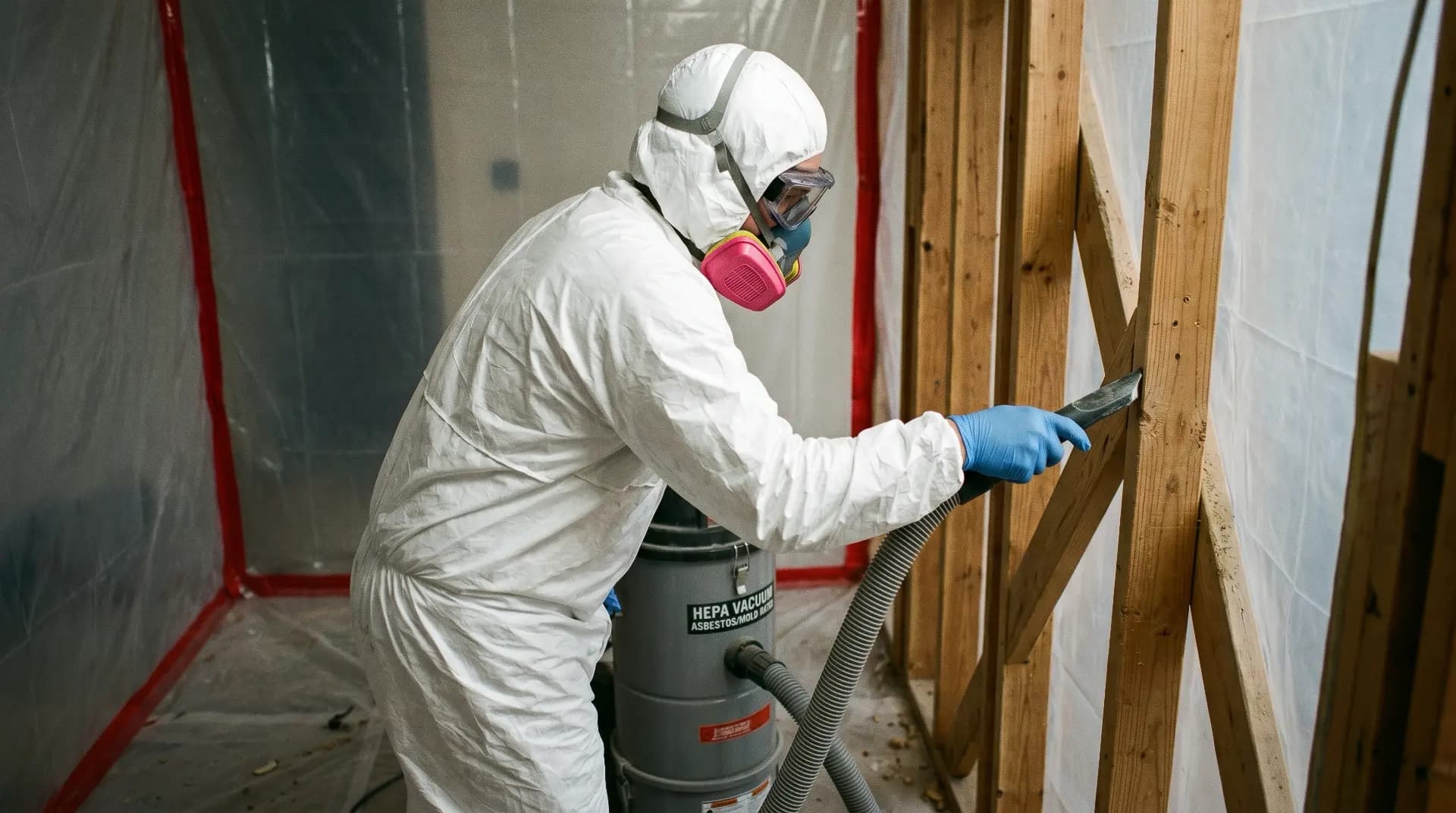
Why this matters more than chemistry: using the same antimicrobial in an open room without containment and controlled HEPA filtration can spread contamination beyond the original work area, and produces a very different outcome from a properly controlled job. Same product, different result.
How professionals actually remediate mold: the IICRC S520 process
The IICRC S520 Standard for Professional Mold Remediation is the document working remediators reference. Its Section 9.3, Remediation Work Procedures, sets out thirteen numbered steps. The flowchart above lists all thirteen with their section numbers, so you can check any single one against the standard yourself. Grouped into what you actually see happen on a job, they run in three phases.
Prepare (ANSI/IICRC S520-2024 §9.3.1 to §9.3.4). Specifications and report review, preliminary steps, containment set-up, signage. On a real job that means the water intrusion which grew the mold gets located and slated for repair before anything else, with responsibility for that repair settled as part of planning. Whether a separate assessment is required depends on the project and on local rules. Where one is appropriate, we recommend the assessor and the remediator be different companies, so the firm finding the problem isn't the one billing to fix it. That is our position rather than something ANSI/IICRC S520-2024 imposes; §1.2.1 dropped the blanket independence rule the 2015 edition carried (see what an assessor does vs. a remediator). Then 6-mil poly walls, a zipper door, a HEPA scrubber configured for negative-air exhaust, and every HVAC supply and return inside the zone sealed.
Remediate (§9.3.5 to §9.3.11). Containment maintenance, suit up and entry, demolition and mold removal, cleaning, deviation from removal process, containment exit protocol, disposal of contaminated materials. Per §9.3.5, containment should hold a minimum of 4 air changes per hour, with air drawn from the entry across the work area and exhausted outside where possible. Affected porous materials come out (drywall, insulation, carpet, ceiling tile, anything paper-faced) and are carried out through the containment exit. §9.3.10 says double-bagging may be necessary rather than requiring it in every case. Surfaces being kept are HEPA-vacuumed and cleaned. Where an antimicrobial is appropriate for the material and project, permitted by the label, and included in the work plan or protocol, it goes on after cleaning at its full labeled dwell time; §2.1.2 treats antimicrobial disinfectants as a supplemental option the remediator should justify to the client, not an automatic step.
Worth noticing what is absent from that list: not one of the thirteen steps is a chemistry step. Antimicrobials and coatings appear in S520 as tools, in a chapter of their own, rather than as stages of the process. Section 1.4 says it directly, calling physical removal of mold contamination the primary means of remediation and treating attempts to kill, encapsulate or inhibit mold instead of proper source removal as generally not adequate. The 2024 edition goes further and treats spray, fog, foam or gas approaches used without physical removal as a deviation from the standard of care. If a company offers to fog your house and skip the physical removal and cleaning of the contamination, that is the sentence to put in front of them.
The definition underneath that is the part worth understanding, because it explains why killing mold is not the same as fixing it. In its Definitions section (ANSI/IICRC S520-2024, Section B), the standard sorts an indoor space into three conditions. Condition 1 is a normal fungal ecology: the ordinary settled and airborne spores you would find in any clean, dry indoor space. Condition 2 is contamination by settled spores and fragments that came from an actual growth source in that same space. Condition 3 is actual mold growth, and the standard's definition of it includes growth that is "active, dormant, dead, non-viable, visible, or hidden."
Read that last one again. Dead mold is still Condition 3. Killing a colony does not move a room out of Condition 3, because a dead colony is still mold growth by the standard's own definition. The contamination has to be physically removed. Worth being precise about what that means: Section B defines physical removal to include wiping, brushing, sanding, blasting and HEPA vacuuming as well as taking out the affected component, so demolition is one method among several rather than the meaning of the term. That is the whole argument for removal over chemistry, and it is why the goal is stated as returning the space to Condition 1 rather than as achieving a kill.
Verify (§9.3.12 to §9.3.13). Two separate steps that most homeowners hear as one, and the difference matters.
Post Remediation Evaluation (PRE) is the remediator's internal completion evaluation. Once visible contamination, dirt, dust and debris are removed, the area is free of microbial malodor, and remaining materials are dry, S520 indicates that it is probable the structural components and systems have been returned to Condition 1. Note the word: probable, not confirmed. Note what Condition 1 does not mean. It is not a sterile room and not a zero-spore reading; it is the normal fungal ecology of a clean, dry indoor space. Any remediator promising to eliminate all mold from your home is promising something the standard does not ask for and physics does not allow.
Post Remediation Verification (PRV) is a separate inspection and assessment by an independent third-party indoor environmental professional. The standard recommends it and treats it as further assurance on top of the PRE, rather than as a universal pass/fail gate. It can involve visual inspection, field data, odor detection, analytical testing or sampling; sampling is one option among several, not the mechanism by which a job passes.
Both of those give you something to ask for before you sign. Where PRV is required or requested, the completion criteria should be confirmed with the appropriate parties, to the extent possible, before remediation begins or as early in the process as possible, rather than settled once the crew is packing up. And if the person performing your PRV is not independent of the remediator, the standard says the remediator should tell you so in writing, as a disclosed deviation. A company that balks at either has told you something useful.
Most homeowner-facing "how to kill mold" content skips containment, disposal and verification altogether. Mold problems can recur when the underlying moisture source, damp conditions, or incomplete contamination removal are not adequately addressed, and skipping those steps is how that happens.
Surface-by-surface: what to use where
The substrate decides whether a surface can be cleaned at all, and that matters more than which product is used. Each surface below has different absorption, different retention, and a different fix.
What kills mold on walls
Painted drywall is a common wall mold question and a surface where DIYers go wrong with bleach. The paint film is non-porous on top; the drywall behind it is porous. Cleaning comes first; where an antimicrobial is used, quat-based antimicrobials or thymol-based botanicals are common choices. ShockWave Concentrate may be used at labeled dilutions such as 2 oz/gal, about 1:64, where appropriate for the intended use; follow the current product label for the specific application. Unpainted or wallpapered drywall is a different problem; once mold has grown into it, it is generally cut out and replaced rather than cleaned. Bathroom-specific moisture sources behind wall mold are covered in bathroom mold, and why walls grow mold and the full fix covers the pattern-reading and scrub-or-cut side of the same job.
What kills mold on wood framing or studs
Physical cleaning, usually sanding. The visible mold is sanded off with a HEPA-filtered random-orbit sander; where an antimicrobial is appropriate and the label permits it, the freshly exposed wood is treated with a quat-based product like Shockwave at full labeled dwell. For heavier contamination, dry-ice or soda blasting cuts through the spore mat without water. Where the project calls for one, a fungicidal coating like Foster 40-20 goes on once the framing is clean and dry and the work has been evaluated. Attic and crawl-space framing has location-specific protocols; attic mold and crawl space mold cover those.
What kills mold on concrete or basement walls
Concrete is non-porous on the face and porous + alkaline at depth. Cleaning and drying come first. Where a product is used after that, Concrobium Mold Control is formulated for the alkaline pH of concrete and concrete-block walls; sodium-carbonate chemistry doesn't fight the substrate the way sodium-hypochlorite chemistry does. Basement mold is almost always a moisture-source problem (foundation seepage, sump-pump failure, dryer vent disconnected inside the wall cavity). Basement mold causes and solutions covers the moisture audit.
What kills mold on HVAC or ductwork
HVAC mold is a different protocol entirely. ANSI/IICRC S500-2021 §13.1 notes that a system contacted by Category 2 or 3 water can spread contamination to unaffected areas, and that even a system the water never touched can move humidity or contamination around while it runs. Per EPA, there are no EPA-registered biocides for porous duct materials, and EPA, NADCA and NAIMA all recommend replacing wet or moldy fiberglass duct liner and ductboard rather than cleaning it. §13.2.3 says the same in the standard's own words: internally lined ductwork, duct board and flexible ductwork affected by microbial contamination should be removed and replaced rather than cleaned. Accessible bare sheet metal may be cleanable where condition and access permit; any antimicrobial or coating is limited to applications the current label allows for that component. On who does the work, §13.3 puts an adequate engineering evaluation outside the standard's own scope and recommends consulting qualified engineering professionals or HVAC contractors, which is why we treat this as a professional job regardless of square footage.
What kills mold spores in the air
HEPA filtration, not chemistry: it removes airborne particulate and does not kill mold. A HEPA scrubber sized to hold at least the 4 air changes per hour §9.3.5 calls for, kept running until the post-remediation evaluation or verification is complete, is the protocol. A 500 to 700 CFM unit is a common choice on smaller residential containments, but the sizing follows the volume rather than the other way round. Aerosol kill claims on consumer "mold bombs" are not validated against the spore load demolition creates.
What about black mold (Stachybotrys) specifically?
Stachybotrys does not require a unique remediation chemistry because of the species name. Product selection follows the substrate, the intended use and the product label, and the controls follow the extent of contamination and the work being performed.
CDC's stated position is narrower than the internet's. It says no test proves an association between Stachybotrys and particular health symptoms, and that all molds should be treated the same for health risk and removal. Remediators still tend to tighten up on suspected Stachybotrys, and the reason is practical rather than diagnostic: it grows on chronically wet porous material, which generally cannot be cleaned and has to come out, and cutting into that material is a high-disturbance task. For workers, respiratory protection should be selected from the task, the extent of disturbance, the anticipated airborne particulate, other hazards, and the employer's respiratory-protection program. A more protective respirator may well be appropriate for high-disturbance work, but the species name alone should not set the filter class. Extent of disturbance gets handled the same way: EPA's 10 square foot figure is a benchmark rather than a cutoff, and for suspected Stachybotrys most remediators work to the smallest patch that can be handled with full containment.
For the full Stachybotrys-specific protocol, see the full Stachybotrys removal guide. The decision tree (what makes black mold a pro job) and the medical-PPE rationale belong there, not duplicated here.
What pros don't use (and why)
A short list of products that show up on consumer shelves and homeowner forums but not on competent remediation trucks.
Bleach. The most popular home mold cleaner, and a common mistake on a job that needs a pro. It can be a reasonable household cleaner on hard, non-porous surfaces, but it is not a substitute for removing contaminated porous material or fixing the water. Per EPA guidance, using a biocide such as chlorine bleach is not recommended as a routine practice during mold cleanup. CDC does allow a dilute bleach solution, no more than 1 cup per gallon of water, for household cleaning of hard surfaces, and that difference is the whole point: bleach is a reasonable household cleaner and it is not a remediation tool. It can clean tile and glass; drywall, fabric, paper and insulation need the contamination physically removed, and wood, grout and caulk vary with their type and condition. And the sharper version of the usual warning: the problem is not just that "looks gone" differs from "is dead". It is that "is dead" differs from "is gone". S520 counts dead and non-viable growth as Condition 3, the same category as a live colony, so a product that kills without removing leaves the room exactly where it started.
Ammonia. Same porous-surface problem as bleach, plus the dangerous-mixing issue (mixing ammonia and bleach produces chloramine gas, which is acutely toxic).
Tea tree oil and essential oils. Lab petri-dish studies show antifungal activity. The application concentration that achieves a meaningful kill on a 200-square-foot containment is impractical, and the products aren't EPA-registered as antimicrobials.
Vinegar. 5% acetic acid has real but narrow antifungal activity. In the one controlled comparison of household antifungal agents we could find, vinegar at roughly 4% acetic acid inhibited Penicillium chrysogenum but not Aspergillus fumigatus. CDC names Cladosporium, Penicillium and Aspergillus as the most common indoor molds, so that is one of the common indoor genera handled and one missed. Fine for surface mildew on bathroom tile or grout; inadequate for active growth on drywall. The full vinegar breakdown covers when it's the right call.
Borax. Mild antifungal activity. Not EPA-registered as an antimicrobial. Decent for laundry; not used on remediation jobs.
When DIY ends and a professional starts
Five triggers flip the answer to "call a professional" regardless of how small the patch looks.
Patch larger than about 10 square feet. EPA says a moldy area under about 10 square feet, roughly a 3-by-3 foot patch, can in most cases be handled by the homeowner. Larger areas generally warrant more structured remediation, and EPA points to its Mold Remediation in Schools and Commercial Buildings guidance for those. Read the number as a benchmark rather than a cutoff in either direction: a smaller patch may also need professional help depending on the water source, HVAC involvement, hidden growth, material type, or occupant health concerns.
Porous material involved. Drywall, carpet, insulation, ceiling tile, fabric, paper-faced anything. Porous substrates retain spores below the visible surface; cleaning the face leaves the colony in place. The fix is removal and replacement, not cleaning, and removal at scale requires containment.
HVAC contamination. Mold inside ducts, on the air handler, or in the condensate pan can carry particulate well beyond the source area whenever the system runs. EPA recommends replacing wet or moldy fiberglass duct material rather than cleaning it, while accessible bare sheet metal may be cleanable where condition and access permit. Always a professional job.
Category 3 water. ANSI/IICRC S500-2021 §10.4.1 sorts water by how contaminated it is, not by the event that caused it. Category 3 is grossly contaminated water that can contain pathogenic, toxigenic or other harmful agents. Sewage is one of the standard's examples, as is flooding from seawater or a rising river, but those are examples rather than the definition, and water that started clean can deteriorate into Category 3 if it sits long enough. What the category changes is concrete: §10.6.7 says that where the preliminary determination is Category 1, the restorer can proceed without contamination controls such as containment barriers and pressure differentials. For Category 2 or 3 intrusions, remediation should occur before restorative drying, and restorers shall use contamination controls and appropriate worker protection, following the Category 2 or 3 procedures in §12.3. We treat this as a professional job, though that part is our recommendation; the standard sets out the procedures rather than who may perform them.
Health symptoms in occupants. If occupants report symptoms they think may be building-related, that is useful exposure history and worth raising with a doctor, though a pattern that changes with time in the building does not by itself establish mold as the cause. It is still a good reason to avoid uncontrolled disturbance. Professional containment with HEPA filtration is used to control the spread of contamination to the rest of the household; uncontrolled DIY disturbance has no such control.
If any of those triggers apply, the next steps are: what an assessor does vs. a remediator (you usually want both, as separate companies), how to hire the right remediator, questions to ask before you sign, common remediation scams to watch for, and typical remediation pricing. For the full DIY-vs-pro decision framework with the moisture-source angle, see the DIY-vs-professional decision threshold.
Once the existing mold is handled, preventing regrowth covers the humidity-control and moisture-monitoring steps that help keep it from coming back.
Next steps
If the patch you're looking at fits inside the DIY scope (under 10 square feet on a hard, non-porous surface, no HVAC involvement, no health symptoms), the homeowner protocol walks through the moisture-source audit, the product choice, and the cleaning steps. If any of the five triggers above applies, the next step is finding a remediator who works to the IICRC S520 standard and an assessor who works independently.
Find a Verified Mold Professional
Every mold remediator in our coverage is identity-checked and tier-ranked, with licenses and insurance verified where available. Verified mold professionals in your state are where to start.
This guide is for educational purposes only and is not a substitute for professional advice. EPA registration numbers in the product spec table should be verified against the EPA's product label search before relying on them; manufacturers update registrations periodically. Always consult certified professionals for specific mold situations in your home.