How to Get Rid of Black Mold (Without Spreading Spores Everywhere)
How to get rid of black mold safely: fix the moisture source first, then either clean a small patch on a hard surface yourself or call a certified remediator.
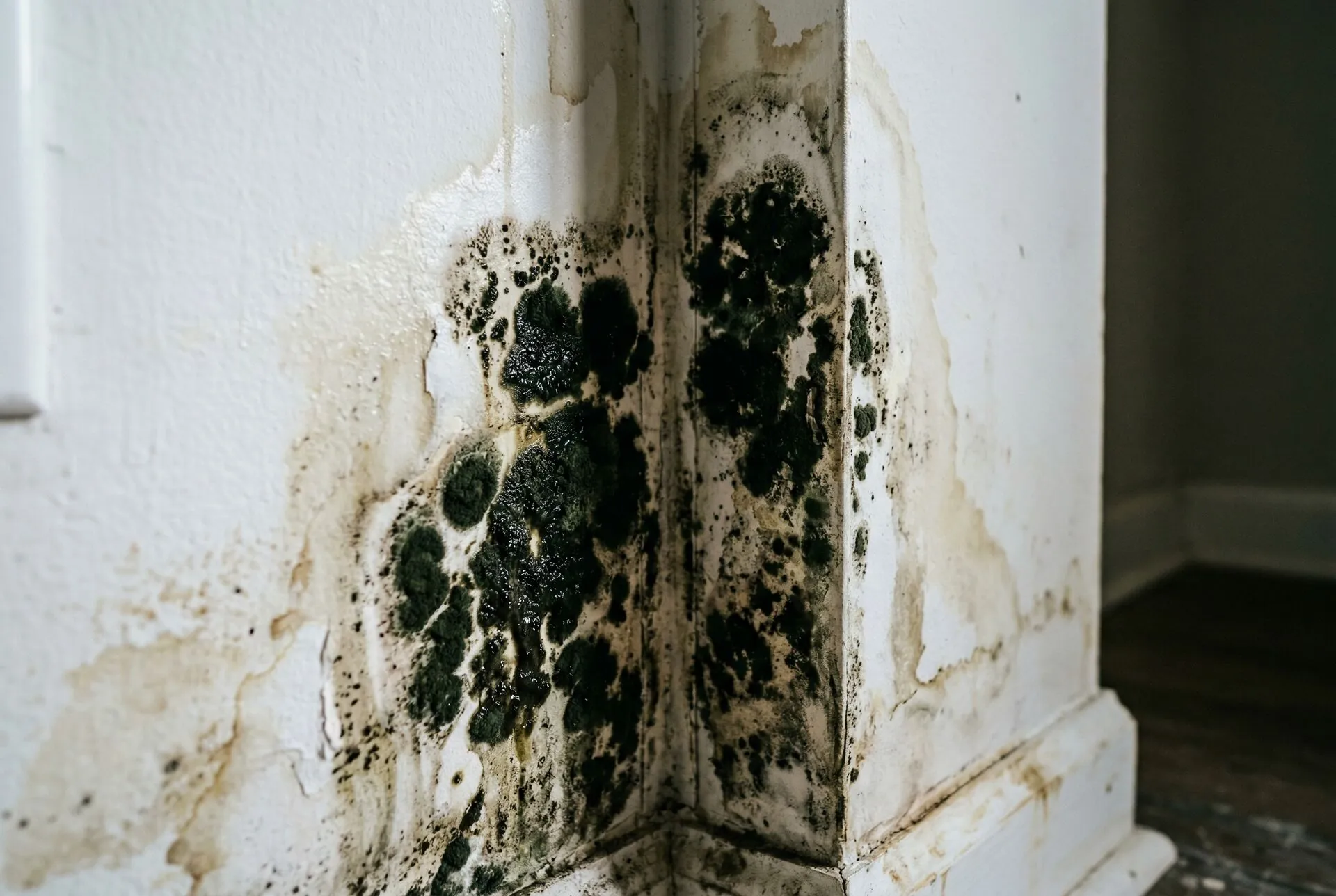
To get rid of black mold safely, you do three things in order: find and fix the moisture source, decide whether it is a job you should take on, weighing the size against the material, the water source and who is in the house, and execute the right protocol. Cleaning the visible growth without fixing the water is the most expensive mistake homeowners make. You'll pay to do it twice.
Quick answer: Black mold on a hard surface, under about 10 sq ft? You can likely handle it yourself with detergent and water and proper PPE. Black mold on drywall, wood, or covering large areas? Call an IICRC-certified remediator. A typical remediation job costs $1,223 to $3,757 nationally (HomeAdvisor).
In This Guide
- What is black mold?: Stachybotrys vs other dark molds
- What are the health risks?: who's at risk and what symptoms to watch for
- How do I identify black mold?: where it hides and whether to test
- Does bleach actually kill mold?: why bleach is the wrong tool for porous materials
- Can I remove black mold myself?: the 10 sq ft benchmark
- How do I safely remove small areas?: cleaning a small area safely
- When should I call a professional?: situations that require certified help
- What does professional remediation look like?: what to expect
- How much does black mold removal cost?: pricing by project size
- How do I prevent black mold?: stopping it before it starts
- FAQs: common questions answered
What Is Black Mold?
"Black mold" usually refers to Stachybotrys chartarum, a greenish-black mold that grows on materials with high cellulose content (drywall, ceiling tiles, wood, and cardboard) when they've been chronically wet for days or weeks.
The name does most of the damage here. Many molds appear black, and most of them aren't Stachybotrys. Cladosporium, Aspergillus niger, and Alternaria all look dark or black and are far more common, and you can't tell them apart by color alone. The full mold identification chart shows the common dark molds side by side. If you're concerned about Stachybotrys specifically, the only way to confirm is professional mold testing. That said, any indoor mold growth should be remediated regardless of species.
For a surface-by-surface look at what black mold looks like, including how to tell it apart from soot, water stains, and other look-alikes, see the dedicated appearance guide. If the black growth is on shower tile, grout, or caulk rather than soaked drywall, it's usually one of these surface species, not Stachybotrys; the guide on black mold in the shower covers how to clean it.
Black Mold Health Risks
Here the honest answer is narrower than most of what is written on this subject. CDC's position is that no test proves an association between Stachybotrys and particular health symptoms, and that all molds should be treated the same for health risk and removal. So the thing to act on is the exposure, not the species name.
What CDC does say about mold generally is that exposure to damp and moldy environments may cause a variety of health effects, or none at all. Not everyone reacts the same way, and certain groups face higher risk.
Symptoms CDC associates with mold exposure
- Stuffy nose
- Sore throat
- Coughing or wheezing
- Burning eyes
- Skin rash
CDC also notes that people with asthma or a mold allergy may have severe reactions, and that people who are immune-compromised or have chronic lung disease may develop lung infections from mold.
Who's Most at Risk?
- Infants and young children: developing respiratory systems
- People with asthma: mold is a known asthma trigger
- People with allergies: heightened immune response
- Immunocompromised individuals: transplant recipients, HIV/AIDS, chemotherapy patients
- Elderly adults: may have reduced respiratory function
When to See a Doctor
See a doctor if you have persistent respiratory symptoms that improve when you leave the house, if symptoms started after discovering mold, or if you've had prolonged exposure (weeks or months). Bring up the mold exposure specifically; many doctors don't ask about environmental factors.
For a detailed symptom breakdown by mold type and exposure duration, see our Mold Exposure Symptoms Guide.
How to Identify Black Mold
Black mold follows the water. Stachybotrys has characteristics worth knowing before you go looking.
Visual and Texture Clues
CDC describes Stachybotrys chartarum as greenish-black, growing on high-cellulose materials such as fiberboard, gypsum board and paper, where moisture has been constant. Read that as a clue about the conditions you are looking for, not a way to name what you found. Other molds look similar, and neither color nor texture confirms a species. Any growth releases spores when disturbed, so don't poke or wipe it before it's contained. For the full visual breakdown by surface, with photos and the common look-alikes, see what black mold looks like.
Where Black Mold Hides
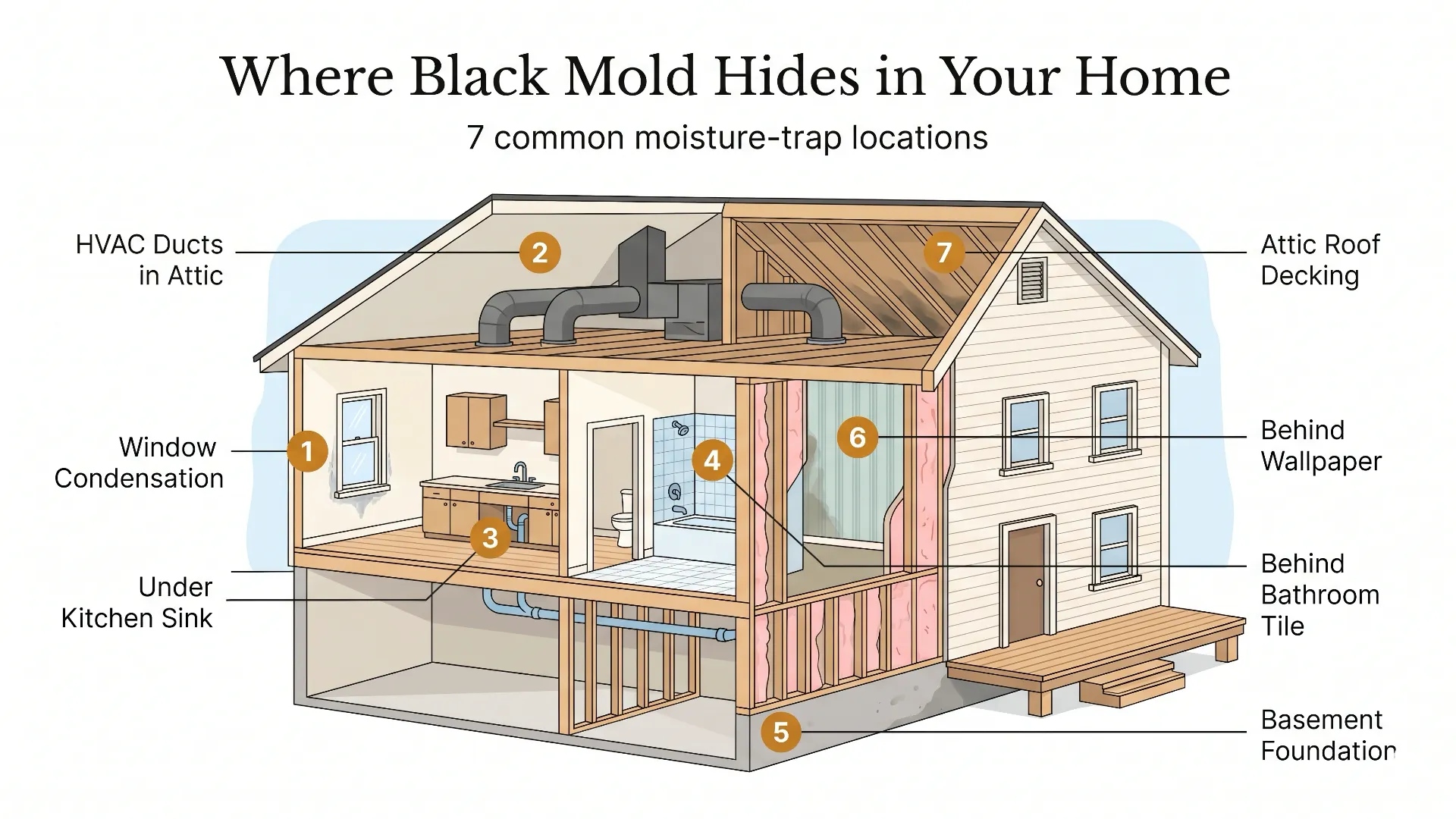
Black mold needs chronic moisture, so these are the places to check first. They tell you where moisture collects, not what is growing there:
- Behind walls near past water leaks or plumbing (what mold on walls means and how to fix it)
- Under sinks where slow drips go unnoticed
- Around windows with persistent condensation
- In basements and crawl spaces with poor drainage
- In attics with roof leaks or poor ventilation
- Behind wallpaper that traps moisture
- In HVAC systems, on fibrous duct liner, insulation, accumulated debris, or water-damaged material beside the ductwork. Condensation on bare metal by itself is a reason to trace the moisture rather than to expect black mold there
Should You Test Before Removing?
The EPA's position: if you can see mold, you don't need to test before removing it. Just remove it. Testing matters most when:
- You can smell mold but can't find it
- You want to confirm Stachybotrys specifically (for insurance claims or health documentation)
- You need a post-remediation verification to confirm the work against agreed completion criteria
- You're buying a home and suspect hidden mold
A professional mold assessment costs $303 to $1,045 nationally, with an average of $671, from 8,284 costs reported to HomeAdvisor. Expect a moisture survey, an inspection of the affected areas and a written report; sampling is included where it answers a specific question rather than as a matter of course.
Bathroom condensation: the most common black-mold pattern
Black mold forming in a vertical stripe below a bathroom window is consistent with condensation, but that pattern does not on its own rule out a leak. Confirm where the water is coming from before you buy the fix, because the window itself, the sill, flashing, plumbing inside the wall, and water getting in from outside can all leave staining in roughly the same place. Where condensation is the cause, the usual contributors are single-pane windows, missing or jammed trickle vents, exhaust fans that discharge into the attic instead of to the outdoors, and thin insulation around window frames. Each one creates a cold surface where humid bathroom air condenses, runs down the wall, and feeds chronic growth.
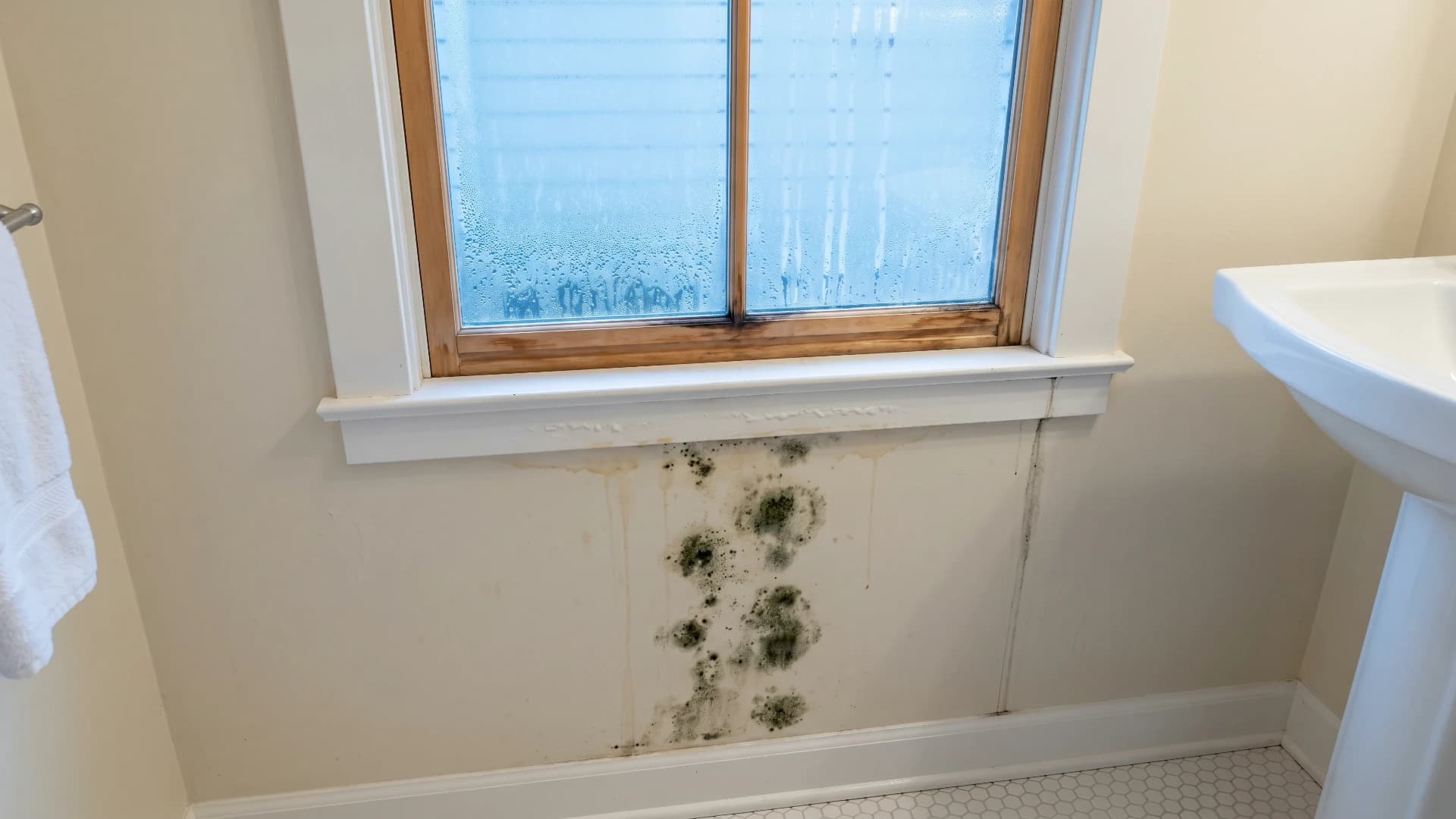
The fix is rarely a cleaner. It's ventilation: run your bathroom exhaust fan during AND for 30 minutes after every shower, keep trickle vents fully open even in winter, and run a dehumidifier in damp months. If a single-pane window is the cold surface causing the condensation, double-pane replacement is the long-term fix.
Does Bleach Actually Kill Mold?
Short answer: on hard non-porous surfaces, yes, but it's the wrong tool for drywall, wood, grout, and anything else that holds moisture below the surface.
The IICRC S520 standard (the published professional standard for mold remediation) does not discuss bleach at all. What it does say is broader and more useful: ANSI/IICRC S520-2024 §2.1.1 states that no liquid product, antimicrobial, stain remover or cleaning solution, should be used as an alternative to physically removing mold contamination, and §1.4 calls physical removal the primary means of remediation. Bleach on drywall runs into the same wall as any other liquid: it is a bleaching agent, so the visible staining fades while the contaminated material and the water feeding it are both still there.
What actually works:
Hydrogen peroxide (3%) with a little dish soap. The surfactant breaks surface tension so the cleaner spreads instead of beading up. This is a practitioner preference, not a published formulation, and it is worth knowing the standard leans the other way: §2.1.1 says that for thoroughly cleaned non-porous building materials, antimicrobials are generally not needed. Clean the surface properly first and the chemistry matters less than the cleaning did.
Undiluted white vinegar. A common household choice on hard non-porous surfaces. It is not an EPA or CDC protocol, and like any liquid product it does not substitute for removing contaminated porous material.
EPA-registered antimicrobial agents. Professional-grade, used by certified remediators on substrates that survive remediation.
What doesn't work on materials that hold moisture below the surface:
Bleach on drywall, wood, or grout. These hold contamination below the surface, and a surface treatment does not reach it. §2.1.1 is explicit that no liquid product substitutes for physically removing the contamination. That is not the same as saying every affected material has to come out. What has to go is the contamination; whether that means cleaning the material or removing it depends on what the material is.
Eucalyptus, tea tree, or clove oil. ANSI/IICRC S520-2024 §9.1.7 names diffusion of essential oils among the approaches that should not be used as a substitute for source removal. They can cover a smell. They do not remove what is producing it.
Stain-blocking primer (Kilz, Zinsser). Paints over the mold, and the mold keeps growing underneath until it pushes back through.
Never mix bleach with vinegar or ammonia. The combination produces chlorine gas. Choose one product. For more on vinegar's specific use cases and limitations, see our Cleaning Mold With Vinegar Guide.
Can You Remove Black Mold Yourself?
This decision comes down to the EPA's 10 square foot benchmark and what material the mold is growing on.
What 10 square feet of mold looks like
The EPA says a patch around this size can usually be cleaned by a homeowner. Read it as a benchmark, not a hard cutoff: a smaller patch you cannot dry out or reach is still a job for a professional.
DIY Is Appropriate When:
- Mold covers less than about 10 square feet (roughly a 3x3 ft patch)
- Mold is on hard, non-porous surfaces (tile, sealed concrete, glass, metal)
- There is no water damage to drywall or structural materials
- The person doing the work has no mold allergy, asthma, COPD or other chronic respiratory disease, and no immune suppression
- You can wear proper PPE (N95 respirator, goggles, gloves)
Call a Professional When:
EPA's benchmark covers homeowner cleanup under about 10 square feet and points to its larger-job guidance above that. The list below is our own recommendation rather than an EPA rule, and it is deliberately conservative: any one of these is a reason to get a professional in, on either side of the benchmark.
- Mold covers more than about 10 square feet
- Mold is on drywall, wood, carpet, or insulation
- Mold is in the HVAC system
- Mold resulted from sewage backup or contaminated water
- Mold keeps coming back after DIY cleaning
- Someone in the household is at higher risk (mold allergy, asthma, COPD, immune suppression), which leans the decision toward hiring out without by itself setting how much work the job needs
- You need insurance documentation or an independent post-remediation verification
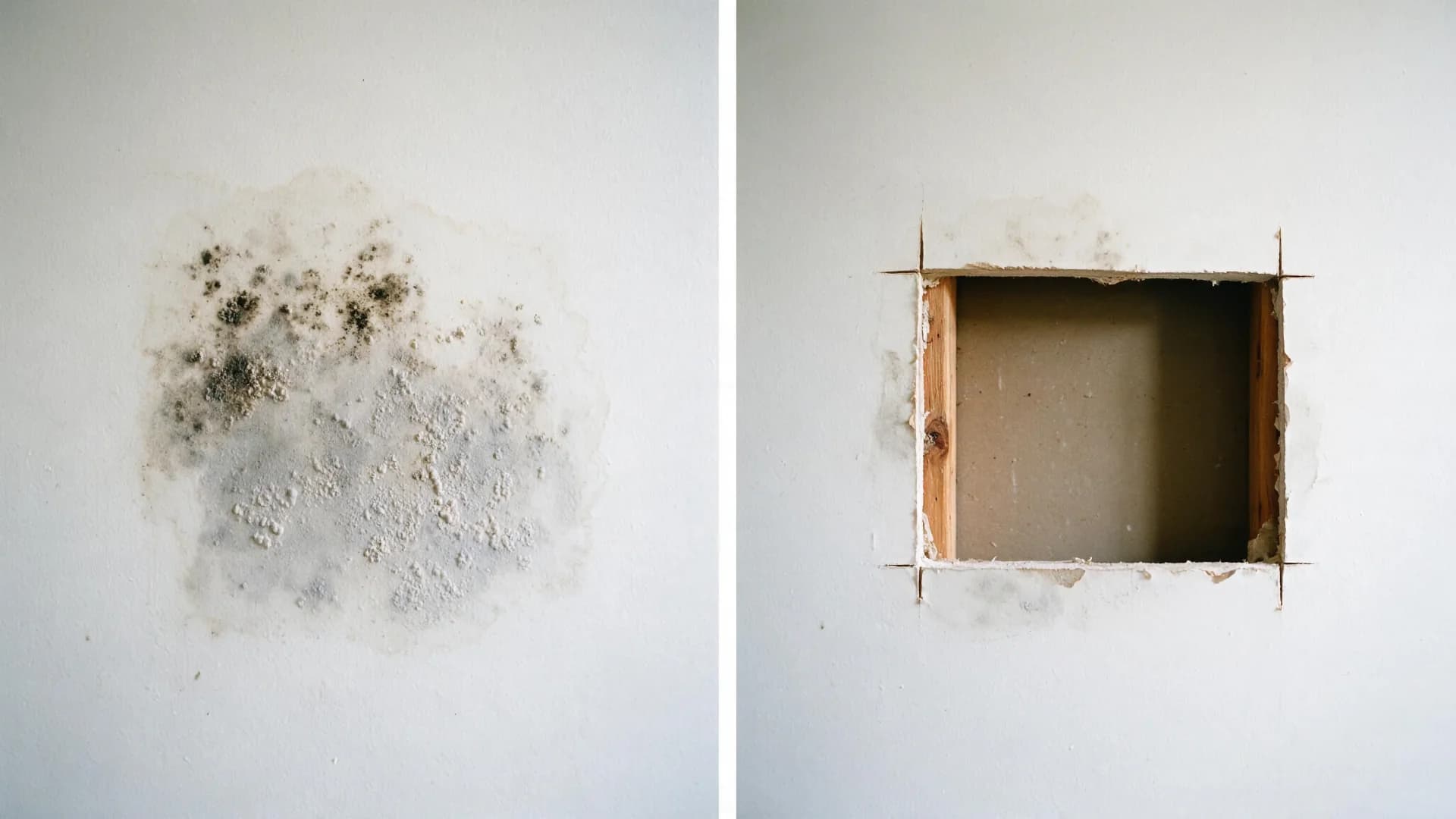
The critical distinction: Surface mold on tile is a cleaning problem. Mold growing on drywall usually is not, because the paper facing is food for it and growth extends into the gypsum core below the visible surface. Drywall is porous, and porous material with growth on it is generally not cleanable, so colonized board normally comes out rather than being treated in place. Containment is then chosen for the scope of that work and how much dust it raises.
For a deeper dive on the DIY decision, see our DIY vs Professional Mold Removal Guide.
How to Safely Remove Small Black Mold Areas (Under 10 sq ft)
If your black mold meets the DIY criteria above, the baseline below is EPA and CDC guidance for homeowner cleanup: clean hard surfaces with detergent and water, dry them completely, and wear the protective equipment. Several of the steps go further than that, and each one says so where it appears. They are conservative field practice rather than anything EPA asks a homeowner to do. Do not skip the precautions on a small patch: disturbing any mold growth sends spores into the air, which is the moment the protective equipment earns its place.
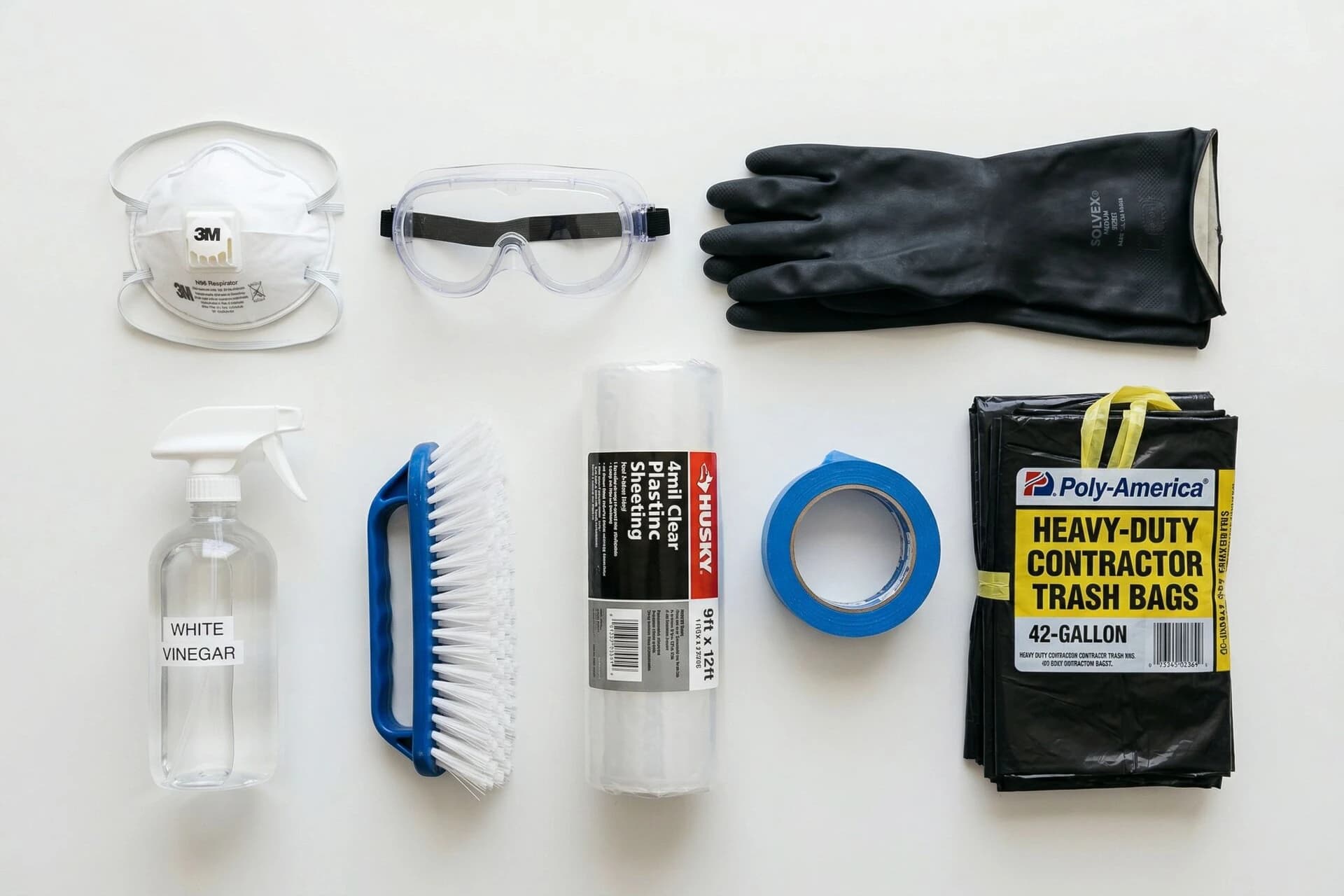
What You'll Need
| Item | Why |
|---|---|
| N95 respirator | Filters mold spores (surgical masks are NOT sufficient) |
| Non-vented goggles | Prevents spores from reaching eyes |
| Rubber gloves (forearm length) | Skin contact protection |
| Plastic sheeting + tape | Seals the room to limit spore spread. An added precaution, not an EPA requirement below about 10 sq ft |
| Spray bottle with water | Misting suppresses airborne spores |
| Detergent and water, or 3% hydrogen peroxide per its label | Primary cleaner. A little dish soap helps the cleaner spread; that is a practitioner preference, not a published formulation |
| White vinegar (undiluted) | Optional household alternative on hard non-porous surfaces. Not an EPA or CDC protocol |
| Stiff scrub brush | Physical removal from hard surfaces |
| Heavy-duty trash bags | Safe disposal of contaminated materials |
| Fan pointed out window | Ventilation during cleaning. An added precaution, not an EPA step |
Step-by-Step Process
Step 1: Seal the room. An added precaution rather than an EPA step: EPA's own table treats containment as generally unnecessary below about 10 square feet. Close all doors. Cover HVAC vents and any openings with plastic sheeting and painter's tape. It limits how far spores travel while you are working, which is cheap insurance on a job you are doing yourself.
Step 2: Gear up. Put on your N95 respirator, goggles, and gloves before touching anything. This is not optional; even brief exposure to concentrated spores can trigger reactions.
Step 3: Dampen before disturbing, on a hard surface. Also an added precaution rather than an EPA step. Lightly spray the area with water from a spray bottle. Damp mold releases fewer airborne spores than dry mold, so this is worth doing before you scrub tile, glass or sealed concrete. Dampen rather than soak. Skip it on porous or already water-damaged material: the extra water works against you there, and material in that condition is the case for calling someone rather than scrubbing.
Step 4: Apply the cleaner. EPA's baseline for a hard surface is detergent and water, scrubbed and then dried completely. If you prefer 3% hydrogen peroxide, use it according to the directions on the bottle rather than a ratio or a dwell time from an article. A little plain dish soap helps: the surfactant breaks surface tension so the cleaner spreads instead of beading up. Worth knowing that ANSI/IICRC S520-2024 §2.1.1 says antimicrobials are generally not needed on thoroughly cleaned non-porous materials, so the scrubbing is doing more of the work than the chemistry is.
Alternatives: undiluted white vinegar is a common household choice, used per its own label; on the tile face itself, glass, and sealed concrete (not grout lines, which are porous), a dilute household bleach solution is an option: CDC's ceiling is no more than 1 cup of household laundry bleach in 1 gallon of water. Never use bleach on porous materials; see the bleach section above for why.
Never mix bleach with vinegar or ammonia. This creates toxic chlorine gas. Choose one product and stick with it. For more on vinegar's effectiveness and limitations, see our Cleaning Mold With Vinegar Guide.
Step 5: Scrub and rinse. After the contact time, scrub with a stiff brush and rinse with clean water. Wipe the area with a clean, damp cloth to remove residue.
Step 6: Bag everything. All rags, gloves, brushes, and plastic sheeting go into heavy-duty trash bags. Seal the bags inside the room before carrying them out.
Step 7: Dry completely. Use fans and/or a dehumidifier to dry the area thoroughly. Mold cannot grow without moisture.
Step 8: Fix the moisture source. This is the most important step. Repair the leak. Fix the ventilation. Run a dehumidifier. If you skip this, expect the growth to come back.
Don't paint or caulk over moldy surfaces. EPA says not to paint or caulk moldy surfaces, because paint applied over them is likely to peel, and the mold keeps growing underneath until it pushes through. Stain-blocking primers seal the visible stain but don't kill the mold. Always clean, dry, and remediate before painting.
Mold that keeps coming back after cleaning is telling you something is unresolved, not telling you exactly what. It can mean the moisture source is still active or a new one has started, that condensation keeps recurring, that the cleaning or removal never reached all of the contamination, or that growth is established somewhere you cannot see, such as inside the wall cavity. What recurrence does settle is that repeating the same surface treatment is not the answer. That is the point to stop spraying and have someone look at the moisture and at how far the growth actually goes.
When to Call a Professional
Professional remediation is necessary when the job exceeds what safe DIY practices can handle.
Size
EPA's guidance for larger jobs uses limited containment from 10 to 100 square feet and full containment above that, and tells remediators to apply professional judgment in both cases. Area is a proxy rather than the cause: EPA says a heavy growth in a relatively small area could release more spores than a lighter growth over a relatively large one. Disturbing contaminated material without negative air pressure and HEPA filtration can carry spores and fragments beyond the work area.
Material
Mold growing on porous materials like drywall, carpet and pad, ceiling tile, or insulation generally cannot be cleaned, so those come out. ANSI/IICRC S520-2024 sorts building materials by how readily they take up moisture (Section B, "Porosity"), and that sorting is what decides the question: porous surfaces are generally not cleanable where mold is actively growing, though they can be where spores have only settled. Unfinished wood framing is semi-porous, which the standard treats as a case-by-case judgment rather than an automatic tear-out, and finished wood is classed non-porous and considered cleanable. Containment is matched to the scope of the work and how much dust it will raise, rather than triggered by the material list. A professional will:
- Set up containment barriers (poly sheeting, negative air)
- Cut out contaminated materials, back past the visible line by a distance judged on the job
- HEPA vacuum all surfaces
- Apply an antimicrobial only where the protocol calls for it and the product's EPA-approved label permits that use
- Verify the work against completion criteria agreed before it started, which may or may not include sampling
Location
Mold in HVAC systems, inside wall cavities, or in crawl spaces requires specialized equipment and training. HVAC mold matters because the system can distribute spores or fragments beyond the source area. If contamination is known or suspected, don't run it until it has been evaluated.
Health Concerns
Unlike the three above, this one is about who is exposed rather than how big the job is. CDC says people with allergies, immune suppression, underlying lung disease, asthma or COPD should not take part in cleaning up mold, and that people with asthma, COPD or immune suppression should not stay in a moldy home or even be there while it is being cleaned.
If that describes someone in the house, it is a reason to hand the work to somebody else, to keep that person out of the area while it happens, and often a reason to bring in a professional whose containment limits what escapes the work area. What it is not is evidence about the building: symptoms someone associates with the mold do not establish that mold is the cause, and they do not decide how much material has to come out.
Choosing the Right Professional
The hard part isn't finding a mold company. It's that the careful one and the careless one often have the same website, the same stock photo of a technician in a Tyvek suit, and the same phone number answered on the first ring. Look for these instead:
State licensing, where it exists. Most states do not license the trade at all, so check what yours actually requires.
IICRC certification. Ask about WRT (Water Restoration Technician) and AMRT (Applied Microbial Remediation Technician) by name.
Liability insurance. Specifically pollution liability, not just general liability.
Independent assessment. Our recommendation is that the company assessing the problem is not the company billing to fix it, though only a small number of states require it (why separation matters).
Written scope of work. A detailed protocol before anyone starts. If it won't go in writing beforehand, that tells you more than anything on the website did.
For the full hiring checklist, see our How to Hire a Mold Professional Guide and Questions to Ask a Mold Company.
Renting? You can clean visible surface mold yourself, but the underlying moisture problem (the leak, the failing window seal, the bathroom with no exhaust fan) is your landlord's responsibility under most state habitability laws. Document everything with dated photos. Send your landlord a written request to address it (email works; keep the thread). If they refuse, your state housing authority is your next step. Surface cleaning without fixing the moisture is a temporary patch, and the growth returns while the water is still there. For EPA-published guidance, see the EPA mold resources.
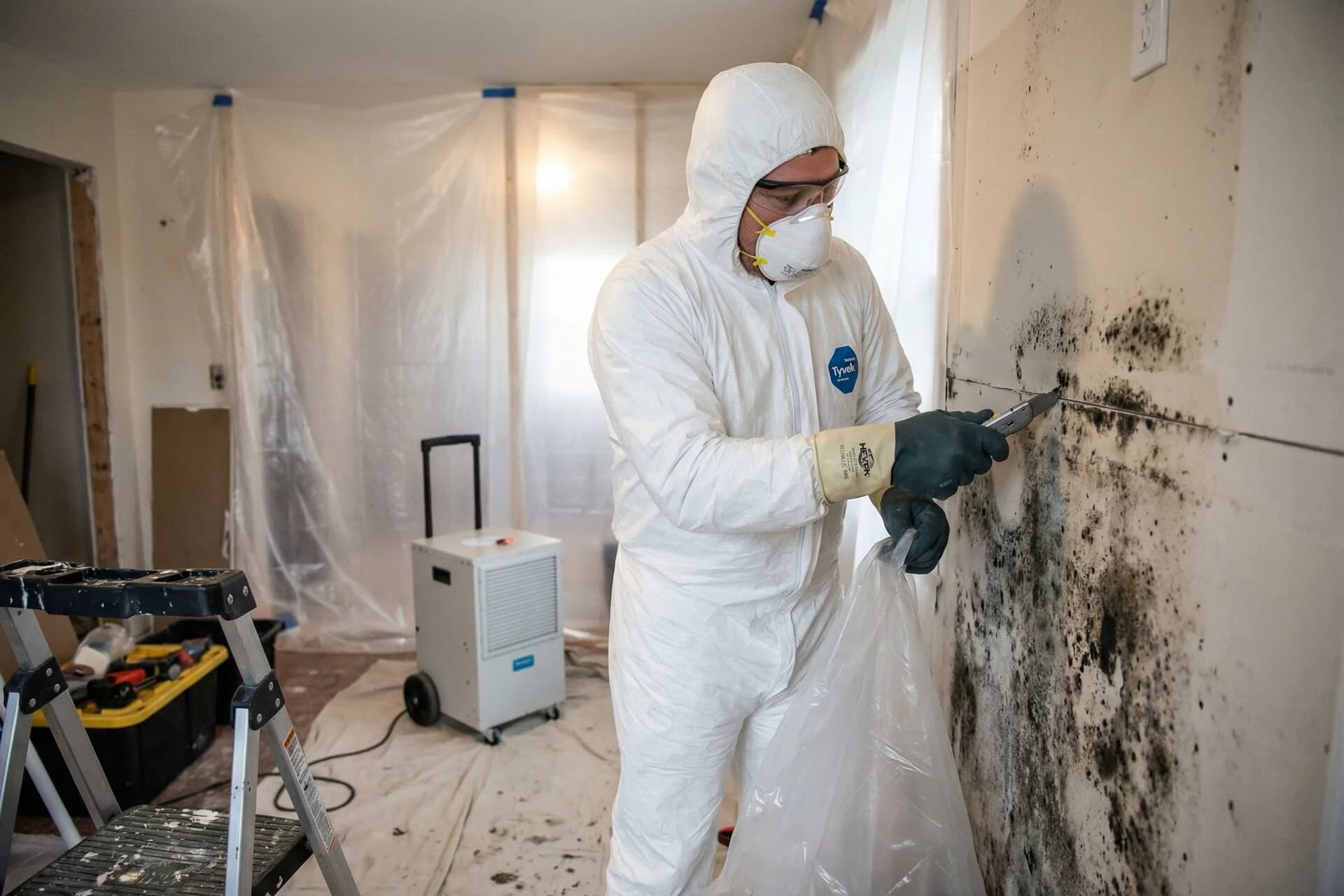
What Professional Black Mold Remediation Looks Like
If you hire a certified remediator, the process typically runs like this.
1. Assessment and Protocol
A mold assessor or indoor environmental professional evaluates the extent and writes a remediation protocol, a detailed plan the remediator follows.
Note: Licensing is not uniform, and neither is separation. Most states do not license mold assessors at all, and only a small number require that the assessment and the remediation come from different companies. Where it is not required, an independent assessment is our recommendation rather than a rule: the company that finds the problem should not be the one billing to fix it.
2. Containment Setup
The remediation team seals the affected area with poly sheeting and sets up negative air pressure using HEPA-filtered air scrubbers. This prevents spores from escaping the work area.
3. Removal
Contaminated materials are carefully removed. For drywall, this means cutting back beyond the visible mold line, because contamination extends further into the material than the staining shows. How far is a judgment made on the job rather than a fixed distance; the standard does not set one. Materials are bagged, sealed, and removed through a designated exit path.
4. HEPA Vacuuming and Treatment
All remaining surfaces (studs, subfloor, concrete) are HEPA vacuumed and cleaned to remove settled spores. An EPA-registered antimicrobial goes on afterwards only where the project protocol calls for it and the product's label permits that use. S520 §2.1.1 is direct about this: no chemical substitutes for the cleaning itself, and for thoroughly cleaned non-porous materials antimicrobials are generally not needed.
5. Post-Remediation Verification
Where an independent assessor is required or requested, they return to confirm the work against the completion criteria. That can include visual inspection, field data, odor detection, analytical testing or sampling, so sampling is one method among several rather than the definition of success. Where sampling is part of the plan, comparing indoor spore counts against an outdoor baseline is one common way to read the results, and it is industry practice rather than anything the standard sets. A number on its own does not decide it. The reading depends on how and where the sample was taken, which fungal types turned up and at what levels, what outdoor conditions were doing that day, and what the inspection found on moisture, odor and visible growth. What ANSI/IICRC S520-2024 §12 actually sets as the minimum is a return to Condition 1, with remaining materials dry and the work area free of visible dust, debris, malodor and mold growth. Agree the completion criteria in writing before work starts and you will know which test you are being held to.
6. Reconstruction
Removed drywall, insulation, and other materials are replaced. This is typically handled by a general contractor, not the remediation company.
Timeline: 1-5 days for remediation, plus turnaround time for any verification sampling.
Black Mold Removal Costs
Professional black mold removal pricing depends primarily on the size of the affected area and the materials involved. We don't have separate figures for black mold, so these are national figures for mold remediation, each from a named source.
| Job | Price | Source | Includes |
|---|---|---|---|
| A small patch | $592 – $1,188 | Pros' quotes on Thumbtack, not final bills | Containment, removal, HEPA cleaning |
| A typical job | $1,223 – $3,757 (average $2,368) | HomeAdvisor, 7,947 reported project costs | Containment matched to scope and exposure, material removal, cleaning |
| Several areas | $3,757 – $10,000 | No source measures this band; it runs between two that are sourced | Multi-room containment, extensive demolition |
| Whole house | $10,000 – $30,000+ | HomeAdvisor, method not given | Whole-home remediation, duct cleaning |
Read the containment column against the Size section above rather than the other way round. EPA's ranges are limited containment from about 10 to 100 square feet and full containment above that, with professional judgment applied in both cases, so a price band is not what decides which one a job gets.
What Drives the Cost Up
Drywall and insulation removal means demolition now and replacement later; HomeAdvisor prints $1,000 to $2,900 for the drywall repair alone.
HVAC cleaning is priced as its own job: HomeAdvisor prints $3,000 to $10,000 for mold in a heating and cooling system.
Crawl space access adds labor where access is difficult. You are paying for the conditions as much as for the work.
Structural damage. Replacing joists, studs, or subfloor is carpentry on top of the remediation, priced by the job.
Post-remediation verification, where sampling is part of it, runs $200 to $600 on one Austin assessor's published price sheet. It's commonly asked for on larger jobs and not universally required.
Cost-Saving Tips
Get three quotes. Pricing varies significantly between companies.
Ask about scope before you compare numbers. Three quotes are only comparable if they cover the same work.
Fix the water first. If the moisture source isn't fixed you will pay for remediation twice, and the second bill arrives after you've already repainted.
Keep testing and removal separate. A company that does both has a financial conflict of interest.
Check your insurance before you start. File a claim if the mold resulted from a covered water event.
For a complete cost breakdown by location, mold type, and project size, see our Mold Remediation Cost Guide.
Preventing Black Mold
Black mold needs three things: moisture, organic material, and time. Remove any one of those and it can't grow.
Moisture Control (Most Important)
Fix leaks immediately. Small, persistent drips create the sustained moisture black mold needs to take hold, and those are the ones that go unnoticed: the supply line behind the toilet, the shutoff valve nobody has looked at, the trap under a guest bathroom sink.
Keep indoor humidity below 50%. Use an inexpensive hygrometer to monitor, and run a dehumidifier in the damp areas. Buy the meter rather than going by how the room feels.
Ventilate bathrooms and kitchens. Run exhaust fans during and 30 minutes after showers and cooking. Switch it off with the light on your way out and it never gets to the second half of its job.
Don't ignore condensation. Condensation on windows, pipes, or walls signals excess humidity. Wiping it dry treats the symptom; the humidity is what brings it back.
After Water Events
Dry everything within 24 to 48 hours. CDC's advice after a flood is to clean up and dry out fully and quickly, within 24 to 48 hours, because prompt drying is what prevents or limits growth. Treat that as the window you are working inside, not as a clock proving growth has started at a particular hour.
Extract standing water. Wet/dry vacuums, pumps, or professional extraction.
Evaluate whatever is still wet after that. Drywall, carpet padding and insulation still wet past the drying window need looking at rather than discarding on the clock. Whether they come out depends on the material, how contaminated it is, where the water came from, and whether it can actually be dried and restored. Porous material that stayed wet and has growth on it is the usual case for removal.
Run dehumidifiers and fans. Keep air moving and dehumidifying until the materials are dry and humidity is back under control, rather than for a set number of days. Work to the material, not to a schedule.
Ongoing Prevention
Inspect regularly. Check under sinks, around water heaters, and in basements monthly. It's the cabinets nobody opens that hide the slow ones.
Clean gutters. Clogged gutters cause water intrusion along foundation walls.
Grade soil away from the foundation. Water should run away from the house rather than pool against it.
Maintain HVAC. Change filters on schedule and keep the drain pans clear.
Frequently Asked Questions
Frequently Asked Questions
How much does professional black mold removal cost?
Can I remove black mold myself?
Is all black-colored mold dangerous?
What kills black mold permanently?
How long does professional black mold remediation take?
Does homeowners insurance cover black mold removal?
What are the health risks of black mold exposure?
How do I know if I have black mold vs regular mold?
Should I leave my house during black mold removal?
Can black mold grow back after remediation?
Recap: How to Get Rid of Black Mold
To get rid of black mold safely, follow this order:
- Find the moisture source first. Cleaning mold without fixing the water makes you pay to do the job twice. Look for leaks, condensation patterns, failing ventilation, and chronic damp.
- Measure against the EPA's 10 square foot benchmark. Under about 10 sq ft is, in most cases, a homeowner job by EPA's measure; our advice keeps that to hard non-porous surfaces (tile, glass, sealed concrete). Drywall, wood, carpet, insulation, HVAC, or anything larger wants a certified remediator. Read the figure as a benchmark rather than a hard cutoff: a smaller patch you cannot dry out or reach is still a professional's job.
- For DIY-eligible patches, clean with detergent and water, or a household cleaner used per its label. Wear at least a NIOSH-approved N95 respirator, non-vented goggles, and forearm-length gloves. Bleach is not the tool on porous surfaces: it removes the color while the contaminated material and the water feeding it are both still there.
- For jobs that call for a professional, hire an IICRC-certified remediator with pollution liability insurance. Our recommendation is that the company assessing the problem is not the company billing to fix it, though only a small number of states require that separation.
- After remediation, verify before reconstruction. S520 §12 sets the minimum as a return to Condition 1, dry materials, and no visible dust, debris, malodor or growth. An indoor-to-outdoor spore comparison is one common way to read those samples, not a requirement of the standard, and it is read alongside the inspection rather than on its own.
The most expensive mistake is ignoring the moisture source. Whether you DIY the cleaning or hire a pro, the moisture fix is what makes the work stick.
For jobs that go beyond what that benchmark covers, you can find a professional mold remediation company and compare certified remediators near you.