Prevention
Mold on Carpet: How to Get It Out, and When to Replace It
Carpet with mold growing in it usually has to go, and the water that soaked it decides the pad. How to tell, what's underneath, and who to call.

A musty smell at floor level, a dark fuzzy patch by the slider, a stained pad under the corner you just peeled back. Whether the carpet can stay depends on three things: whether mold is growing in it or just settled on it, what kind of water got it wet, and what's under it. Carpet and pad with mold growing in them usually come out. Carpet that got wet with clean water and dried fast can often stay.
Reaching for vinegar and a scrub brush is the usual first move, and most of the internet backs it. On carpet, what's underneath really decides more than what's in the bottle.
Can carpet with mold be saved?
Sometimes. The deciding question is whether mold is growing in the carpet or only landed on it.
S520, the standard for professional mold remediation, places carpet in its porous group alongside drywall and padded or upholstered items (Section B, p. 20). Porous material with mold growing in it is generally not cleanable, the standard notes, while the same material with spores and dust that settled on it from growth elsewhere may be.
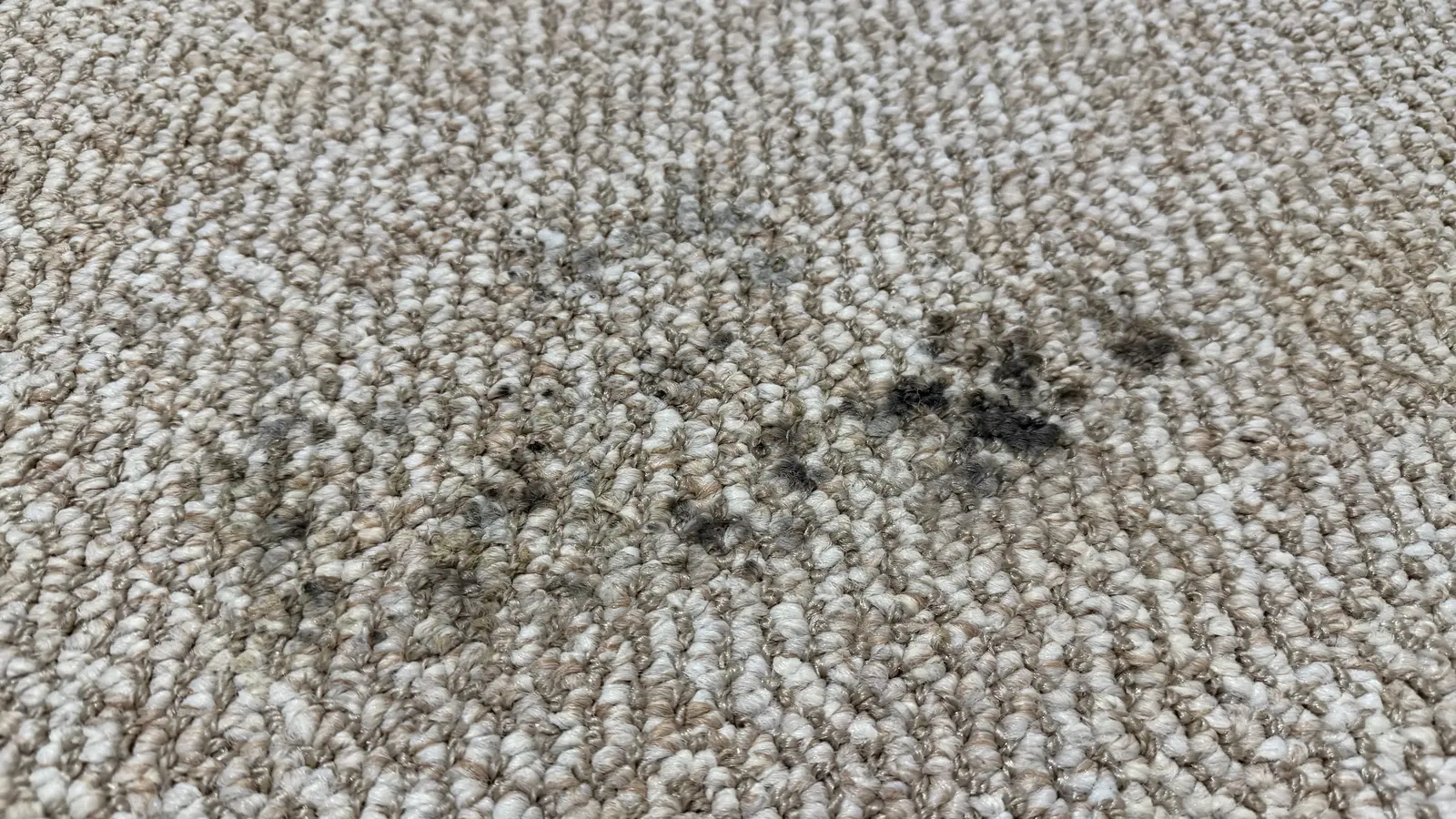
What you have decides what stays
| What you have | What the sources say | What it usually means |
|---|---|---|
| Wet carpet, nothing growing yet | EPA's guidance for wet carpet starts with pulling the water out and running a dehumidifier to dry it within 24 to 48 hours. Materials dried that fast in most cases won't grow mold. | Usually stays, if the water was clean (next section). |
| Mold growing on the face, the back or the pad | S520: generally not cleanable (Section B, pp. 14, 20). EPA: may have to be thrown away, because mold can grow into the spaces in it. | Usually comes out, pad and all. |
| Spores or dust that settled on it from growth elsewhere in the room | S520: may be cleanable (Section B, p. 20). | Often cleaned, as part of dealing with the growth that caused it. |
Growth that has dried out still counts, since S520's definition includes dormant and dead growth (Section B, p. 14). Color doesn't change any of it, either: CDC says all molds should be treated the same with respect to potential health risks and removal. Not sure it's mold at all? Start with how mold looks on carpet.
What kind of water got the carpet wet?
Where the water came from decides what has to come out, sometimes before anything has grown.
S500, the professional standard for water damage restoration, sorts water into three categories with household examples (§10.4.1, pp. 44 to 45):
- Category 1, often called clean water, comes from a sanitary source, such as a broken supply line, a sink or tub that overflowed with nothing in it, rain or melting snow.
- Category 2, often called gray water, carries real contamination, such as washing machine or dishwasher discharge, a toilet overflow with urine and no feces, or groundwater seeping up through a basement slab.
- Category 3, often called black water, is grossly contaminated, including sewage, a backup from beyond a drain's trap, floodwater from a river, stream or the sea, and storm-driven rain.
The carpet rules follow directly from those categories (§16.3.7, p. 94). After gray water, the pad should come out and be thrown away, while S500 lets a restorer consider cleaning the carpet and drying it in place. After black water, both the carpet and pad come out, and the floor underneath is checked for cleaning and drying. EPA says to call in a professional experienced with contaminated water whenever sewage or other contaminated water is involved, and its flood cleanup sheet lists carpet among the items to throw away after a flood.
Clean water doesn't stay clean, either. S500 says it can turn gray or black depending on how long things stay wet and how warm it is, and that a smell can be the sign it has.
What's under the carpet: pad, tack strip and subfloor
What's under the carpet often settles the question. EPA lists the underside of carpets and pads among the places mold hides.
Before you lift anything, pause if you live in an older home or one of unknown age. There may be old vinyl tile, the backing of old vinyl sheet flooring, or adhesive under the carpet, and EPA lists all three among the places asbestos can be found. You can't tell by looking. Resolve any applicable asbestos concerns before pulling carpet up, and since lifting even a corner disturbs whatever is underneath, put your protective gear on first.
The pad is the foam, rubber or felt cushion the carpet sits on. Most pads soak up water, which puts them in S520's porous group (Section B, p. 20). That means a pad with mold growing in it usually goes, just like moldy carpet, and after gray or black water, S500 says it should come out, no matter how it looks. Our guide on what mold looks like on carpet shows the signs.
Around the edges of the room sits the tack strip: thin wood strips with rows of small upturned nails that grip the stretched carpet. S520 lists tack strip alongside nails and screws as the puncture hazards a remediator clears during removal (§9.3.7, p. 49). Whether it can stay is the remediator's call, so ask.
Under all of it is the subfloor or concrete slab, and EPA says the subfloor under wet carpet has to be cleaned and dried too. For a wood subfloor, S500 says to check it for moisture and consult a specialized expert if structural or engineered wood is damaged (§16.3.7, p. 94). Our guide on when moldy wood has to be replaced covers that decision. On concrete, water coming up from below is a basement mold problem first.
Is this a job you can do yourself?
Yes, if the carpet got wet with clean water and is drying, and no mold is growing on it. If you see or suspect mold growing on installed carpet, even a small spot, have a mold remediator look at it. They check the carpet, its back, the pad and the floor underneath, and decide what has to come out. Looking at a spot can't tell you whether it's dirt, settled dust or mold growing into the carpet. EPA says that if the moldy area is less than about 10 square feet, in most cases you can handle the job yourself, and its cleanup table lists throwing carpet out starting at 10 square feet. S520 sets no size line at all (Foreword, p. 6).
That line is our advice, and it's narrower than EPA's benchmark. We'd hand the job to a remediator when:
- you see or suspect mold growing on the carpet, its back or the pad
- the water was gray or black
- the subfloor is wet, soft or moldy
- the growth or the musty smell comes back once everything is dry
- the home is older or of unknown age, and suspect flooring or adhesive under the carpet hasn't been evaluated for asbestos
A small patch may be a small problem, too. Its size alone doesn't tell you how far it goes.
CDC says three groups shouldn't help clean up mold: people with allergies, people with immune suppression or underlying lung disease, and people with chronic respiratory disease such as asthma or COPD.
How do you get mold out of carpet?
These steps are for carpet that got wet with clean water and has no mold growing on it. EPA's cleanup table lists damp wiping for hard surfaces and wood, never for carpet, which is why there's no spray-and-scrub step here:
- Stop the water first. Otherwise, it just keeps feeding the carpet.
- Put on at least an N95 respirator, gloves and goggles without vent holes, with long sleeves and pants.
- If the carpet is still wet, pull the water out with a wet vacuum, then clean the vacuum's tank, hose and attachments. The wet vacuum is for water only: EPA says wet vacuums may spread spores when there isn't enough liquid, so don't run one over carpet that has dried.
- Dry it with a dehumidifier. EPA says not to use fans before you've determined the water is clean, and CDC's after-disaster guide says not to use them once mold has started to grow, because they may spread it. When the water is known to be clean and no mold growth is suspected, fans aimed at the wet materials, run with a dehumidifier, help them dry quickly. If the water may have been contaminated or mold may be growing, keep fans off until the affected materials are removed or contained. Going forward, keep indoor humidity below 60 percent, ideally 30 to 50 percent, as EPA advises. Our mold prevention guide covers how.
- Once the carpet has dried, you can go over it with a HEPA vacuum, not a household one, to pick up settled dust. EPA recommends HEPA vacuums for final cleanup, and S520 has professionals avoid shop-type and standard household vacuums for mold (§9.1.5, p. 45). Bag what the vacuum collects. A HEPA vacuum isn't a treatment for mold growing in carpet. If you see or suspect growth, have a remediator check the carpet, its back, the pad and the floor underneath.
- In an older home or one of unknown age, have any suspect flooring or adhesive under the carpet evaluated by a qualified asbestos professional before you lift the carpet. Then look again at the back of the carpet, the pad and the floor. Growth on the back or in the pad, a spot that comes back, or a musty smell once everything is dry means it needs a remediator's look, not another pass.
What kills mold in carpet?
Killing it isn't the goal. Getting it out, or getting the carpet out, is. EPA says dead mold may still cause allergic reactions in some people, so it has to be removed, not just killed. S520 says simply applying a chemical isn't physical removal (Section B, p. 20), and for professional remediation, physical removal is the primary means (§1.4, pp. 23 to 24).
That's why vinegar, bleach, hydrogen peroxide and baking soda aren't in the steps: none of them is EPA's or CDC's method for carpet. Vinegar is an optional household cleaner at most, and our guide on what vinegar can and can't do covers the details. As for bleach, CDC's limit of no more than 1 cup of bleach per gallon of water is about diluting household bleach. The product's label decides which surfaces it can go on, generally hard, nonporous ones, and carpet isn't one. The bleach guide has a section on which surfaces bleach can clean.
Heat and sunlight can help something dry, though S520 says temperature extremes shouldn't be used as an alternative to cleaning and physical removal (§2.3, p. 28). A steam cleaner or a rented carpet-cleaning machine also puts more water into carpet that's already the problem, so on carpet with mold growing in it, we'd skip both. Our guide on heat, steam and sunlight goes further. A product sold for carpet gets used only as its label says, and no product finishes the job by killing.
What about area rugs?
A rug is a belonging, not part of the floor, so S520 treats it as contents, like furniture and clothing, rather than like installed carpet (§11, p. 55; §11.4, p. 59). That changes who you call.
For a valuable or sentimental rug, EPA suggests a specialist, carpet and rug cleaners among them. S500 recommends cleaning in a specialist's plant (§14.9.8, p. 83), and S520 lists cleaning and repair of area rugs as a specialty service (§11.4, p. 59). Black water is the exception: S500 says loose carpet soaked by it should be thrown out like installed carpet. If restoring a high-value rug is attempted, the standard describes a specialist's submersion cleaning, with testing by an indoor environmental professional afterward if needed.
When should you call a mold remediator?
Once you see or suspect mold growing in installed carpet, its back or the pad, we'd treat it as a mold remediation job rather than a carpet-cleaning or drying job. S500 itself hands visible or suspected mold to S520 and says qualified persons should remediate mold before drying (§10.4.2, p. 45).
A few questions tell you a lot about a company before you hire one:
- What comes out (carpet, pad, tack strip), and what stays?
- How will you check the subfloor?
- How will the carpet leave the house? S520 calls for contaminated materials to be removed in as large a section as practical and wrapped or bagged before they're carried out (§9.3.7, p. 49).
- What kind of water do you think this was?
- Who on the crew holds an IICRC mold credential, such as the AMRT?
You can find more in our list of questions to ask a mold company.